
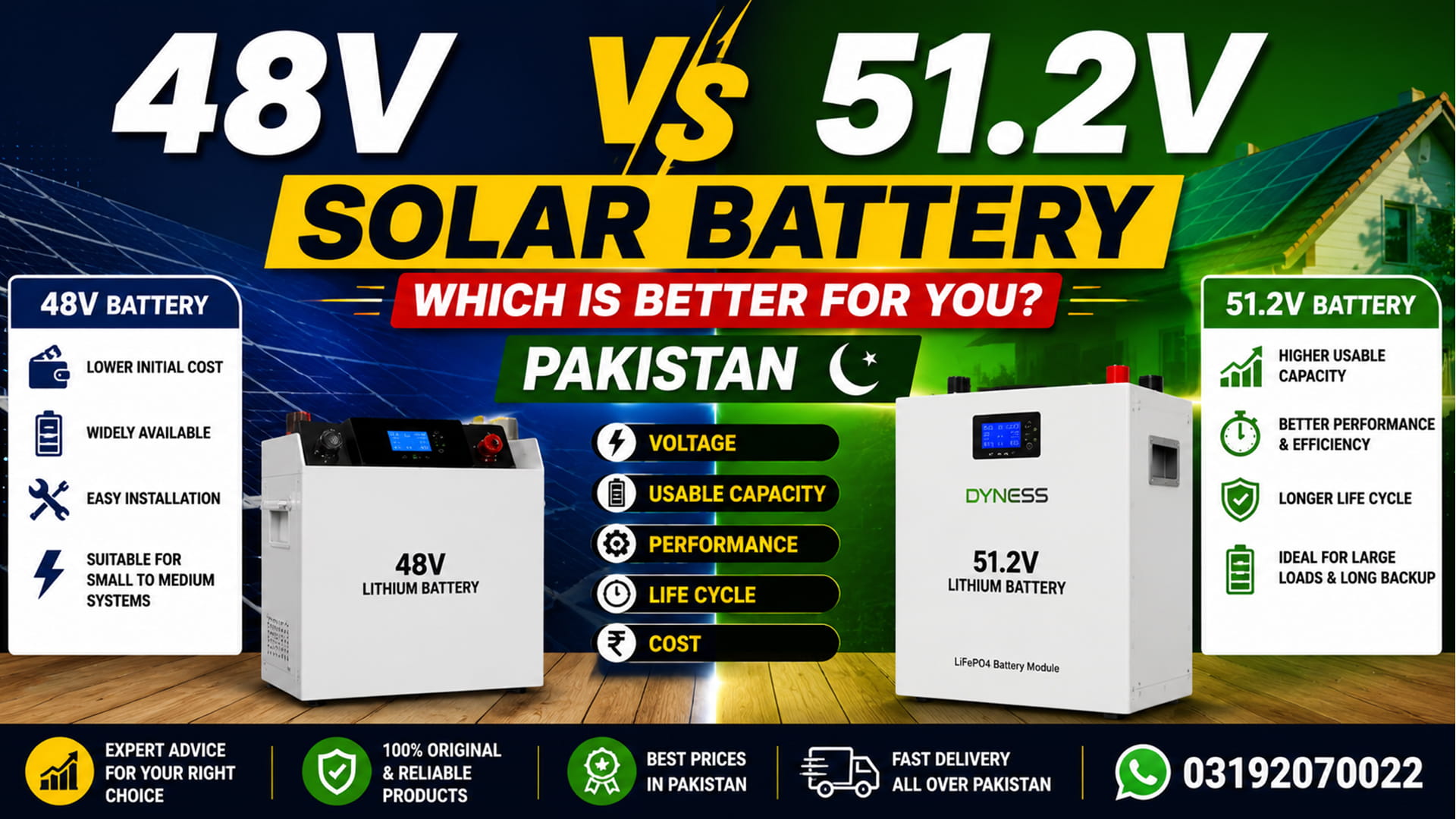
If you’ve been shopping for a solar battery in Pakistan over the last year, you’ve probably noticed something confusing: two batteries can both be labeled “48V,” yet one of them actually runs at 51.2V. If you’ve scratched your head wondering whether that’s a typo, a marketing trick, or something you actually need to understand before you spend your money — you’re not alone. This single point of confusion sends more buyers to Google (and to WhatsApp chats with battery dealers) than almost any other solar-related question in Pakistan right now.
The short version is this: “48V” and “51.2V” aren’t really two competing systems fighting for your rooftop. In most cases, 51.2V is simply the true nominal voltage of a modern lithium (LiFePO4) battery that the market still calls “48V” out of habit, because that’s the voltage class older lead-acid battery banks used for decades. But the difference matters a lot more than a label — it affects how your battery talks to your inverter, how much usable power you actually get, how long the battery survives Pakistan’s brutal summers, and how safely it charges on a system that was designed for something else entirely.
This guide breaks down exactly what’s going on, in plain language, so you can make a confident decision whether you’re setting up a new solar system in Lahore, replacing an old battery bank in Karachi, or adding backup storage to beat load-shedding in Islamabad, Multan, or Quetta.
What Does “Voltage Class” Actually Mean for a Solar Battery?
Every solar battery bank is built around a nominal voltage — a rough, rounded number used to describe the system class, not the exact voltage at any given moment. Nominal voltage tells your inverter, charge controller, and installer what “family” of equipment they’re dealing with.
Common voltage classes used in Pakistani solar and UPS setups include 12V, 24V, and 48V. The 48V class has long been the standard for mid-to-large home and commercial solar setups, because it strikes a good balance between cable thickness, inverter efficiency, and battery bank size.
The catch is that “48V” was originally defined by lead-acid chemistry. A traditional 12V lead-acid or tubular battery actually sits around 12.6–12.8V when fully charged, so four of them wired in series land you at roughly 50–51V at full charge and closer to 48V at rest — hence the “48V” label.
Lithium batteries work differently. A single LiFePO4 (Lithium Iron Phosphate) cell has a nominal voltage of 3.2V, not 12V. To build a “48V-class” lithium battery, manufacturers wire 16 of these cells in series (commonly called a 16S pack). Do the math — 16 × 3.2V — and you get exactly 51.2V nominal. That’s not a mistake or an inflated number; it’s simply the honest nominal voltage of the lithium chemistry used to fill the same voltage class that lead-acid batteries used to occupy.
48V Lead-Acid and Tubular Battery Systems
For most of Pakistan’s solar and inverter history, 48V systems meant four 12V lead-acid or tubular batteries connected in series. These are the deep-cycle or tubular batteries many households already have installed in their UPS or solar setup, and they remain popular because:
- They’re widely understood by local electricians and installers.
- They’re compatible with almost every inverter sold in Pakistan over the past 15 years.
- Replacement parts and servicing knowledge are available in virtually every city and small town.
The downsides are equally well known to anyone who has lived with them through a Karachi summer: heavy weight, the need for regular water top-ups (in flooded/tubular types), a shorter usable life when repeatedly deep-discharged, and a noticeable drop in performance once ambient temperatures climb past 40°C — which is a near-daily reality across Punjab and Sindh for several months a year.
51.2V Lithium (LiFePO4) Battery Systems
Lithium batteries built on 16S LiFePO4 architecture have become the fastest-growing category in Pakistan’s solar market, and for good reason. Because of their true 51.2V nominal rating, they deliver a flatter, more stable voltage curve throughout the discharge cycle — meaning your inverter sees a more consistent power supply from a full battery down to a nearly empty one, rather than the steady voltage sag you get with lead-acid.
LiFePO4 chemistry is also considered one of the safer lithium chemistries available, with better thermal stability than the lithium-ion chemistries used in laptops or phones, which matters enormously in a climate where battery rooms and roof-mounted enclosures regularly see extreme heat.
You can browse the current lineup of lithium and tubular battery options built for exactly this kind of climate on the Buy Battery products page, where each battery is listed with its voltage class and configuration so you know precisely what you’re getting before you commit.
Key Differences: 48V vs 51.2V Solar Batteries
1. Charging Voltage and Inverter Compatibility
This is the single most important technical difference, and the one that causes the most confusion for buyers switching from lead-acid to lithium. Lead-acid batteries typically charge to around 56–58.4V (absorption/float voltage) at the “48V” class, while a 16S LiFePO4 battery’s full-charge voltage sits closer to 54.4–58.4V, depending on the manufacturer’s cell balancing and BMS (Battery Management System) settings.
The practical implication: not every inverter that supports “48V lead-acid” will automatically charge a 51.2V lithium battery correctly out of the box. Many modern hybrid and solar inverters sold in Pakistan now include a dedicated “Li” or “Lithium” battery mode in their settings menu specifically to handle this difference — but older inverters, or ones set permanently to lead-acid charging curves, can under-charge or, in rare cases, stress a lithium pack if the settings aren’t matched correctly.
Before buying a 51.2V lithium battery to pair with an existing inverter, it’s worth confirming your inverter has a lithium/BMS-communication mode, or at minimum an adjustable charging voltage setting. If you’re unsure, the team at Buy Battery can walk you through compatibility for your specific inverter model.
2. Depth of Discharge (DoD) and Usable Capacity
This is where lithium batteries pull dramatically ahead. Lead-acid and tubular batteries are generally rated for 50% depth of discharge if you want a reasonable lifespan — discharge them further and more often, and their cycle life drops sharply. A 51.2V LiFePO4 battery, by contrast, is commonly rated for 80–100% depth of discharge without the same punishing effect on longevity.
In real terms, this means a lithium battery rated at a given amp-hour capacity delivers far more usable energy than a lead-acid battery of the same “rated” capacity, because you can actually use most of what’s stored rather than protecting half of it as a buffer.
3. Cycle Life and Long-Term Value
Tubular and lead-acid batteries in the 48V class typically deliver somewhere in the range of 300–500 full cycles before capacity fades noticeably, particularly under Pakistan’s heat and frequent partial-discharge cycling from load-shedding. LiFePO4 batteries at 51.2V are commonly rated for 2,000 to 6,000+ cycles, depending on build quality and how well the BMS manages charge and temperature.
Over a multi-year period, this cycle-life gap is often the deciding factor for households and businesses that experience daily charge-discharge cycles rather than occasional backup use.
4. Weight, Size, and Installation
Lead-acid battery banks at 48V are heavy — often requiring reinforced shelving or dedicated battery racks, and multiple people to install or replace. Lithium batteries at 51.2V pack significantly more energy into a fraction of the weight and physical footprint, which matters for rooftop installations, small commercial spaces, and homes where floor space or structural load is a genuine constraint.
5. Performance in Pakistan’s Climate
Heat is the great equalizer — and destroyer — of battery performance in Pakistan. Lead-acid chemistry loses capacity and lifespan noticeably once internal temperatures climb, and water loss accelerates in flooded designs during peak summer. LiFePO4 batteries handle high ambient temperatures more gracefully and, when paired with a properly designed BMS, will actively protect the cells from overheating during charge cycles — an important safety feature for rooftop or rooftop-adjacent enclosures that bake in direct sun for hours.
That said, no battery chemistry is immune to Pakistan’s extremes, which is why battery placement, ventilation, and enclosure design still matter regardless of which voltage class or chemistry you choose.
6. Maintenance
Tubular and flooded lead-acid batteries need periodic water top-ups, terminal cleaning, and monitoring of specific gravity in more traditional setups — tasks that get skipped in busy households and shorten battery life as a result. Sealed lithium battery packs are essentially maintenance-free by comparison, which is a meaningful convenience factor for people who don’t want an added household chore.
Which One Is Better for Pakistani Homes and Businesses?
There isn’t a single universal answer — the right choice depends on how you actually use your system.
For homes primarily dealing with load-shedding backup: If your battery mostly sits at or near full charge and only discharges during occasional power cuts, a well-built 48V lead-acid or tubular battery bank can still deliver solid, budget-conscious performance, especially if you already have compatible inverter infrastructure in place.
For homes and businesses running daily solar cycling: If your system charges from solar panels every day and discharges every night — the pattern common to serious net-metering and off-grid setups — the deeper discharge tolerance and longer cycle life of a 51.2V lithium battery usually pays for itself in reduced replacement frequency and more usable capacity per rupee spent over the system’s lifetime.
For commercial and industrial setups: Businesses running critical loads — clinics, small factories, telecom towers, retail outlets — tend to lean toward 51.2V lithium for its lighter weight, more predictable voltage output, and lower long-term maintenance overhead, particularly where downtime for battery servicing has a real cost.
For off-grid rural and remote installations: Where technician visits are infrequent, the maintenance-free nature of lithium at 51.2V often outweighs the higher upfront consideration, since there’s no one nearby to top up water levels every few months.
If you’re weighing your specific load requirements — number of fans, lights, refrigerators, motors, or business equipment — it’s worth getting a proper sizing consultation rather than guessing. You can explore compatible options and get sizing guidance through the Buy Battery contact page, where the team can match a battery configuration to your actual daily consumption.
Inverter and System Compatibility Checklist
Before switching between a 48V lead-acid setup and a 51.2V lithium battery, run through this quick checklist:
- Does your inverter have a dedicated lithium/Li-ion battery charging profile, or only a lead-acid profile?
- Can the charging voltage and float voltage be manually adjusted if no dedicated lithium mode exists?
- Does your inverter support BMS communication (CAN bus or RS485) for smarter charge management, or will it charge the lithium battery “blind” using a fixed voltage curve?
- Is your existing wiring and breaker rating suitable for the battery’s maximum continuous discharge current?
- Does the battery’s built-in BMS include over-voltage, under-voltage, over-current, and temperature protection as standard?
Getting these details right up front avoids the two most common complaints battery sellers in Pakistan hear: “the lithium battery isn’t charging fully” and “my old inverter doesn’t seem to like the new battery.” Both are almost always solved by matching the inverter’s charging profile to the battery chemistry correctly rather than assuming any 48V-class inverter will “just work” with any 51.2V-class battery.
Cost Considerations Without the Guesswork
Pricing for both voltage classes varies by amp-hour capacity, brand, warranty length, and whether you’re buying a standalone battery or a complete battery-plus-inverter package. Rather than relying on outdated or region-specific numbers you might find scattered across forums and marketplace listings, it’s more reliable to check current, verified pricing directly.
WhatsApp us now for the latest price of the battery at 03192070022.
How to Choose the Right Battery for Your Setup
- Calculate your actual daily load in watt-hours, not just the wattage of individual appliances, since runtime depends on total energy consumed, not peak power alone.
- Check your inverter’s supported battery voltage and chemistry settings before choosing between 48V lead-acid and 51.2V lithium.
- Decide how often you’ll be cycling the battery — daily solar use versus occasional backup changes the math on cycle life significantly.
- Factor in your installation environment — rooftop heat exposure, available space, and structural weight limits all favor lighter lithium options in many cases.
- Confirm warranty terms and BMS protection features, since these vary meaningfully between brands even within the same voltage class.
For a broader look at battery types, sizing methods, and maintenance tips relevant to Pakistan’s climate, the Buy Battery blog covers additional guides worth reading before you finalize your purchase, and the full battery category listing gives you a complete view of available configurations in one place.
In practical terms, yes — 51.2V is the true nominal voltage of a 16S LiFePO4 lithium battery marketed within the “48V” voltage class traditionally defined by lead-acid systems. They occupy the same system category but are not always drop-in electrically identical without confirming inverter compatibility.
Often yes, but only after confirming your inverter supports lithium charging profiles or allows manual voltage adjustment. Direct replacement without checking these settings can lead to incomplete charging or reduced battery lifespan.
Generally, 51.2V LiFePO4 batteries tolerate high ambient temperatures better and offer significantly higher cycle life than traditional lead-acid or tubular batteries under the same conditions.
Not always. Many inverters already sold in Pakistan include a lithium battery mode. Older inverters may need a firmware update, a settings adjustment, or in some cases a replacement to safely and efficiently charge a lithium battery.
For light, occasional backup use, a good-quality 48V lead-acid or tubular setup can still be a reasonable choice. Lithium’s advantages become more pronounced with daily cycling, higher loads, or long-term maintenance-free operation.
Final Thoughts
The “48V vs 51.2V” question isn’t really a battle between two rival technologies — it’s a question of understanding what’s actually inside the box you’re buying, and making sure the rest of your system is set up to use it properly. Lead-acid at 48V remains a dependable, familiar choice for straightforward backup needs, while 51.2V lithium delivers the deeper discharge, longer lifespan, and lighter footprint that daily solar cycling and Pakistan’s demanding climate increasingly call for.
As your trusted battery partner, Buy Battery supplies premium batteries built specifically for Pakistan’s climate — powering homes, businesses, and vehicles nationwide, with straightforward guidance so you buy the right voltage class the first time.
WhatsApp us now for the latest price of the battery at 03192070022.