
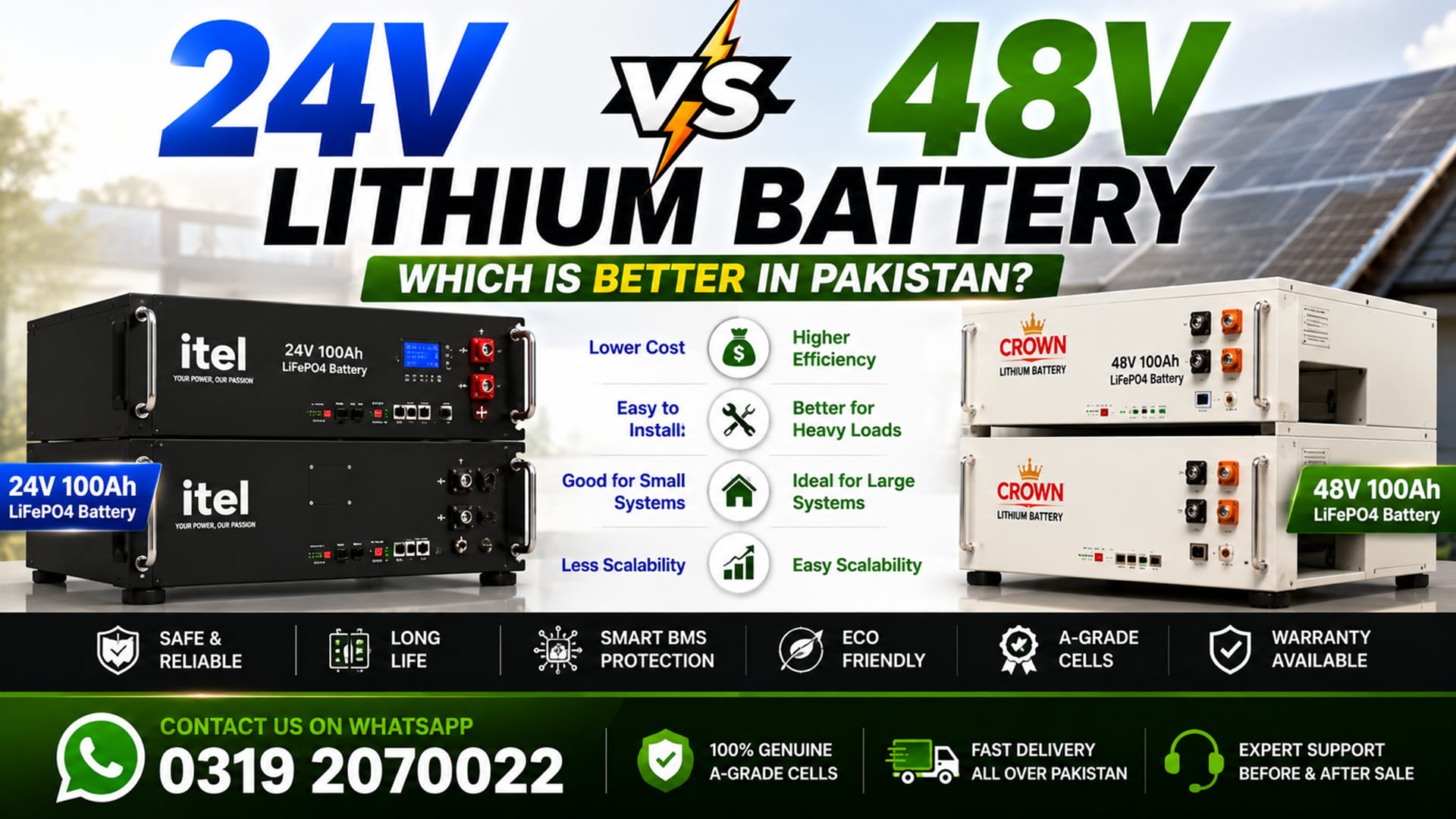
There is a short answer and a long answer, and the short answer is unhelpful on its own.
Short answer: your inverter decides. If you already own a 48V inverter, buy a 48V battery. If you own a 24V inverter, buy a 24V battery. You cannot mix them, and no adapter exists that makes this problem go away.
The long answer matters when you are buying the whole system at once and the voltage is still an open question, or when you are weighing whether to replace a 24V inverter to move up. That decision has consequences in cable cost, efficiency, expansion room and how long the system stays adequate. It is also one of the few decisions in a solar installation that is genuinely difficult to reverse later.
This guide works through it properly. No prices, since they move weekly. WhatsApp us now for the latest price of the battery at 03192070022 once you know which voltage you need.
The physics, in one equation
Everything below follows from one relationship: power equals voltage multiplied by current.
Hold the power constant and double the voltage, and the current halves.
Run 3000W at 24V and the system draws 125 amps. Run the same 3000W at 48V and it draws about 62 amps. Same power delivered to your house, half the current moving through the wires.
That single difference cascades into almost every other decision.
Cable thickness. Conductor size is determined by current, and copper is one of the more expensive parts of an installation. Halving the current lets you use meaningfully thinner cable for the same run.
Energy losses. Resistive loss in a cable is current squared multiplied by resistance. Halving the current cuts those losses to a quarter, before you account for the thinner cable you can now use. In a 24V system with a long cable run between battery and inverter, these losses are not trivial.
Heat. Losses become heat, and heat appears at exactly the places you do not want it: terminals, lugs, breakers, connectors. Most electrical failures in solar installations happen at connections, not in cables.
Component ratings. Breakers, fuses, isolators and busbars are all rated by current. A 125A system needs heavier and more expensive protection hardware than a 62A one.
At low power none of this matters much. At high power it dominates.
Where each voltage genuinely belongs
Here is how the two options break down in practice.
24V suits smaller systems
A 24V battery makes sense behind inverters up to roughly 3KW. In Pakistan that typically means a single room setup, a small flat, a shop, an office with a few computers, or a household running fans, lights and a fridge without air conditioning on backup.
The advantages at this scale are real. Inverters and charge controllers in the 1KW to 3KW range are widely available in 24V, often at lower cost than their 48V equivalents. A 24V bank can be built from fewer cells, so the entry level pack is smaller and cheaper. And at 2000W the current is around 83 amps, which is manageable with sensible cable sizing over a short run.
There is also a practical point about minimum sizes. If your evening load is genuinely small, a 48V system forces you to buy more storage than you need, because 48V packs start at capacities that assume a bigger house. Buying storage you will not use is not thrift.
48V suits everything larger
Above 3KW, 48V stops being a preference and becomes the sensible engineering choice.
This is where most Pakistani households now sit, because the 5KW hybrid inverter has become the default residential installation. At 5000W, a 48V system draws roughly 98 amps before losses. The same 5000W at 24V would draw over 200 amps, which pushes you into cable sizes, lug sizes and breaker ratings that get expensive and awkward quickly.
Everything else follows. The high capacity packs are built for 48V. Hybrid inverters with proper battery communication are overwhelmingly 48V. Parallel expansion is designed around 48V. If you expect the system to grow, this is the ecosystem you want to be inside.
Our 48V 100Ah battery guide covers sizing and stacking for that class in detail.
Why 48V and not higher
Worth a short detour, because people reasonably ask why the industry stopped at 48 when the logic favours higher voltage.
Two reasons.
First, safety regulation. A nominal “48V” LiFePO4 pack is really 51.2V and peaks at about 58.4V when fully charged. That keeps it just under 60V DC, which is the threshold commonly used to define extra low voltage in electrical standards. Below it, installation and handling requirements are considerably lighter. A system designed at 60V nominal would charge well above that line and drag a much heavier regulatory and safety burden along with it. Both 24V and 48V sit comfortably in the safe zone, so 48V is not “more dangerous” than 24V in any meaningful regulatory sense.
Second, ecosystem. Decades of inverters, charge controllers, and DC appliances were built around 12V, 24V and 48V. Standardisation has its own gravity.
Higher voltage systems do exist for large commercial and utility installations, at 200V, 400V and beyond. They come with correspondingly serious safety requirements and are not a home consideration.
The mistake that costs people the most
Here is something people assume from lead acid experience, and it does not carry over.
With lead acid, you can wire two 12V batteries in series to make 24V, or four to make 48V. That is standard practice and it works because a lead acid battery is a passive component.
A lithium pack is not passive. It contains a BMS, and many drop in lithium packs are explicitly not designed for series connection. Wiring two 24V lithium packs in series to make 48V can put the BMS boards at voltages they were never designed to handle, and it removes the protection each board is supposed to provide because neither can see what the other is doing. Some manufacturers do produce packs rated for series operation, and those state it clearly in their documentation.
The rule: never series connect lithium packs unless the datasheet explicitly permits it and states the maximum number in series.
The practical consequence is important. If you buy 24V lithium today and outgrow it in two years, you generally cannot promote your existing packs to a 48V system. You will be selling them and buying again, plus replacing the inverter. Lead acid gave you an upgrade path. Lithium usually does not.
This is why the voltage decision deserves more thought than most people give it.
Think about where you will be in five years
Given the above, the honest question is not “what do I need tonight” but “what will this house need for the life of this battery.”
A quality LiFePO4 pack should run eight to ten years or more. That is a long time in a household. Consider what is likely to change.
Air conditioning is the big one. A household that does not run AC on backup today may well want to in three years, especially as summers lengthen. A 1.5 ton inverter AC pulls 1000 to 1500W in steady operation, which on a 24V system means over 60 amps for that appliance alone.
Household load generally trends upward. More appliances, more electronics, a water pump, a second fridge, children who each need a fan and a device charging.
And electricity prices have moved sharply enough in recent years that the case for shifting more of your consumption onto solar strengthens over time rather than weakening.
So the decision rule I would offer: if your current load genuinely sits below 2KW and you are confident it will stay there, 24V is efficient and appropriate. If you are anywhere near 3KW, or you can imagine adding cooling within a few years, go to 48V now. The cost difference at purchase is much smaller than the cost of replacing an entire system later.
If you are still working out what your load actually is, our guide to solar battery sizing in Pakistan covers the calculation.
What does not change between the two
Some things are identical regardless of which voltage you choose, and it helps to know what is not part of this decision.
The chemistry is the same. Both are LiFePO4 packs built from 3.2V cells. A 24V pack is 8 cells in series, a 48V pack is 16. The safety, cycle life and temperature behaviour of the cells are unaffected by how many you string together. Our guide to LiFePO4 battery pricing covers the chemistry side.
Cell grade matters equally. Grade A matched cells versus B grade or reclaimed cells is the biggest driver of real world performance at either voltage.
BMS quality matters equally. Active versus passive balancing, temperature sensing, low temperature charge protection and inverter communication are all just as important on a 24V pack.
Temperature rules are identical. Never charge LiFePO4 below 0°C, and keep the pack shaded and ventilated because cycle life ratings are measured near 25°C and Pakistani summers are not.
Depth of discharge is the same. Both give you 80 to 90 percent usable capacity, against roughly 50 percent for lead acid.
Comparing capacity across voltages
A point of confusion worth clearing up, because it leads people to compare the wrong things.
Amp hours are not comparable across different voltages. Energy is what matters, and energy is volts multiplied by amp hours.
A 24V 100Ah lithium pack, at a true nominal 25.6V, holds about 2.56 kWh.
A 48V 100Ah lithium pack, at a true nominal 51.2V, holds about 5.12 kWh.
Same amp hour figure, double the energy. If someone quotes you “100Ah” without the voltage, you have been given half a specification.
Convert everything to kilowatt hours before comparing anything. Then apply your usable depth of discharge and subtract inverter losses of ten to fifteen percent to get what actually reaches your appliances.
Charge controller and solar array notes
One more practical difference if you are designing the whole system.
MPPT charge controllers convert your panel array voltage down to your battery voltage. A controller feeding a 48V bank can generally accept a higher panel string voltage, which means you can wire more panels in series and fewer in parallel. Longer series strings mean lower current on the DC side from the roof, thinner cable on that run too, and lower losses.
With a 24V bank, you are often wiring shorter series strings and more parallel ones, which means more current coming down from the roof and more combiner hardware.
For a small array this is a minor consideration. For anything over about 3kW of panels it is another point in favour of 48V.
No. The inverter will not operate, and attempting it risks damage. The battery bank voltage must match the inverter’s design voltage.
Not meaningfully. Both sit below the 60V DC extra low voltage threshold. Standard installation practice, correct fusing and proper cable sizing apply to both.
Yes, at the same power level, because resistive losses fall with the square of current. The advantage grows as your load grows and is negligible at very small loads.
Adding more 24V capacity in parallel is straightforward if your inverter can support the additional load. Moving to 48V means replacing the inverter and generally the batteries too, so it is worth planning before rather than after.
48V, clearly. The current draw at 24V for AC loads pushes cable and protection hardware into an expensive range.
Yes, we carry 24V and 48V configurations. The full range is on the products page.
Deciding
Take it in this order.
If you already own an inverter, its voltage decides for you. Match it.
If you are buying the whole system, work out your peak load and your realistic load in five years. Below 2KW and staying there, 24V is the efficient choice. At or near 3KW, or with cooling anywhere in your plans, choose 48V and stop thinking about it.
Then, whichever you pick, focus your attention on the things that actually vary between packs: cell grade, BMS capability, continuous discharge rating and who honours the warranty.
If you want a second opinion on your specific setup, WhatsApp us now for the latest price of the battery at 03192070022 with your inverter model, your evening load and your city. We will tell you what fits before quoting. You can also reach the team through our contact page.
Buy Battery is your trusted battery partner. Premium batteries built for Pakistan’s climate, powering homes, businesses and vehicles nationwide.