
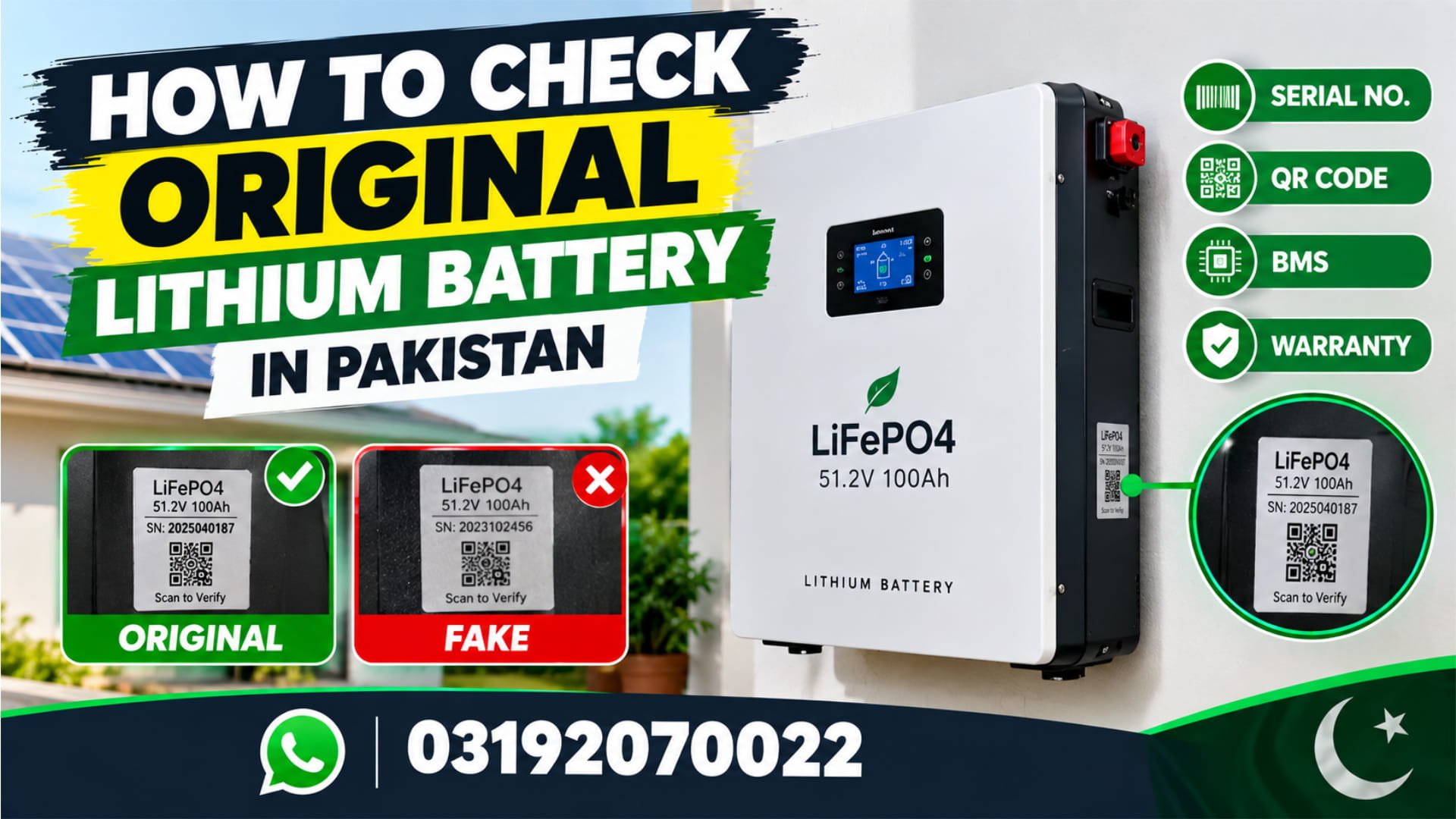
“Original” is the wrong word for most of what goes wrong in this market, and understanding that changes how you should check for it.
Outright fake lithium batteries, empty boxes or units with no cells at all, are rare. What is common, and much harder to spot, is a pack that is genuinely lithium, genuinely functional, and quietly inferior to what the label claims: unmatched or reclaimed cells sold as Grade A, a capacity rating inflated well beyond what the pack can actually deliver, a BMS with fewer protections than advertised, or an enclosure claiming a dust and water rating it was never tested to.
None of that shows up by looking at the box. It shows up in specific checks, some of which take thirty seconds and some of which take a proper test. This guide walks through both. No prices here. WhatsApp us now for the latest price of the battery at 03192070022 once you know what to look for.
Start before you buy, not after it arrives
The most effective verification happens in the conversation with the seller, before any money changes hands, because it is the point where a seller with something to hide is most likely to give an evasive answer.
Ask for the cell manufacturer and grade in writing, on the quotation rather than spoken. Grade A cells are tested and matched for capacity and internal resistance before assembly. A seller who cannot or will not name the cell brand, or who answers vaguely with “good quality cells,” has told you something even if they have not said it directly.
Ask whether the warranty is backed by the importer or only by the individual shop. A shop-backed warranty is only as durable as the shop, and a seller reluctant to clarify this is often a seller who knows the distinction does not favour them. Our guide to lithium battery warranty claims in Pakistan covers why this matters and what to ask before you buy, not after something goes wrong.
Ask if a capacity test is available before or at installation, and whether the result will be recorded and given to you. A seller confident in their product has no reason to avoid this.
And be genuinely suspicious of a price dramatically below every other quote you have received. It is rarely generosity. It is almost always one of the differences covered below.
The weight check
This is the single fastest physical test and one almost nobody does.
LiFePO4 cells have a fairly predictable mass, because the chemistry and the physical construction do not vary much between manufacturers at a given capacity. A pack built from genuine, correctly sized cells will fall within a known weight range for its stated capacity. A pack that is noticeably lighter is not full of what the label claims, whether that means undersized cells, fewer cells than the configuration suggests, or cells substituted for something cheaper.
You do not need to know the exact expected figure to use this test. Ask the seller what the unit should weigh before it arrives, then weigh it on delivery. A significant, unexplained shortfall is a legitimate reason to pause and ask questions before installing anything.
Reading the resting voltage
A cheap multimeter and two minutes tells you more than most of the specification sheet.
A genuine 16S LiFePO4 pack, the standard “48V” configuration built from sixteen cells in series, should show a resting voltage somewhere in the low 50s if it was shipped at partial charge, which is standard practice for safe transport. Fully charged it should reach roughly 58.4V. Fully discharged it falls to around 40V. A reading well outside that range on a pack claimed to be 48V is worth investigating before you connect it to anything.
An 8S pack, the “24V” configuration, halves those numbers: resting in the mid-20s, roughly 29.2V fully charged, around 20V fully discharged.
If the reading matches roughly 45V rather than the low 50s, and the seller insists it is a standard 16S 48V pack, ask directly whether it is actually built as fifteen cells in series rather than sixteen. A 15S pack is a real, legitimate configuration in some equipment, but it holds meaningfully less energy than a 16S pack of the same amp hour rating, and charging it on settings meant for 16S can cause the BMS to cut off charging early every single cycle. Our guide to 51.2V 100Ah battery pricing explains this distinction and the correct voltage ranges in full.
The capacity test that actually means something
Datasheet numbers are claims. A capacity test is evidence.
If the seller or installer can run one, it works like this: fully charge the pack to its specified top voltage, then discharge it through a known, steady load, such as a resistive heater bank or a controlled inverter load, while measuring the current and timing how long it runs before hitting the low voltage cutoff. Multiply the average current by the hours run and you get the amp hours actually delivered.
A pack performing close to its rated capacity, within perhaps 5 to 10 percent under a moderate discharge rate, is behaving as claimed. A pack that delivers meaningfully less, particularly anything approaching half its rated figure, has either been mislabelled or built from cells that do not match the printed specification.
This test takes hours to run properly and most buyers will not do it themselves. What you can reasonably ask for is whether the seller has already done it and can show you the result, or whether they will do it as part of commissioning with you present or with the result documented and shared. A seller unwilling to entertain this request at all, on a product they claim meets its specification, is giving you useful information.
Checking the BMS, without opening the case
You should not open a sealed battery enclosure yourself, both because it can void the warranty and because it exposes you to a live pack with no protection while it is open. But there is still a useful check available.
Many packs with a communicating BMS pair with a manufacturer’s smartphone app over Bluetooth, showing individual cell voltages, temperatures and state of charge. If yours has this feature, check the spread between the highest and lowest cell voltage. A small spread, generally a few tens of millivolts, indicates properly matched cells and an active balancer doing its job. A wide and growing spread indicates cells that were not well matched to begin with, regardless of what grade the seller claimed.
If the pack has no app or display and claims a communicating BMS compatible with your inverter, that claim is itself testable: connect it and see whether your inverter actually shows a live state of charge reading pulled from the battery, or whether it is estimating from voltage as it would with any uncommunicative pack.
Reading the datasheet against itself
A few numbers on a spec sheet should agree with each other, and when they do not, it tells you something.
The stated kilowatt hour figure should equal the stated voltage multiplied by the stated amp hours. For a 48V 100Ah pack, that is 51.2V times 100Ah, which is 5.12 kWh. If a datasheet prints something noticeably different, generally rounded upward, treat the rest of the sheet with more scepticism.
The cycle life figure should carry two conditions: the depth of discharge it was tested at, and the temperature. A number like “6000 cycles” printed with no conditions attached is not a specification, and a seller who cannot supply the testing conditions when asked likely does not have them.
The continuous discharge current in amps should be printed clearly, not implied by the capacity. A 100Ah rating tells you nothing about how fast the pack can safely deliver that energy, and a pack that cannot cover your inverter’s peak draw will trip out under load regardless of how much energy it holds. Our 48V 100Ah buying guide explains why this figure matters as much as capacity.
The ingress protection claim, physically inspected
An IP65 rating printed on a sticker is a claim. Genuine IP65 construction is visible if you know where to look.
Check for gasket seals around every access panel and door. Check that cables enter and exit through properly sealed glands, not through a hole with a cable simply passed through and left. Check that there are no visible gaps, unsealed screw holes, or vents that would let dust straight into the case.
If a seller cannot produce a test certificate for the rating when asked, and the physical construction shows obvious unsealed points, the printed rating is decorative rather than tested. Our guide to what IP65 actually means covers the standard in full and what genuine sealing looks like.
Patterns to watch for in this specific market
A few things come up repeatedly in the Pakistani lithium market and are worth naming directly.
Reclaimed or second-life cells, pulled from decommissioned packs or rejected batches, rebadged and sold as new Grade A stock. These can measure acceptably on delivery and fail within a year, which is exactly why a capacity test at the point of sale matters more than a visual inspection.
Capacity ratings printed generously above what the pack actually delivers, sometimes by a meaningful margin. This is where the datasheet arithmetic check above catches the more obvious cases.
A 15S pack sold and labelled as a standard 16S 48V unit, which delivers roughly 7 percent less energy than advertised and can cause charging problems if your inverter is configured for the more common configuration.
BMS boards with lower actual current ratings than the printed specification suggests, which only becomes apparent under real load, which is why the continuous discharge figure deserves direct questioning rather than passive trust.
IP ratings claimed without testing, covered above.
None of these require a conspiracy to explain. Much of it comes from a fast-growing market where sourcing has outpaced quality control, and a seller further down the supply chain may genuinely not know what is inside a box they are reselling. That does not make the risk to you any smaller. It does mean the checks above matter regardless of whether the seller in front of you is acting in good faith.
If you already installed something you now suspect
Run the resting voltage check and, if you can access it, the app-based cell voltage spread check first. Both are non-invasive and immediate.
If either result looks wrong, or the battery is clearly underperforming its rated capacity in real use, document it: photographs, the voltage readings, how long it lasted under a known load compared to what was claimed, and your original invoice and serial number.
Contact the seller with that documentation and ask for a resolution under the warranty terms you were given. If the response is unsatisfactory, our earlier guide to warranty claims covers what a fair process looks like and what legal standing you have if a legitimate claim is refused.
Rarely. The casing, labelling and even the weight can look entirely normal on an inferior pack. The checks that actually tell you something are the resting voltage, a capacity test, and cross-checking the datasheet numbers against each other.
Not always, but it is the single most reliable early warning sign. A price well below the market for the same stated specification is usually explained by cell grade, BMS quality or capacity rating, not by the seller being unusually generous.
A basic multimeter covers the voltage check. A proper capacity test needs a controlled load and time, which is usually more practical to request from the seller than to run yourself.
Weigh it against what the seller told you to expect, check the resting voltage matches its claimed configuration, and confirm the serial number and documentation match what you were sold.
No. Opening a sealed pack yourself risks injury from a live battery and will generally void the warranty regardless of what you find inside.
Yes. Ask us for the cell brand, grade and a capacity test result on any unit before you buy, and we will provide it.
Buying with confidence
Ask for cell grade and warranty backing in writing before you pay. Weigh the unit and check its resting voltage on delivery. Ask for or run a capacity test before you rely on it. Cross-check the datasheet numbers against each other. And treat a price that looks too good against everything else you have seen as a question to ask, not a reason to celebrate.
WhatsApp us now for the latest price of the battery at 03192070022, and ask for the cell grade, BMS specification and a capacity test on any unit you are considering. You can also see full specifications for our current range on the products page.
Buy Battery is your trusted battery partner. Premium batteries built for Pakistan’s climate, powering homes, businesses and vehicles nationwide.