
Search for Crown Elektra pricing and you will find the same nominal battery listed with wildly different warranties, different ingress protection ratings, and prices that vary by tens of thousands of rupees between sellers. That is not one seller being dishonest and another being honest. It usually means they are not actually selling the same product, even when the listing says they are.
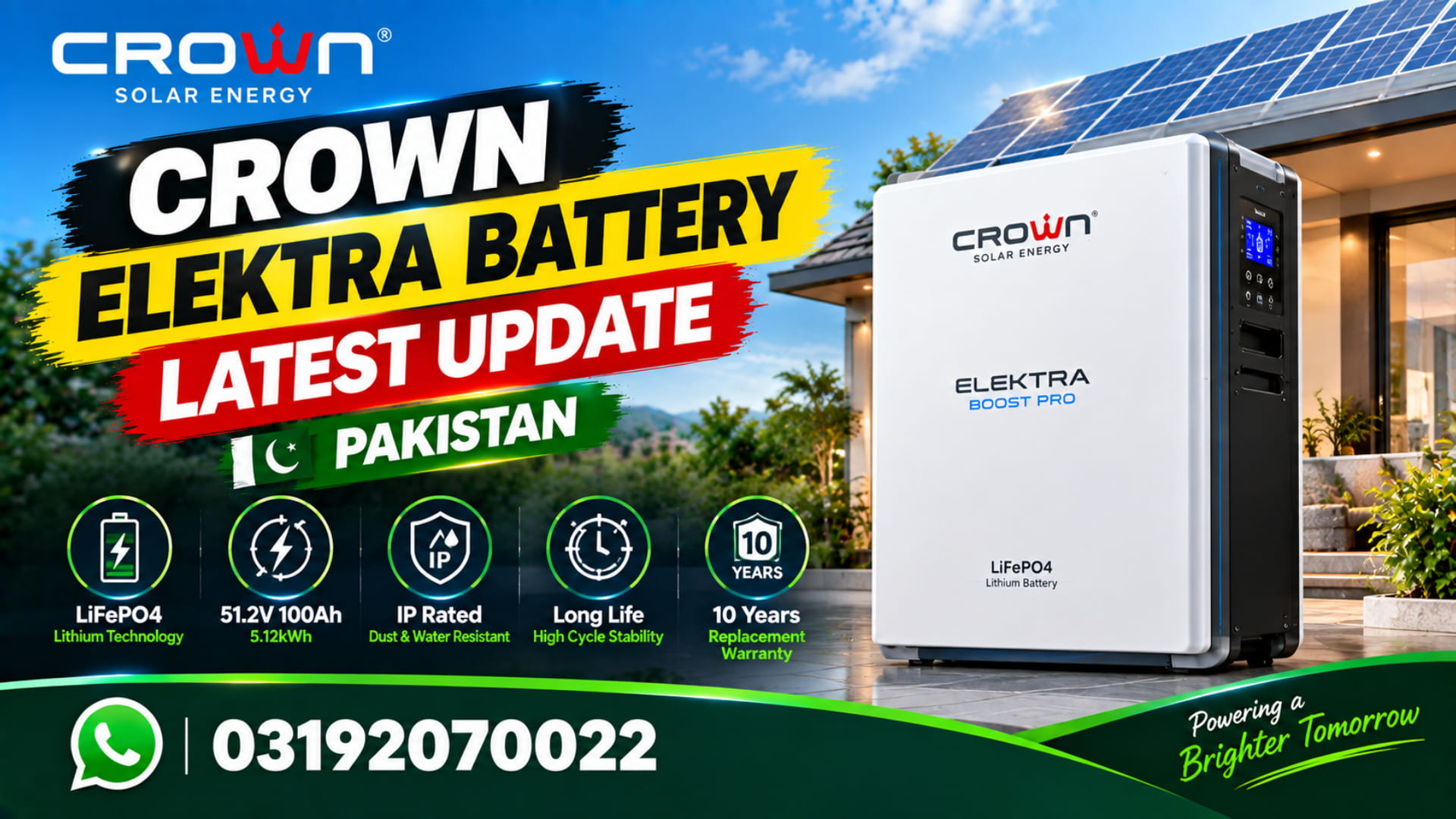
Crown Elektra, more fully branded as Elektra Boost by Crown Solar Energy, is a real and reasonably well established LiFePO4 line in the Pakistani market, sold across several tiers rather than as a single product. Understanding which tier you are being quoted, and what actually differs between them, matters more here than with most brands, because the naming across resellers is inconsistent enough to genuinely confuse buyers.
This guide sorts that out. No prices here, since rates move with the exchange rate and vary meaningfully by tier and seller. WhatsApp us now for the latest price of the battery at 03192070022 once you know which configuration you need.
The Elektra Boost family, and why the tiers matter
Crown Solar Energy sells this line under at least three tier names: Elektra Boost Lite, standard Elektra Boost, and Elektra Boost Pro. The three are not simply different capacities. They differ in warranty term, and the Pro tier adds features the other two do not carry as standard.
We stock the Crown Elektra range across several configurations, including an IP65-rated 24V 100Ah unit, a 48V 100Ah Lite variant, and a higher-capacity Pro unit paired for 5KW systems. The exact specification of each depends on the model code, which is precisely why the tier name matters when you enquire, not just the voltage and amp hour figure.
What actually differs between the tiers
Warranty term. This is the clearest and most consistently reported difference across the market. Listings for the standard and Pro tiers commonly advertise a 10 year replacement warranty. Listings specifically for the Lite tier commonly advertise a shorter 5 year term. That is a coherent trade-off, a lower entry cost against a shorter warranty period, and it is worth knowing before you compare a Lite quote against a standard quote purely on price.
Communication capability. The Pro tier has been documented with RS485 and CAN communication support, meaning it can report true state of charge and fault conditions to a compatible inverter rather than leaving the inverter to estimate from voltage. This is a meaningful practical difference on a hybrid inverter setup, not a marketing distinction, and it is not something you should assume is present on every tier without confirming it for the specific model you are quoted.
Ingress protection. Both IP65 and IP21 rated units exist within the broader Crown Elektra range, sold by different resellers, sometimes for what is described as the same base model. IP21 means protected against dripping water and basic solid object ingress, suitable for a fully indoor, climate-controlled installation. IP65 means dust tight and protected against water jets from any direction, suitable for outdoor, rooftop or semi-exposed installation. These are not close substitutes, and confusing them is a real risk in this specific market rather than a hypothetical one. If your installation is anywhere outdoor, rooftop, or semi-exposed, confirm you are being quoted the IP65 variant specifically, not assumed into it because the model name sounds similar to one that is.
The two common capacities
Across the tiers, the two configurations that come up most often are 24V (25.6V true nominal) 100Ah and 48V (51.2V true nominal) 100Ah.
The 24V 100Ah holds 25.6V × 100Ah, which is 2.56 kWh nominal. After usable depth of discharge and inverter losses, that delivers roughly 2 kWh to your appliances, enough for a shop, a single room, or a household running fans and lighting without a fridge on backup for several hours.
The 48V 100Ah holds 51.2V × 100Ah, which is 5.12 kWh nominal, delivering roughly 4 kWh. This is the size that suits a normal household evening on a 5KW hybrid inverter: fans, lights, a fridge, a television and general electronics for several hours.
Beyond these two, our range includes a higher-capacity Pro-tier unit intended for larger loads. Ask us for the exact rated capacity and continuous discharge current of that specific model, since Pro-tier units are positioned for heavier draw and the number that matters for a 5KW inverter is the continuous discharge rating in amps, not just the total energy stored.
The discharge rating, and why it matters for a 5KW inverter
One detail worth understanding before you commit to a 48V 100Ah unit for a 5KW hybrid inverter. A 5KW inverter at full output draws roughly 98 amps from a 48V bank, closer to 105 to 110 once you account for conversion losses.
Elektra Boost units have been documented with a continuous discharge rating around 1C, which on a 100Ah pack means roughly 100 amps continuous. That is close to what a 5KW inverter needs at its ceiling, but close is the operative word. It leaves little margin for a compressor or motor startup surge landing at the same moment as heavy household load. If your household regularly pushes the inverter near its full rating, ask specifically for the continuous and peak discharge figures on the exact model you are quoted, and consider whether a second pack in parallel, adding both capacity and discharge headroom, suits you better than relying on a single unit at the edge of its rating.
The warranty inconsistency, and what it tells you
Search for Crown Elektra warranty terms and you will find figures ranging from one year at some outlets to ten years at others, advertised against what is nominally the same 48V 100Ah or 24V 100Ah product. That spread is real, and it is not a typo repeated across multiple sellers.
The explanation is almost certainly a mix of two things. Different tiers genuinely do carry different warranty terms, as covered above, and some resellers are not clear about which tier they are actually listing. And separately, a warranty printed on a reseller’s page is only worth what that reseller, or the manufacturer standing behind them, will actually honour, a point covered in more depth in our guide to lithium battery warranty claims.
The practical lesson is straightforward: do not rely on a warranty term you saw advertised somewhere else. Confirm the exact term, in writing, from whoever you are actually buying from, and confirm whether it is backed by the importer or only by the individual shop. That distinction decides what happens if you ever need to use it.
Operating temperature and the cold weather caveat
Elektra Boost units have been documented with an operating temperature range around -10°C to 55°C. That figure is useful, but it typically describes the pack’s general operating window rather than confirming safe charging behaviour at the cold end of that range specifically.
The chemistry point that applies regardless of brand: charging LiFePO4 below 0°C causes permanent lithium plating on the anode, and a general “operating temperature” figure on a spec sheet does not always distinguish charging behaviour from discharging behaviour at low temperatures. If you are installing in Quetta, Skardu, Ziarat, Kalam or another region with routine sub-zero winter mornings, ask specifically whether the unit has active low temperature charge protection, rather than assuming the published operating range covers it.
Sizing your Crown Elektra bank
The method is the same regardless of brand. List what you want running when the grid is down and for how long. A DC inverter ceiling fan draws roughly 75W, LED lights 10 to 15W each, an inverter refrigerator averages 100 to 150W across a day, a television around 80W, and a router and chargers add up to roughly 50W. Multiply watts by hours, add about 15 percent for inverter and wiring losses, divide by 1000 for kilowatt hours.
A typical evening of fans, lights, a fridge and electronics for six hours lands between 3 and 5 kWh, which a single 48V 100Ah unit covers. Add an inverter air conditioner for a few hours and you are into two units in parallel, or a larger single unit such as our Pro-tier option.
If stacking multiple units, use the same tier and model rather than mixing, keep them close in age, match their state of charge before connecting, and use equal-length cables to the busbar so no unit carries more current than its neighbours over time.
Crown Elektra against the rest of our range
We also stock the itel lithium range in the same common configurations, 24V and 48V at various capacities. Both are genuine LiFePO4 products, and neither is automatically the better choice for every household. The differences that actually matter, cell grade, BMS communication, continuous discharge rating, ingress protection and warranty backing, are specific to the exact model within each brand rather than to the brand name itself. Ask us for a side-by-side comparison against your specific load and inverter, and we will quote both fairly rather than steering you toward one.
What to confirm before ordering
Given the variation documented across this specific product line, treat these as standard questions rather than optional extras.
Which tier you are being quoted, Lite, standard, or Pro, and what warranty term applies to that specific tier.
The exact ingress protection rating, IP21 or IP65, matched to where the unit will actually be installed.
The continuous and peak discharge current in amps, checked against your inverter’s actual peak draw.
Whether the BMS communicates with your specific inverter model, and over which protocol.
Whether low temperature charge protection is present, if you are anywhere with genuinely cold winters.
Who backs the warranty, and whether replacement parts are stocked in Pakistan rather than requiring an overseas order.
Lite typically carries a shorter warranty term at a lower entry cost. Standard and Pro tiers are more commonly documented with longer warranty terms, and the Pro tier has been documented with additional features such as inverter communication over RS485 or CAN. Confirm the exact terms for the specific model you are quoted rather than assuming based on the tier name alone.
Both exist within the broader range, depending on the specific model. Confirm which rating applies to the unit you are buying, and match it to your installation location, since an indoor-rated IP21 unit is not suitable for an outdoor or rooftop installation.
It can, provided the continuous discharge rating of the specific unit covers your inverter’s peak draw of roughly 100 amps. Confirm this figure rather than assuming it from capacity alone, and consider two units in parallel if your household regularly runs the inverter near its ceiling.
It can, provided the continuous discharge rating of the specific unit covers your inverter’s peak draw of roughly 100 amps. Confirm this figure rather than assuming it from capacity alone, and consider two units in parallel if your household regularly runs the inverter near its ceiling.
Different tiers carry different terms, and not every reseller is clear about which tier they are listing. Confirm the exact term and who backs it directly with your seller rather than relying on a figure seen elsewhere.
Yes, across Pakistan.
Getting the current price
Confirm the tier, the ingress protection rating, and the continuous discharge current before comparing any two quotes on price alone. WhatsApp us now for the latest price of the battery at 03192070022 with your inverter model, your city and a rough idea of your evening load, and we will confirm the right Crown Elektra configuration, or a itel alternative if that suits you better, before quoting.
You can see our current range on the home page and the products page, read more buying guides on the blog, find out more about us on the about us page, and reach the team directly through the contact page.
Buy Battery is your trusted battery partner. Premium batteries built for Pakistan’s climate, powering homes, businesses and vehicles nationwide.