
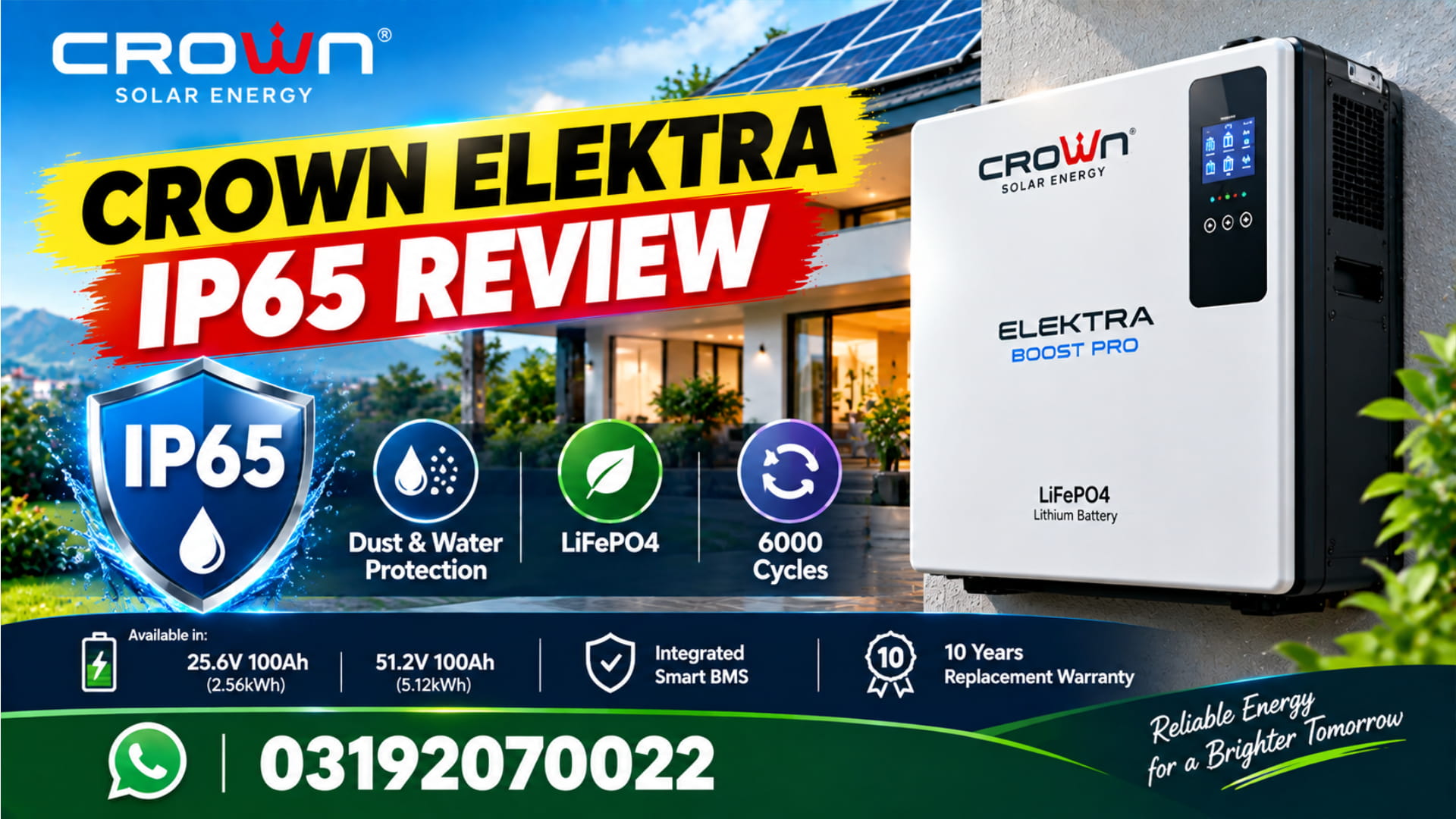
A review of a battery is really a review of a spec sheet plus an honest account of what that spec sheet means once it is sitting on a rooftop in Multan rather than in a lab. That is what this is: an assessment built on the Crown Elektra IP65’s documented specifications, how an IP65 rating actually behaves under Pakistani conditions, and what to verify before you buy, rather than a marketing rewrite of the box.
We stock this unit specifically because the standard Elektra Boost line, sold by most other resellers, is commonly IP21 rated, meaning indoor use only. The IP65 variant exists precisely for the installations where that matters most here: rooftops, carports, and semi-exposed utility areas. No prices in this review, since rates move with the exchange rate. WhatsApp us now for the latest price of the battery at 03192070022 once you know if this is the right unit for your installation.
What it actually is
The Crown Elektra IP65 is a LiFePO4 pack built on the same Elektra Boost architecture as the rest of Crown Solar Energy’s range, distinguished by its enclosure rather than its chemistry. It shares the family’s core configuration options, most commonly 24V (true nominal 25.6V) and 48V (true nominal 51.2V), built from sixteen or eight cells in series depending on voltage.
What sets this specific variant apart is the sealing. Where the standard IP21 Elektra Boost is built for a dry, indoor location, the IP65 variant is built to keep dust and water jets out entirely, which is a different design brief for the enclosure, the cable glands and the access panels, not just a sticker change.
Before you order, confirm the exact model code and capacity you are being quoted. “IP65” describes the enclosure rating, not the amp hour figure, and Crown’s range includes this rating across more than one capacity.
The sealing, assessed properly
An IP65 claim is only as good as the physical construction behind it, so this is where a review earns its keep rather than repeating the sticker.
Genuine IP65 construction requires gasket seals around every access panel, properly sealed cable glands where wiring enters and exits, and no unsealed vents or gaps that would let fine dust straight in. The rating comes from two separate lab tests, one for solids and one for liquids, and a unit genuinely rated IP65 has passed both rather than one.
This matters enormously here because of two specific Pakistani conditions the rating is directly tested against. The seasonal dust storms that hit Sindh and south Punjab drive fine particulate into anything with an unsealed gap, and the monsoon brings sustained, driving rain to large parts of the country for weeks at a time. Both are exactly what the IP65 standard’s solids and liquids tests are built to certify against.
One honest limitation worth stating plainly: IP65 protects against water jets and driving rain, not submersion. It is not justification for siting the unit somewhere it could sit in standing floodwater during a heavy monsoon downpour. Site it above realistic water levels regardless of the rating.
What it delivers
Using the true nominal voltages rather than the rounded labels, a 24V configuration holds 25.6V × 100Ah, which is 2.56 kWh nominal, and a 48V configuration holds 51.2V × 100Ah, which is 5.12 kWh nominal. After typical usable depth of discharge of 80 to 90 percent and inverter conversion losses of roughly 10 to 15 percent, expect delivered energy of roughly 2 kWh from the 24V unit and roughly 4 kWh from the 48V unit.
In practical terms, the 24V unit suits a shop, a small utility area, or a household running fans and lighting without a fridge on backup for several hours. The 48V unit covers a normal evening for a household on a 5KW hybrid inverter: fans, lights, a fridge, a television and general electronics for four to six hours depending on exactly what is running.
If your load includes air conditioning on backup, a single unit at either capacity will not carry it far. A 1.5 ton inverter AC draws 1000 to 1500W in steady operation, which consumes the entire delivered capacity of a 48V unit within a few hours before anything else in the house runs.
Build and protection, generally
The Elektra Boost family across its tiers is documented with a smart BMS providing protection against overcharge, deep discharge, short circuit and temperature extremes, which is standard and expected coverage for a LiFePO4 pack at this price point. Whether the specific IP65 unit you are quoted includes active or passive cell balancing, and whether its BMS communicates with your inverter over CAN or RS485, depends on which tier and model code you are buying. Ask directly rather than assuming, since these details are not always obvious from the outside of the casing.
Continuous discharge current is the specification worth pressing hardest on if you plan to run a 5KW inverter near its ceiling. A 5KW inverter at full output draws roughly 98 to 110 amps from a 48V bank. Documented figures for the Elektra Boost line commonly cite discharge rates around 1C, which on a 100Ah pack works out to roughly 100 amps continuous, close to but not comfortably above what a 5KW inverter demands at its limit. If your household regularly pushes the inverter hard, confirm the exact continuous and peak figures for your specific unit, and consider whether two units in parallel gives you more comfortable headroom than relying on one at the edge of its rating.
Where it genuinely earns its place
The core case for this specific variant is straightforward and, on the evidence, a real one. If your installation is anywhere outdoor, rooftop, in a carport, or in a semi-exposed utility area, an IP21 rated battery is the wrong purchase regardless of its other specifications, and a genuine IP65 unit is close to a minimum sensible standard. This unit exists to be that answer within the Crown Elektra range specifically, at a point where the more commonly stocked IP21 Boost units sold elsewhere in the market simply are not suitable.
It also benefits from everything LiFePO4 generally offers over lead acid in this climate: no water topping, no ventilation requirement for gassing, far longer cycle life under daily solar cycling, and a much lighter footprint for the same usable energy. None of that is specific to this variant, but it is worth stating as the baseline case for the chemistry underneath the enclosure.
Where to be careful
A few things worth flagging honestly rather than glossing over.
Warranty terms across the broader Elektra Boost range have been documented very inconsistently by different resellers, ranging from as little as one year to as much as ten years advertised against what is nominally the same product. That variation appears to trace back to different tiers carrying different terms, and to some resellers not being clear about which tier they are actually listing. Confirm the exact warranty term and who backs it in writing from whoever you buy from, rather than trusting a figure seen on another seller’s page.
Documented operating temperature ranges for this family sit around -10°C to 55°C, which is a reasonable general window but does not on its own confirm safe charging behaviour at the cold end of that range. LiFePO4 charged below 0°C suffers permanent lithium plating on the anode regardless of brand, and a general operating temperature figure does not always distinguish charging from discharging at low temperatures. If you are installing in Quetta, Skardu, Ziarat or another region with routine sub-zero winter mornings, ask specifically about low temperature charge protection rather than assuming the published range covers it.
And as with any IP65 claim in this market, ask whether the rating has been independently tested, and inspect the physical sealing where you can, rather than accepting the two characters on a spec sheet without any documentation behind them.
How it compares within our range
We also stock the itel range in similar configurations, including units with their own IP65-rated variants. Both are genuine LiFePO4 products from established suppliers to the Pakistani market, and the specific details that actually decide which suits you, cell grade, BMS communication, continuous discharge rating and warranty backing, vary by the exact model within each brand rather than by brand name alone. If you are weighing this against an itel equivalent, ask us for both specification sheets side by side rather than deciding on brand reputation alone.
Within the Crown Elektra line itself, this IP65 variant sits alongside the standard indoor-rated Boost, the shorter-warranty Lite tier, and the higher-specification Pro tier. If your installation is fully indoor and climate-controlled, the IP65 rating buys you protection you may not need, and a standard indoor unit may represent better value. If there is any realistic dust or water exposure, this variant is the one worth paying for.
The verdict
Recommended for anyone installing outdoors, on a rooftop, in a carport, or in any semi-exposed location in Pakistan, provided the IP65 rating is confirmed and genuinely constructed rather than assumed from the model name. The core LiFePO4 case, long cycle life, no maintenance, light weight, holds regardless of installation location, and this variant specifically extends that case to where most of the country’s homes actually have room to put a battery.
Not the right choice, or at least not sufficient on its own, if your household regularly runs a 5KW inverter near its full rating and you have not confirmed the continuous discharge rating covers that, if you need genuine cold-weather charging assurance and have not confirmed low temperature protection specifically, or if your load includes meaningful air conditioning on backup, where a single 100Ah unit at either voltage will be exhausted quickly and a larger configuration or multiple units in parallel makes more sense.
What to confirm before ordering
The exact model code and capacity, since IP65 spans more than one configuration within the range.
The warranty term for that specific model and who backs it, given the documented inconsistency across resellers.
The continuous and peak discharge current in amps, checked against your inverter’s actual peak draw.
Whether the BMS communicates with your inverter, and over which protocol, if you are on a hybrid inverter that supports it.
Whether low temperature charge protection is present, if your installation sees routine sub-zero mornings.
No. IP65 means protected against dust and low pressure water jets from any direction, not submersion. Do not site it anywhere it could sit in standing floodwater.
Structurally it is rated for that level of dust and water exposure, but shade it regardless. Cycle life ratings are measured near 25°C, and direct summer sun raises the internal temperature well above that regardless of how well sealed the enclosure is.
Primarily the enclosure. The standard Boost is commonly IP21 rated, intended for indoor installation only. This variant is built and sealed for outdoor and semi-exposed conditions.
Provided the specific unit’s continuous discharge rating covers your peak draw of roughly 100 amps at full inverter output. Confirm this figure rather than assuming it from the capacity alone.
Confirm directly with your seller. Advertised terms for this product family vary considerably across the market, and the figure that matters is the one written on your own invoice and warranty documentation.
Yes, across Pakistan.
Getting the current price
Confirm the exact model and capacity, the warranty term and backing, and the continuous discharge rating before comparing this against any other quote. WhatsApp us now for the latest price of the battery at 03192070022 with your installation location, your inverter model and your evening load, and we will confirm whether this is the right unit before quoting.
You can see our current range on the home page and the products page, read more buying guides on the blog, find out more about us on the about us page, and reach the team directly through the contact page.
Buy Battery is your trusted battery partner. Premium batteries built for Pakistan’s climate, powering homes, businesses and vehicles nationwide.