
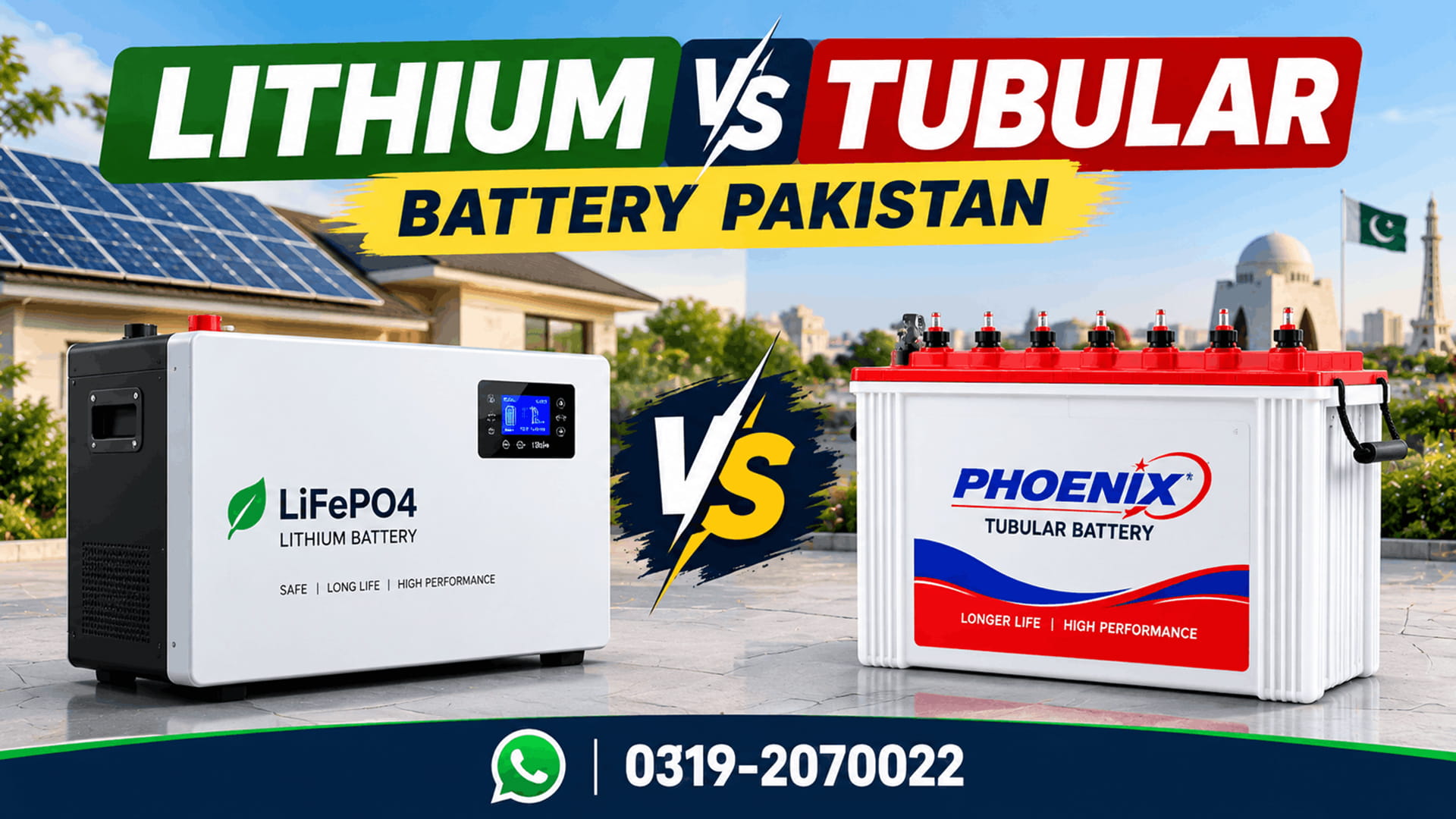
Most comparisons of these two are written by someone selling one of them, and you can usually tell within a paragraph.
So let me put my position up front: we sell both categories, we think lithium is the right answer for most solar installations in Pakistan, and there are specific situations where tubular is the better buy and we will say so. One of those situations is genuinely surprising and gets missed in every article I have read on this subject. It is in the section on cold weather below.
What follows is the comparison done properly, on the dimensions that actually affect you. No prices, since they move weekly and a published figure ages badly. WhatsApp us now for the latest price of the battery at 03192070022 when you want the current rate on either type.
What a tubular battery actually is
Worth understanding, because “tubular” is not a brand or a marketing tier. It describes a specific construction.
In an ordinary flat plate lead acid battery, the positive plate is a flat grid pasted with active material. Every time you discharge and recharge, that material expands and contracts slightly. Over hundreds of cycles it sheds off the grid and falls to the bottom of the case. Capacity drops, and eventually the accumulated sludge can bridge the plates and short the cell.
A tubular battery solves this mechanically. The positive plate is a row of vertical spines, each surrounded by a tube of woven polyester gauntlet packed with active material. The gauntlet physically holds the material against the spine. It cannot shed, because it has nowhere to go.
That single design change is why tubular batteries survive deep cycling far better than flat plate ones. It is a genuinely good piece of engineering and it is why tubular remains the sensible lead acid choice for solar rather than a flat plate or automotive battery.
But it is still lead acid. The gauntlet solves plate shedding. It does not change the chemistry underneath, and the chemistry is where the remaining differences come from.
Cycle life, and what that means in years
This is the difference everyone knows about, so let me put numbers around it.
A good tubular battery in solar service delivers somewhere in the region of 1200 to 1500 cycles at 50 percent depth of discharge, and considerably fewer if you regularly go deeper. Solar batteries cycle daily. Do the arithmetic and you are looking at roughly three to four years of daily cycling, assuming disciplined use.
A quality LiFePO4 pack delivers several thousand cycles at 80 percent depth of discharge. In daily solar service that translates to eight to ten years or more.
So across a ten year horizon you are comparing one lithium purchase against two or three tubular purchases. That is before accounting for the labour of removing and replacing a very heavy battery bank twice, and before the periods where you are running on a degraded bank in the months before you accept it needs replacing.
There is a caveat I will not skip. Those tubular cycle figures assume you keep it above 50 percent charge. Almost nobody does during a long load shedding stretch in July. Every deep discharge permanently removes capacity, and the shortfall between the datasheet and reality is usually the owner’s behaviour rather than the manufacturer’s optimism.
Usable capacity: the comparison people get wrong
Someone quotes you a 200Ah tubular battery and a 100Ah lithium battery and the tubular looks like twice the product. It is not.
Usable energy is capacity multiplied by the depth of discharge you can safely use.
A 12V 200Ah tubular battery holds 2.4 kWh nominal. Take it to 50 percent, which is as deep as you should regularly go, and you have about 1.2 kWh available per cycle.
A 12.8V 100Ah LiFePO4 pack holds 1.28 kWh nominal. Take it to 90 percent and you have about 1.15 kWh available.
Those are nearly the same battery in daily use. One weighs three times as much and needs replacing years earlier.
Always convert to kilowatt hours and then apply depth of discharge before comparing anything. Amp hours alone will mislead you, especially across different voltages.
The efficiency gap nobody mentions
This is the argument I find most persuasive and the one that appears least often, because it is invisible on a spec sheet.
Round trip efficiency is how much of the energy you put into a battery you get back out. Lead acid, including tubular, runs somewhere around 80 to 85 percent. LiFePO4 runs around 95 to 98 percent.
That gap is not a rounding error. With tubular, roughly fifteen to twenty percent of every kilowatt hour your panels generate disappears into heat and gassing during charging. On a 5kW array generating perhaps 20 kWh on a good summer day, that is three to four kilowatt hours a day thrown away. Every day, for the life of the system.
You paid for those panels. Storing their output in a lossy battery means part of that investment never reaches your appliances.
There is a related problem that bites harder in winter. Lead acid charging has a long absorption stage where current tapers right down while the battery finishes the last fifteen or twenty percent. That stage takes hours. On a short December day when your usable charging window is five hours rather than nine, a tubular bank frequently never completes it. Chronic undercharging causes sulphation, sulphation causes permanent capacity loss, and the battery quietly degrades through every winter.
LiFePO4 accepts bulk charge at high current until it is nearly full, so it fills the available window efficiently. On a short winter day that difference is substantial.
Maintenance, in practical terms
Tubular batteries need distilled water topped up, typically every four to eight weeks depending on temperature and charging regime. In summer, more often. If the electrolyte drops below the plates, that exposed area is permanently damaged.
They vent hydrogen while charging, so they need real ventilation. Not a cupboard.
They emit acid fumes that corrode nearby metal and electronics. Anyone who has installed an inverter directly above a battery bank has seen what that does to the terminals and the PCB over a couple of years.
Terminals corrode and need cleaning and greasing.
And someone has to actually do all of this. In practice, most households do it enthusiastically for three months and then forget, which is a large part of why real world tubular life falls short of datasheet life.
LiFePO4 is sealed. No water, no gassing, no acid fumes, no terminal servicing beyond an annual check that the bolts are still torqued correctly. Site it sensibly and it asks nothing of you.
Heat, and the Pakistani reality
Every battery loses life in heat, but the two chemistries lose it at different rates.
For lead acid there is a well known rule of thumb: life roughly halves for every 10°C of sustained operating temperature above 25°C. A tubular bank living at 40°C through a Multan, Sukkur or Rahim Yar Khan summer is burning through its cycle budget at a rate the datasheet never contemplated. That is a large part of why tubular batteries that promise four years deliver two and a half in the heat belt.
LiFePO4 also degrades faster when hot, and I am not going to pretend otherwise. But it starts from a much larger cycle budget and it tolerates elevated temperature better, so the same conditions cost you proportionally less. It also generates less internal heat while charging, because it is not wasting fifteen percent of the input energy.
Either way, the installation matters as much as the purchase. Shade it, ventilate it, keep it off a hot floor, never put it in a sealed metal box on a roof.
Where tubular genuinely wins
Four situations, and the last one is the interesting one.
A hard budget ceiling. If the lithium option is simply out of reach, a tubular battery that gives you three years of backup is better than no battery. That is a real answer and I would rather give it than lose someone to a worse purchase elsewhere.
A rented property you will leave soon. Matching the asset life to your occupancy is rational. If you are moving in a year, buying a ten year battery is not obviously smart.
Backup only, not daily cycling. If you have grid power most of the time and the battery is a standby that discharges occasionally rather than every night, the cycle life advantage of lithium matters much less. Tubular handles infrequent cycling well.
Cold regions, for one specific reason. This is the one almost nobody mentions. LiFePO4 must not be charged below 0°C, because at those temperatures lithium plates onto the anode as metal rather than intercalating into it, and the damage is permanent and cumulative. In Quetta, Skardu, Ziarat, Kalam and Astore, sub zero winter mornings are routine. A properly protected lithium pack will simply refuse to charge until it warms, which is correct behaviour but means you lose part of your charging window on cold mornings.
Lead acid has no such restriction. Its capacity drops in the cold, but it will accept charge below freezing without permanent harm.
This does not make tubular the automatic choice in the northern areas. Lithium packs with low temperature charge protection and heated variants exist and work well. But if you are in a genuinely cold location and buying a lithium pack that lacks that feature, you have a real problem, and a tubular bank is a legitimate alternative worth weighing rather than dismissing.
There is also a fifth point that is specific to Pakistan and worth knowing: lead acid has an established scrap value here. When a tubular battery dies, it has a residual worth, because lead recycling is a mature local industry. Lithium recycling infrastructure in Pakistan is still developing, so end of life recovery is not yet comparable. That partly offsets the replacement cost of tubular, and it is an honest point in its favour.
Where lithium wins
Daily solar cycling, which is what a solar battery is for. Longer life, deeper usable discharge, far better round trip efficiency, faster charge acceptance on short winter days, no maintenance, no ventilation requirement, no acid fumes near your electronics, and less than half the weight for the same usable energy.
For a household on a 5KW hybrid inverter cycling the bank every single evening, this is not a close comparison. The chemistry that handles daily deep cycling badly is the wrong tool for a job defined by daily deep cycling.
If you want the chemistry side in more depth, our guide to LiFePO4 battery pricing in Pakistan covers cell grades, construction and what actually drives cost.
Making the call
Answer three questions honestly.
How often will it cycle? Every night means lithium. Occasionally, as standby, means tubular deserves consideration.
How long will you keep it? Ten years in your own home favours lithium heavily. Two years in a rental does not.
Where will it live? A hot rooftop enclosure punishes tubular much harder. A sub zero winter location needs either a lithium pack with low temperature protection or a lead acid bank.
If you would like help running that against your actual setup, our broader guide to solar battery selection in Pakistan walks through sizing, and you can see both categories in our current range on the products page.
Only if your inverter supports a lithium charge profile or lets you set absorption, float and cutoff voltages manually. Lead acid settings include an equalisation stage that is actively harmful to lithium. Confirm your model before ordering.
No. Never parallel different chemistries. Their charge and discharge curves are incompatible and the arrangement will damage one or both.
Typically three to four years in daily solar service if it is well maintained and kept in a cool place. Considerably less in the heat belt or with frequent deep discharge.
Both are safe when installed properly. Tubular vents hydrogen and needs ventilation. LiFePO4 is the most thermally stable of the common lithium chemistries, with no cobalt and a much higher thermal runaway threshold than the lithium used in phones and laptops.
Over a full ten year horizon it usually does, because you are comparing one purchase against two or three, plus the efficiency losses you avoid. Over a two year horizon it does not. Match the calculation to how long you will actually own it.
Yes, across Pakistan.
Getting a current price on either
Decide based on cycling frequency, ownership horizon and where the battery will physically live. Then, whichever category you choose, judge the individual product on build quality and warranty backing rather than the headline capacity.
WhatsApp us now for the latest price of the battery at 03192070022 with your inverter model, your city and a rough idea of your evening load, and we will tell you what fits before quoting.
Buy Battery is your trusted battery partner. Premium batteries built for Pakistan’s climate, powering homes, businesses and vehicles nationwide.