
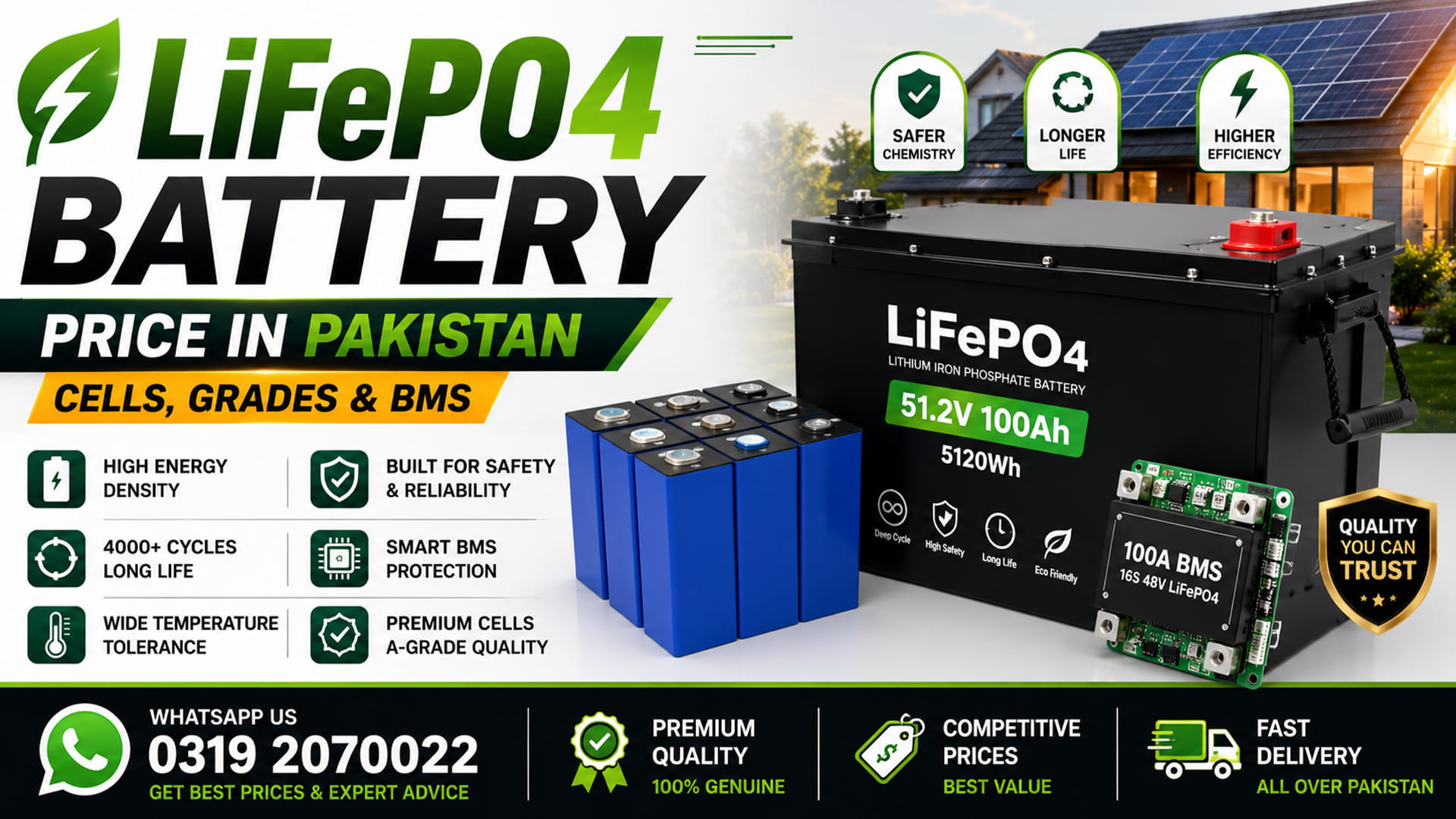
If you have searched specifically for LiFePO4 rather than just “lithium battery,” you are already past the beginner stage. You know the chemistry has a name and you probably suspect that the name matters.
It does. And once you understand what is physically inside a LiFePO4 pack, the price differences between two boxes that look identical stop being mysterious and start being predictable.
This piece is about the chemistry and the cells, because that is where roughly two thirds of what you pay actually goes. No figures, since they move with the exchange rate and global cell markets. WhatsApp us now for the latest price of the battery at 03192070022 when you want the current rate.
What LiFePO4 actually means
Lithium iron phosphate. The formula is LiFePO₄, and the important part is what it does not contain.
Most lithium batteries you encounter in phones and laptops use a cathode built around cobalt, either lithium cobalt oxide or a nickel manganese cobalt blend. Cobalt gives high energy density, which is why your phone is thin. It also brings a supply chain concentrated in politically difficult places, a high price, and a specific thermal weakness.
LiFePO4 replaces cobalt with iron and phosphate, arranged in what chemists call an olivine crystal structure. Iron is abundant and cheap. Phosphate bonds are strong. That single substitution changes almost everything about how the battery behaves.
Four consequences follow, and each one shows up in your system.
Lower energy density. LiFePO4 stores roughly 90 to 160 watt hours per kilogram, against perhaps 150 to 250 for NMC. A LiFePO4 pack is heavier and bulkier for the same stored energy. In an electric car that is a serious penalty. In a battery bolted to your wall that never moves, it is close to irrelevant.
Much better thermal stability. The phosphate bond does not readily release oxygen when the cell is stressed. Thermal runaway in LiFePO4 begins at a substantially higher temperature than in cobalt based chemistries, and when it does occur it is far less energetic because there is no internal oxygen supply feeding the reaction. For a battery installed inside a home in a country that regularly sees 45°C ambient temperatures, this is the single most important property of the chemistry.
Far longer cycle life. LiFePO4 cells routinely deliver several thousand full cycles where NMC might give one to two thousand. The olivine structure is mechanically stable through charge and discharge, so it degrades more slowly.
Lower cost per kilowatt hour. No cobalt, cheap iron, and enormous manufacturing scale. This is why lithium iron phosphate has become the dominant chemistry in stationary storage worldwide, not just here.
The trade is straightforward. You give up weight and compactness, and you get safety, longevity and price. For a home or business energy store, that is an obviously good trade.
The voltage numbers that follow from the chemistry
Chemistry determines cell voltage, and cell voltage determines everything about how your pack is built.
A LiFePO4 cell is nominally 3.2 volts. Fully charged it reaches about 3.65V. Fully discharged it drops to about 2.5V. Those are properties of the materials, not design choices.
Put sixteen cells in series and you get 16 × 3.2 = 51.2V nominal, which is the standard home battery configuration written as 16S. Fully charged that pack reaches roughly 58.4V, and empty it falls to about 40V. This is why “48V” batteries are actually 51.2V batteries wearing an older label inherited from lead acid systems, a distinction explained fully in our 51.2V 100Ah battery guide.
The other feature worth knowing is the shape of the discharge curve. A LiFePO4 cell sits stubbornly near 3.2 to 3.3V through the great majority of its usable capacity, then falls off a cliff at the end. Your appliances love this, because they get stable voltage almost until empty. Your inverter hates it, because it cannot infer state of charge from a voltage that barely moves. That flat curve is the whole argument for buying a pack whose BMS reports true state of charge over CAN or RS485 rather than leaving the inverter to guess.
Where the money goes in a LiFePO4 pack
Break the price into its components and the market makes sense.
Cells: roughly 60 to 70 percent. This is the pack. Everything else is packaging around it.
BMS: a meaningful and variable share. A basic board that balances passively and cuts off at limits is cheap. One that balances actively, senses temperature at multiple points, protects against low temperature charging and speaks to your inverter is not.
Mechanical build. Busbars, terminals, compression fixtures that hold the cells under correct pressure, casing material, and whether the enclosure carries an IP65 dust and water rating.
Assembly and testing. Whether the finished pack was capacity tested and balanced before shipping, or simply screwed together and boxed.
Commercial layer. Import duties, freight, warranty provision, and whether replacement modules sit in a warehouse in Pakistan or have to be ordered from abroad when something fails.
Since cells dominate, cell quality dominates price. Which brings us to the part that matters most.
Cell grades, explained properly
This is the single biggest driver of price differences between LiFePO4 packs in Pakistan, and it is nearly invisible from the outside.
Cells come off a production line with natural variation in capacity and internal resistance. Manufacturers then sort them.
Grade A cells meet full specification and are matched into batches with closely aligned capacity and internal resistance. They carry proper documentation and traceable serial numbers.
Grade B cells have measurable deviation. They might be slightly under rated capacity, or have higher internal resistance, or show cosmetic defects that hint at process problems. They work. They are sold at a discount for a reason.
Grade C and reclaimed cells are the bottom of the market: rejects, cells pulled from decommissioned packs, or unmatched leftovers assembled into something that looks like a battery.
Here is why matching matters more than the individual grade label. In a sixteen cell series pack, every cell carries the same current. The pack is full when the strongest cell is full, and empty when the weakest cell is empty. Usable capacity is therefore set by the weakest cell in the string, not the average.
Well matched cells drift apart slowly, and a good balancer keeps them together. Poorly matched cells drift apart quickly, the balancer cannot keep up, and the spread widens with every cycle. The pack loses usable capacity even though most of its cells are perfectly healthy.
The timeline is what makes this dangerous for buyers. A pack built from unmatched cells frequently tests correctly on the day it arrives. The problem surfaces at eight or twelve months, by which point you have no baseline measurement to point at and the seller may be difficult to find.
Ask for the cell manufacturer and grade in writing, on the quotation rather than in conversation. It is a reasonable question and a seller who will not answer it has told you the answer.
Cell formats
You will see three physical formats and the differences are practical.
Prismatic cells are rectangular aluminium cans. This is what almost every serious home storage pack in Pakistan uses. They stack efficiently, they are easy to compress and busbar together, and the standard capacities in current production are large: 280Ah, 304Ah and 314Ah cells are the workhorses of the stationary storage industry. A 48V 314Ah unit is sixteen of those big cells in series.
Cylindrical cells, typically 32700 size for LiFePO4, are used in smaller packs and some portable units. More cells means more connections, which means more potential failure points, but also better heat dissipation and easier redundancy.
Pouch cells are flexible foil packages. Efficient use of space, but they swell as they age and need mechanical constraint. Less common in the packs sold here.
If you are being offered a 100Ah pack, ask whether it is built from a small number of large prismatic cells or a large number of small ones. Both are legitimate. The construction quality of the interconnections matters more in the second case.
The truth about cycle life numbers
Every LiFePO4 datasheet quotes a cycle figure, and most of those figures are close to meaningless as printed.
A cycle rating is only a specification when it carries two conditions: the depth of discharge it was tested at, and the temperature. “6000 cycles” is a marketing number. “6000 cycles at 80 percent depth of discharge, 25°C, to 80 percent remaining capacity” is a specification you can hold someone to.
Three things affect how many of those cycles you actually see.
Depth of discharge. Shallower cycling gives dramatically more cycles. A pack cycled to 50 percent daily will outlive the same pack cycled to 90 percent daily, often by a wide margin.
Temperature. Every sustained stretch well above 25°C draws the number down. A pack in a sealed metal enclosure on a rooftop in Multan or Jacobabad in June is not living at test conditions for a single hour.
Calendar ageing. Cells degrade with time regardless of use, and they degrade faster when stored hot and at high state of charge. A battery that sits at 100 percent in a hot room for months ages faster than one cycled moderately in a cool one.
Which is why “how many years will it last” has no honest single answer. Installed sensibly, in shade, with ventilation and correct charge parameters, a quality LiFePO4 pack should comfortably outlive several lead acid replacements. Installed on a rooftop in direct sun and cycled flat every night, it will disappoint you.
Where global cell prices sit now
Worth knowing, because the assumption that lithium always gets cheaper is no longer safe.
For several years it did get cheaper, as Chinese overcapacity in LFP cathode production pushed material costs down hard. That environment is what made Pakistan’s solar expansion affordable.
The direction has since changed. Lithium carbonate prices hit four year lows during 2025 before rebounding sharply through the second half of the year, climbing 56 percent from around US$10,798 per metric ton in January to US$16,882 by 29 December. Analyst forecasts for 2026 point higher rather than lower, on the basis that supply growth is modest while storage demand keeps expanding into new markets.
The practical implication for a buyer here is that waiting six months is no longer a reliable way to pay less. The market context behind local pricing is covered in more detail in our guide to the lithium battery price in Pakistan today.
Charging LiFePO4 correctly
Chemistry dictates charge parameters, and getting these right at commissioning is the highest value quarter hour in the whole installation.
For a 16S pack, absorption voltage typically sits between 56.8V and 57.6V, which is about 3.55 to 3.60V per cell. Pushing toward 58.4V gains very little capacity and adds real stress at the top of every cycle.
Float typically sits between 54.4V and 55.2V. Lithium does not need a maintenance float the way lead acid does.
Low voltage disconnect is usually set between 44V and 47V depending on how much usable capacity you want versus how kind you want to be to the cells.
Disable equalisation completely. That stage exists to stir stratified electrolyte and desulphate plates in lead acid batteries. LiFePO4 has neither problem, so equalisation is simply sustained overvoltage, and your BMS will spend its life cutting the charger off to defend the cells.
And the cold rule, which is chemistry rather than preference: never charge LiFePO4 below 0°C. At those temperatures lithium plates onto the anode as metal instead of intercalating into it, and that damage is permanent and cumulative. In Quetta, Skardu, Ziarat, Kalam and much of upper KP this is a routine winter condition, so low temperature charge protection or a heated pack is worth specifying explicitly.
What to ask before you buy
Cell manufacturer and grade, in writing.
Cell configuration, written as 16S1P or similar, so you can confirm the voltage and calculate the true kWh.
Continuous discharge current in amps, and peak current with its permitted duration.
Whether the BMS balances actively or passively, and whether it communicates with your specific inverter model over CAN or RS485.
Whether low temperature charge protection is present.
Cycle life with its test conditions attached.
Who honours the warranty and whether replacement modules are stocked in Pakistan.
The pack weight, because LiFePO4 cells have predictable mass and a suspiciously light pack is not full of what the label claims.
Our approach to sourcing and supporting what we sell is set out on the about us page, and the current lineup with full specifications is on the products page.
LiFePO4 is one chemistry within the lithium ion family. When people say “lithium ion” they often mean cobalt based chemistries like NMC, which behave quite differently.
It is the safest of the common lithium chemistries by a clear margin, because the phosphate bond does not readily release oxygen under stress. Install it in a ventilated space away from direct heat, with proper cabling and protection, as you would any energy storage.
Lower energy density per kilogram, which is the trade you make for stability and cycle life. It matters in vehicles and barely matters in a wall mounted home battery.
Only if it supports a lithium profile or allows manual voltage configuration. Lead acid settings will either undercharge the pack or stress it at the top of every cycle.
Not by looking. Ask for documentation, ask for a capacity test on the specific unit, and buy from someone who will put the cell grade on the invoice.
Yes, across Pakistan.
Getting a current price
Judge a LiFePO4 pack on its cells first, its BMS second, and its warranty backing third. The label on the outside tells you very little that matters.
For the current rate on any configuration, WhatsApp us now for the latest price of the battery at 03192070022 with your inverter model, your city and a rough idea of your evening load. If you are still comparing options across chemistries and use cases, our guides to the best solar battery in Pakistan and the broader lithium battery price in Pakistan cover that ground.
Buy Battery is your trusted battery partner. Premium batteries built for Pakistan’s climate, powering homes, businesses and vehicles nationwide.