
Every article with this title gives you a numbered list, and every list is different, and none of them explain how the ranking was arrived at. That should tell you something.
The uncomfortable truth is that there is no single best solar battery in Pakistan, because the country does not have a single climate, a single load profile, or a single budget. A pack that performs beautifully in a shaded utility room in Islamabad may have a hard life on a rooftop in Jacobabad. A battery that suits a two fan household in a rented flat is the wrong purchase for a house running two air conditioners overnight.
What does exist is a set of criteria that separates a good battery from a bad one, and those criteria are the same everywhere. Learn them and you can judge any quote you are handed, including ours.
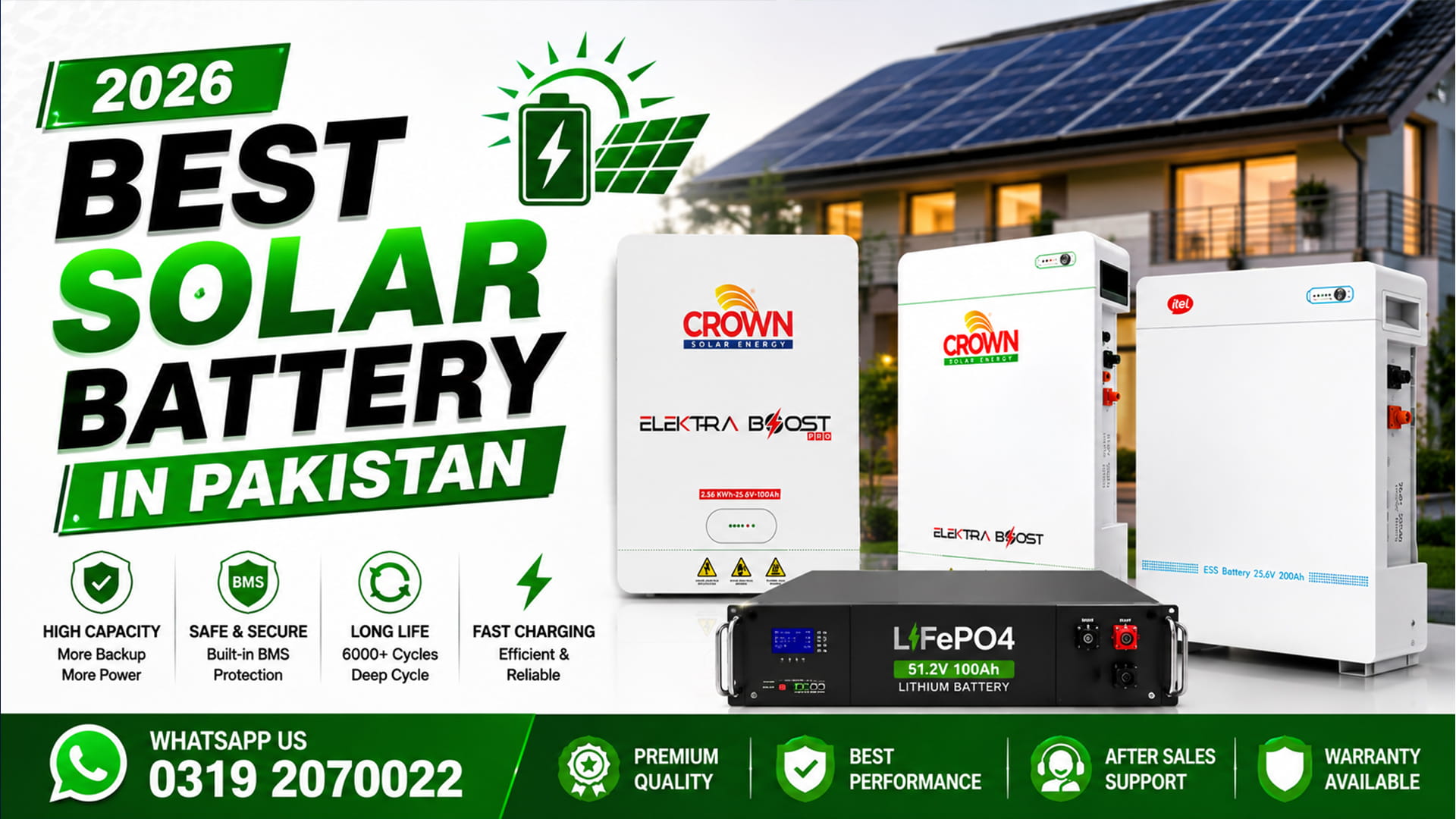
That is what this guide is. No prices, because they move weekly. When you have narrowed down what you need, WhatsApp us now for the latest price of the battery at 03192070022.
Start with the chemistry question
Before comparing individual products, settle the category. There are four things you will be offered and they are not close substitutes.
Flooded lead acid is the cheapest purchase and the most expensive ownership. Removable caps, liquid electrolyte, distilled water top ups every few weeks, ventilation required because it vents hydrogen while charging. Realistically 300 to 500 useful cycles if you never take it below half charge, which almost nobody manages during a July load shedding stretch. Every deep discharge permanently removes capacity. It fails gradually and then suddenly.
Tubular is the proper lead acid upgrade. The positive plate is a set of tubes packed with active material inside a woven gauntlet, which resists the plate shedding that kills flat plate batteries under repeated cycling. Deeper discharge tolerance, considerably longer life, and a genuinely reasonable choice on a tight budget with a modest load. Still heavy, still needs water and ventilation, still loses capacity in sustained heat.
Dry, AGM and gel are sealed lead acid variants. No water topping, no acid spills, minimal ventilation fuss, which is why they became the default for indoor UPS installations. Better cycle life than flooded, nowhere near lithium, and they sulphate if left at partial charge for weeks, which happens every winter when charging windows shorten.
Lithium iron phosphate, or LiFePO4, costs the most on day one and behaves completely differently afterwards. Several thousand cycles rather than several hundred. Usable depth of discharge of 80 to 90 percent instead of 50. High charge acceptance, which matters on a short December day. Less than half the weight for the same usable energy. No maintenance beyond sensible siting.
For most solar installations in Pakistan today, LiFePO4 is the answer, and I would rather explain why than simply assert it. The reason is not that lithium is fashionable. It is that solar batteries get cycled every single day, and daily cycling is precisely what lead acid is worst at. A battery that goes from full to half and back again 365 times a year burns through a lead acid cycle budget in under two years.
The full chemistry breakdown, including where tubular still genuinely makes sense, is in our guide to solar battery pricing in Pakistan.
The eight things that separate good from bad
Once you are in the lithium category, these are what actually differ between packs that look identical on a shelf.
1. Cell grade
This matters more than everything else combined, and it is the hardest thing to see.
Grade A cells are tested and matched for capacity and internal resistance before they are assembled into a pack. B grade, reclaimed and mixed batch cells are much cheaper and drift apart in service. Once cells drift, the weakest one caps the capacity of the entire pack, and no balancing circuit fully recovers that.
The insidious part is the timeline. A pack built from unmatched cells often measures correctly on the day it arrives. The problem appears at eight or twelve months, by which point the seller may be unreachable and you have no baseline test to point at.
Ask for the cell brand and grade in writing, on the quotation rather than verbally.
2. BMS capability
A battery management system is not a single feature, it is a spectrum.
At the basic end, passive balancing bleeds charge off high cells through a resistor and turns it into heat. It is slow and it only ever removes energy. At the better end, active balancing moves charge between cells, which works much faster on a pack that has begun to drift.
Then there is what the BMS reports. LiFePO4 has a deliberately flat discharge curve, sitting near 52 to 53V through most of its usable range on a 48V pack. That is excellent for your appliances and useless for estimating state of charge from voltage. A BMS that communicates with your inverter over CAN or RS485 sends true state of charge, individual cell voltages, temperatures and fault conditions. Without it, your inverter’s percentage display is an educated guess.
Communication compatibility is model specific, not brand specific. “Works with most hybrid inverters” is not an answer.
3. Continuous discharge rating
Two packs can both read 48V 100Ah and be rated 100A and 50A continuous respectively. They store identical energy. Only one supports a 5KW inverter at full output, because 5000W at 51.2V is roughly 98 amps before losses.
Get this wrong and the BMS disconnects under heavy load, your lights go off, and you blame the inverter. The 5kW solar battery guide works through that arithmetic in detail.
4. Temperature protection
Specifically, low temperature charge protection. LiFePO4 discharges fine below freezing but charging below 0°C causes lithium plating on the anode, and that damage is permanent and cumulative.
A pack with proper protection refuses charge until it warms. Heated packs draw a small amount of energy to warm the cells first. Neither feature is prominent on most datasheets, which is why you have to ask.
5. Enclosure rating
IP65 keeps dust and low pressure water jets out. Anyone who has opened an electrical box after a dust storm in Sindh or south Punjab understands why this is not a marketing line.
6. Warranty backing
An importer backed warranty and a shop backed warranty are different products. The second one lasts exactly as long as the shop does. Ask who honours it, what it covers, and whether replacement modules are stocked locally rather than ordered from abroad when something fails.
7. Cycle life, stated honestly
A cycle rating is meaningless without two conditions attached: the depth of discharge it was measured at, and the temperature. “6000 cycles” tells you nothing. “6000 cycles at 80 percent DoD, 25°C” is a specification.
8. Serviceability
Can a single failed module be replaced, or does the whole unit go? Rack mount designs generally win here because any module pulls out without disturbing the rest of the bank.
Best for your situation, not best overall
With those criteria in hand, here is how the answer changes by household.
Small home, shop or single room setup. A 12V or 24V lithium pack behind a 1KW to 3KW inverter. You do not need 48V and the extra cost of a high current pack buys you nothing at this scale. Prioritise cell grade and warranty over discharge rating.
Standard household on a 5KW hybrid inverter. This is the majority of installations in Pakistan now, and the 48V 100Ah class is where most people land. Roughly 5.12 kWh nominal, about 4 kWh delivered after depth of discharge and conversion losses, which covers fans, lights, a fridge and electronics through an evening. Here the continuous discharge rating genuinely matters, so insist on at least 100A. Our 48V 100Ah battery guide covers sizing and stacking.
Household running air conditioning on backup. A 1.5 ton inverter AC draws 1000 to 1500W in steady operation, so three or four hours of it is most of a single pack before anything else runs. Two packs in parallel, or a single larger unit in the 48V 314Ah class. If stacking, use the same model, same capacity, similar age, matched state of charge before connection, and equal length cables to the busbar.
Large home or small commercial premises. Fewer, larger units usually beat many small ones. Fewer connections, fewer failure points, one warranty. Check that your array and charge window can actually refill the bank in winter.
Cold region installation. Quetta, Skardu, Ziarat, Kalam, Astore and much of upper KP. Low temperature charge protection is not optional here, and a heated pack is worth the premium. Everything else is secondary to this.
Coastal installation. Karachi, Gwadar, Ormara and the coastal belt have a corrosion problem that inland buyers never think about. Salt laden humid air attacks terminals, lugs and enclosure hardware, and condensation inside a poorly sealed enclosure does the rest. Prioritise a properly sealed IP65 unit, use anti corrosion grease on terminals, and inspect connections more often than the manual suggests.
Heat belt installation. Jacobabad, Sibi, Larkana, Rahim Yar Khan, Multan. Every chemistry loses cycle life at elevated temperature, and cycle ratings are measured near 25°C. The battery choice matters less here than where you put it. Shade it, ventilate it, keep it off a hot floor, never mount it in direct sun or in a sealed metal box on a roof.
You can compare the units we stock across these categories on the products page.
How to verify a battery before you pay
A few checks that cost nothing and catch most problems.
Weigh it, or ask its weight. LiFePO4 cells have predictable mass, so a 48V 100Ah pack has a fairly predictable weight. A pack noticeably lighter than it should be is not full of what the label claims.
Check the resting voltage on delivery. A healthy sixteen cell LiFePO4 pack shipped at partial charge should read somewhere in the low 50s. Anything well outside that warrants a conversation before installation.
Ask whether the seller will provide a capacity test result for the specific unit rather than a generic model datasheet.
Confirm what is bundled. Delivery, cables, lugs, breakers, installation support and inverter configuration are sometimes included and sometimes not. Two quotes are not comparable until you know.
And check the cell configuration, written as 16S1P or similar. Sixteen LiFePO4 cells in series gives 51.2V nominal and 5.12 kWh at 100Ah. A pack built as 15S gives exactly 48V and 4.8 kWh, which is about 7 percent less energy for the same headline amp hour rating, and it will not charge correctly on an inverter configured for a 16S pack. The 51.2V 100Ah guide explains that distinction fully.
Warning signs
A quote dramatically below every other quote is not a bargain, it is an answer to one of the questions above that you have not asked yet.
Be wary of a seller who cannot name the cell manufacturer. Be wary of “6000 cycles” quoted without depth of discharge and temperature conditions. Be wary of a warranty period that sounds generous but is backed only by the shop selling it. Be wary of anyone charging a premium for a 51.2V pack over a 48V one, because those are the same battery with different labels.
And be wary of a capacity rating with no matching kWh figure, or one where volts times amp hours does not equal the stated kWh. Something is being rounded generously.
Why this decision matters more than it used to
For years the standard advice was to skip the battery entirely and let net metering do the storage. Export surplus during the day, draw it back at night, settle monthly.
That changed. The Economic Coordination Committee approved amendments cutting the net metering buyback rate to Rs 10 per unit from Rs 27, with the government stating existing consumers would be unaffected and the new rate applying to new connections. Exporting a unit now earns a fraction of what buying it back costs, so storing and self consuming captures far more value.
Pakistan already has the panels. The country imported 22 gigawatts of them in 2024, close to half the entire installed national generating capacity of 46 GW, and solar reached 24 percent of total generation in the first five months of 2025, ahead of gas, coal, nuclear and hydro. Storage is the piece most of those systems are still missing, which is why choosing well matters now in a way it did not three years ago.
Brand is a weaker signal than cell grade, BMS specification and who backs the warranty. Two packs carrying the same brand name can contain very different cells. Judge the specification, not the sticker.
For daily solar cycling, usually yes, because daily deep cycling is exactly what lead acid handles worst. For a very tight budget with a small load, or a property you will leave within a year, tubular can still make sense.
Lead acid, roughly two to four years depending on how deeply you cycle it. LiFePO4, commonly eight to ten years or more. Installation temperature affects both significantly.
Not advisable. Packs should match in voltage, capacity, model and age. Never parallel lithium with lead acid.
Only up to the point your array can refill it. A bank too large for your generation will not reach full charge on a short winter day, and a pack that never completes a full cycle ages faster.
Yes, across Pakistan.
Working out what suits you
The short version: settle the chemistry first, then judge cell grade, BMS capability and continuous discharge rating, then match the size to your evening load rather than to your inverter, then install it somewhere shaded and ventilated with the right charge parameters set at commissioning.
If you would rather skip the research, WhatsApp us now for the latest price of the battery at 03192070022 with your inverter model, your city and a rough idea of what you run at night. We will tell you what fits before we tell you what it costs. More buying guides are published on the Buy Battery blog.
Buy Battery is your trusted battery partner. Premium batteries built for Pakistan’s climate, powering homes, businesses and vehicles nationwide.