
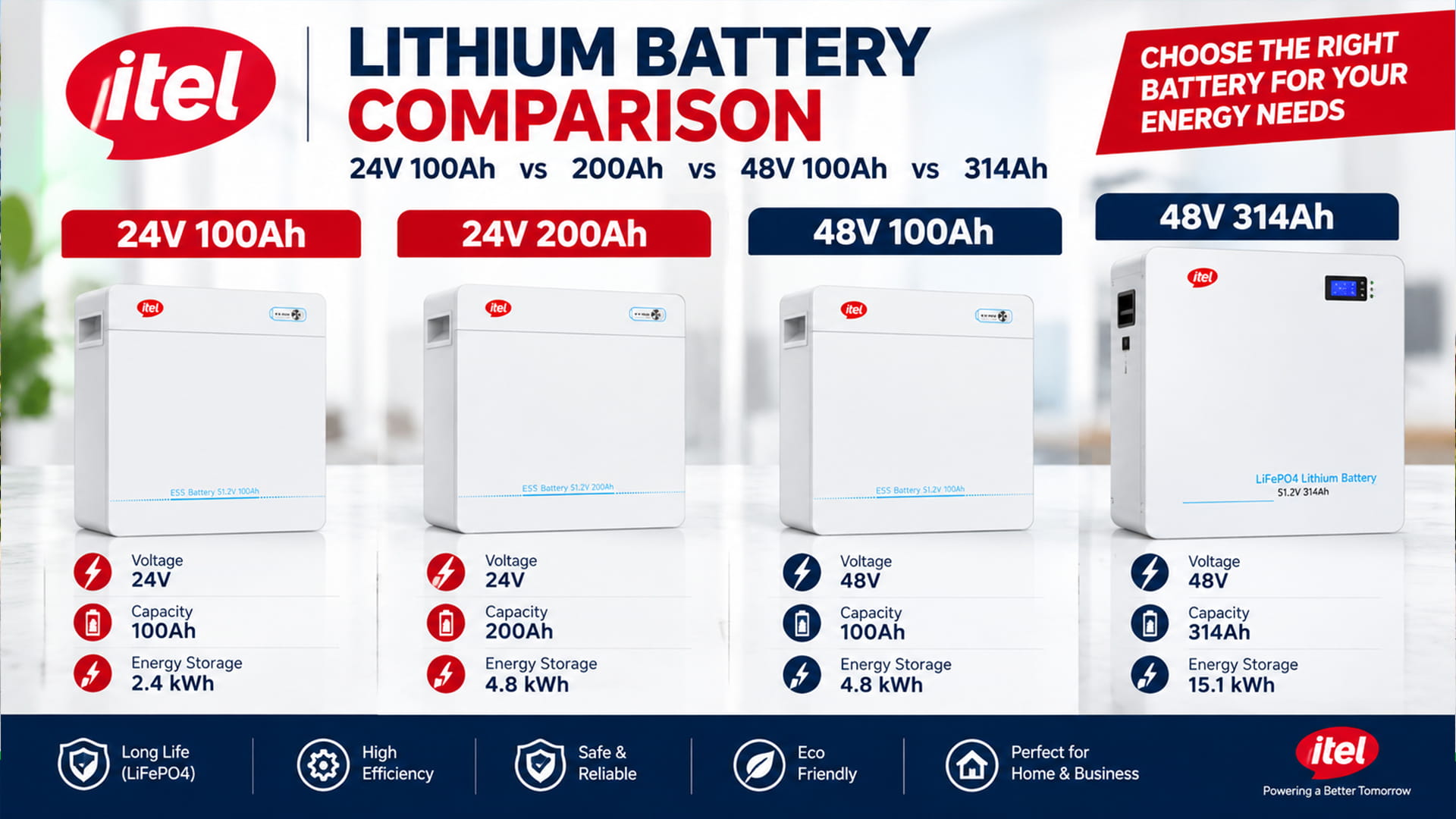
Four models sounds like four decisions. It is really three, and one of them is not a decision at all.
That is the useful thing to understand before you start comparing. Two of these batteries hold identical energy and cannot be chosen between, because your inverter has already chosen. One pair is a straightforward capacity question. And one comparison, the one most people never think to run, is between a single large unit and two smaller ones that add up to roughly the same thing.
This guide runs each matchup properly and gives a verdict on each. No prices, since rates move with the exchange rate and cell markets. WhatsApp us now for the latest price of the battery at 03192070022 for the current figure on any pairing you want compared.
If you want the range laid out individually rather than head to head, our itel lithium battery guide covers each model on its own terms.
First, compare the right number
Amp hours are meaningless across different voltages, and three of these four comparisons involve a voltage change or a capacity change that makes raw amp hours misleading.
Energy is volts times amp hours, using the true nominal voltage. A “24V” LiFePO4 pack is eight cells at 3.2V, so 25.6V. A “48V” pack is sixteen cells, so 51.2V.
itel 24V 100Ah: 2.56 kWh nominal, roughly 2 kWh delivered.
itel 24V 200Ah: 5.12 kWh nominal, roughly 4 kWh delivered.
itel 48V 100Ah: 5.12 kWh nominal, roughly 4 kWh delivered.
itel 48V 314Ah: about 16.08 kWh nominal, roughly 12.5 kWh delivered.
“Delivered” accounts for 80 to 90 percent usable depth of discharge and another 10 to 15 percent lost in inverter conversion. That is the figure that actually reaches your fans and fridge, and it is the only one worth comparing.
Matchup 1: itel 24V 100Ah vs itel 24V 200Ah
Same voltage, double the capacity. The cleanest comparison in the range, because nothing changes except how much energy is in the box.
The 24V 100Ah delivers about 2 kWh. At a 400W evening load that is roughly five hours. At 250W it stretches past eight. This suits a shop, a small office, a single room, or a household running fans and lights without a refrigerator on backup.
The 24V 200Ah delivers about 4 kWh. The same 400W load now runs about ten hours, or you can carry a heavier load for the same duration: several fans, a full set of lights, a refrigerator, a television and chargers, which typically comes to 800 or 900W.
Verdict. The deciding factor is whether a refrigerator is on your backup circuit. A modern inverter fridge averages 100 to 150W across a day once you account for compressor cycling, and adding it to an otherwise light load usually pushes you past what the 100Ah unit can carry comfortably. Fridge on backup, or more than about four fans, means the 200Ah.
There is a second argument for the larger unit that people underrate. A pack cycled to 90 percent every night ages faster than one cycled to 50 percent, and cycle life ratings are measured at a stated depth of discharge for exactly that reason. Buying the size that leaves you headroom is not just about tonight’s backup. It is about how many years you get.
The counterargument is real too: buying capacity you never use means paying for energy that sits idle, and a pack left at high state of charge in a hot room ages on the calendar regardless of use. Size modestly above your normal evening load, not far above it.
Matchup 2: itel 24V 200Ah vs itel 48V 100Ah
This is the one that looks like a decision and is not.
Both hold 5.12 kWh. Both deliver about 4 kWh. On an energy basis they are the same product.
They are not interchangeable, because a 24V inverter requires a 24V bank and a 48V inverter requires a 48V bank. There is no adapter and no configuration setting that bridges them. If you already own an inverter, this comparison is over before it starts.
It also cannot be fixed later. With lead acid you could wire batteries in series to build a higher voltage bank. Lithium packs contain a BMS, and most drop-in packs are explicitly not designed for series connection, so combining two 24V units to make 48V is generally not an option. Check the datasheet for any specific model, and if it does not permit series operation, do not attempt it.
Verdict. Your inverter decides. But if you are buying the whole system fresh and the voltage is genuinely still open, choose 48V unless your load is small and will stay small.
The reason is current. Power equals voltage times current, so 3000W at 24V draws 125 amps where the same 3000W at 48V draws about 62. Cable thickness scales with current, resistive losses scale with the square of it, and breakers, lugs and busbars are all rated by it. Heat appears at terminals and connections, which is where most solar installations actually fail.
Below roughly 2KW of load, 24V is efficient and appropriate. At or near 3KW, or with any chance of adding air conditioning within the life of the battery, 48V is the sensible choice. Our full breakdown of 24V versus 48V systems covers the trade-offs in detail.
Matchup 3: itel 48V 100Ah vs itel 48V 314Ah
The main decision for anyone on a 5KW hybrid inverter, which is now the standard residential installation in Pakistan.
The 48V 100Ah delivers about 4 kWh. That covers a normal household evening without cooling: six fans, a dozen LED lights, an inverter refrigerator, a television and chargers comes to roughly 900W, which runs about four and a half hours. Trim to four fans and you clear six hours comfortably.
The 48V 314Ah delivers about 12.5 kWh, roughly three times as much. That covers two inverter air conditioners for several hours alongside a full household load, or a modest load right through the night with margin to spare.
Verdict. Air conditioning is the dividing line, and it is not a close call.
A 1.5 ton inverter AC draws 1000 to 1500W in steady operation. Three hours of AC alone is 3 to 4.5 kWh, which is the entire delivered capacity of the 100Ah unit before anything else in the house runs. If you want cooling on backup, the 100Ah pack on its own will not do it.
If you do not run AC on backup, the 314Ah is more battery than a normal household evening requires, and there is a specific reason that matters beyond cost.
The charging constraint on the 314Ah
A 5kW array in Pakistan produces roughly 18 to 25 kWh on a clear summer day, dropping to about 10 to 15 kWh in late December when days are short and the sun sits low. Dust on the panels and high cell temperatures shave off more than people expect.
A 16 kWh bank behind a 5kW array will not reach full charge on a short winter day once you have also covered daytime household consumption. A pack that never completes a full charge cycle ages faster than one that does.
So the 314Ah is not simply “the bigger option.” It assumes an array sized to fill it. If you are buying at this capacity, plan the panels alongside it, or accept shallow cycling through the winter months. The 5kW system sizing guide works through that arithmetic.
Matchup 4: two 48V 100Ah packs vs one 48V 314Ah
Almost nobody runs this comparison, and it is the one where the answer is least obvious.
Two 100Ah packs in parallel give about 10.24 kWh nominal, roughly 8 kWh delivered. One 314Ah unit gives about 16 kWh nominal, roughly 12.5 kWh delivered. Not identical, but they occupy overlapping territory, and for a household needing somewhere between 8 and 12 kWh both are plausible answers.
Where the paired 100Ah packs win.
You can buy incrementally. Start with one, add the second when your load grows or your budget allows. That is genuine flexibility.
You get redundancy. If one pack develops a fault, the other keeps running while it is repaired or replaced. A single large unit is a single point of failure.
Discharge current adds up. Two packs rated 100A continuous each give you 200A of headroom, which matters if you run motors, pumps or compressors that surge hard on startup.
And handling is easier. Two units at manageable weight are simpler to get up a staircase than one very heavy cabinet.
Where the single 314Ah wins.
Fewer connections. Every parallel bank adds busbars, cable runs and lugs, and connections are where solar installations fail far more often than cables are. One unit means fewer places for heat to build up at a loose terminal.
One warranty with one start date, rather than two warranties beginning a year or two apart.
No matching problem. Packs in parallel should be the same model, the same capacity and close in age, because an older higher-resistance pack takes less of the load and makes the newer one work harder. Adding a second pack two years later means accepting some imbalance. A single unit sidesteps this entirely.
And more usable energy in the same footprint, which matters when wall or floor space is tight.
Verdict. If your load is settled and you know you need 10 kWh or more, the single 314Ah is the cleaner installation. If your requirement is uncertain, or you want to start smaller and grow, or you want redundancy, two 100Ah packs are the better structure.
One thing that should not decide it: assuming the parallel route is cheaper. Ask us to quote both configurations before you assume, because the comparison is not always in the direction people expect. WhatsApp us now for the latest price of the battery at 03192070022 and we will price both.
Quick reference
Small load, 24V inverter, no fridge on backup — 24V 100Ah.
Normal household, 24V inverter — 24V 200Ah.
Normal household, 48V inverter, no AC on backup — 48V 100Ah.
Household with AC on backup, or large home, or small commercial — 48V 314Ah, or two 48V 100Ah packs if you want to build up gradually.
Uncertain and growing — two 48V 100Ah packs, starting with one.
What is identical across all four
Worth knowing what is not part of any of these comparisons.
The chemistry. All four are LiFePO4 built from 3.2V cells. Safety, thermal behaviour and cycle characteristics come from the cells, not from how many are strung together.
The temperature rules. Never charge LiFePO4 below 0°C, because lithium plates permanently onto the anode at those temperatures. If you are in Quetta, Skardu, Ziarat, Kalam or upper KP, ask about low-temperature charge protection before ordering any of these.
The heat rules. Cycle-life ratings are measured near 25°C. Shade the pack, ventilate it, keep it off a hot floor, and never mount it in a sealed enclosure in direct sun in Multan, Jacobabad or Rahim Yar Khan.
The charge settings. Set a lithium profile at commissioning and disable equalisation, which exists to stir lead acid electrolyte and does nothing for lithium except hold it at excessive voltage.
The parallel rules, for any multi-pack bank: same model, same capacity, similar age, matched state of charge before connection, and equal-length cables to the busbar so no pack sits on a lower-resistance path and carries more current than its neighbour.
One thing to confirm before ordering
The 48V 100Ah is built in more than one variant, with different model codes covering wall-mounted, stackable and rack-format versions. Ingress protection ratings differ between them, with some intended for indoor installation only and others sealed for dusty or semi-exposed locations.
That is not a detail to leave to chance in Sindh or south Punjab, where dust is a permanent condition rather than a seasonal one. Tell us where the battery will physically live and we will confirm the correct variant and model code. Full specifications for any unit are available on request, and the current range is on the products page.
The 48V 100Ah is the standard pairing for a normal household evening. Move to the 48V 314Ah, or two 100Ah packs, if you want air conditioning on backup. Confirm the continuous discharge rating covers your peak draw of roughly 100 amps.
Only if you own a 24V inverter. They hold identical energy but are not interchangeable, and you cannot convert between them.
For a settled load, generally yes: fewer connections, one warranty, no matching problem. For a growing or uncertain load, multiple packs give you flexibility and redundancy.
No. Packs in parallel must match in model and capacity.
That depends far more on installation temperature and charge behaviour than on which model you choose. Shaded, ventilated and correctly configured, a quality LiFePO4 pack should run eight to ten years or more.
Yes, across Pakistan.
Working out which one
Confirm your inverter voltage, because that removes half the range immediately. Calculate your real evening load rather than guessing from the inverter’s rating. Decide whether air conditioning is on the backup circuit, because that single question separates the 100Ah class from the 314Ah class. Then decide whether you want one large unit or a bank you can grow.
Send us your inverter model, your city and a rough idea of what you run at night, and we will tell you which of the four fits before quoting. You can reach the team through our contact page, and there is more detail on discharge ratings and stacking in our 48V 100Ah buying guide.
Buy Battery is your trusted battery partner. Premium batteries built for Pakistan’s climate, powering homes, businesses and vehicles nationwide.