
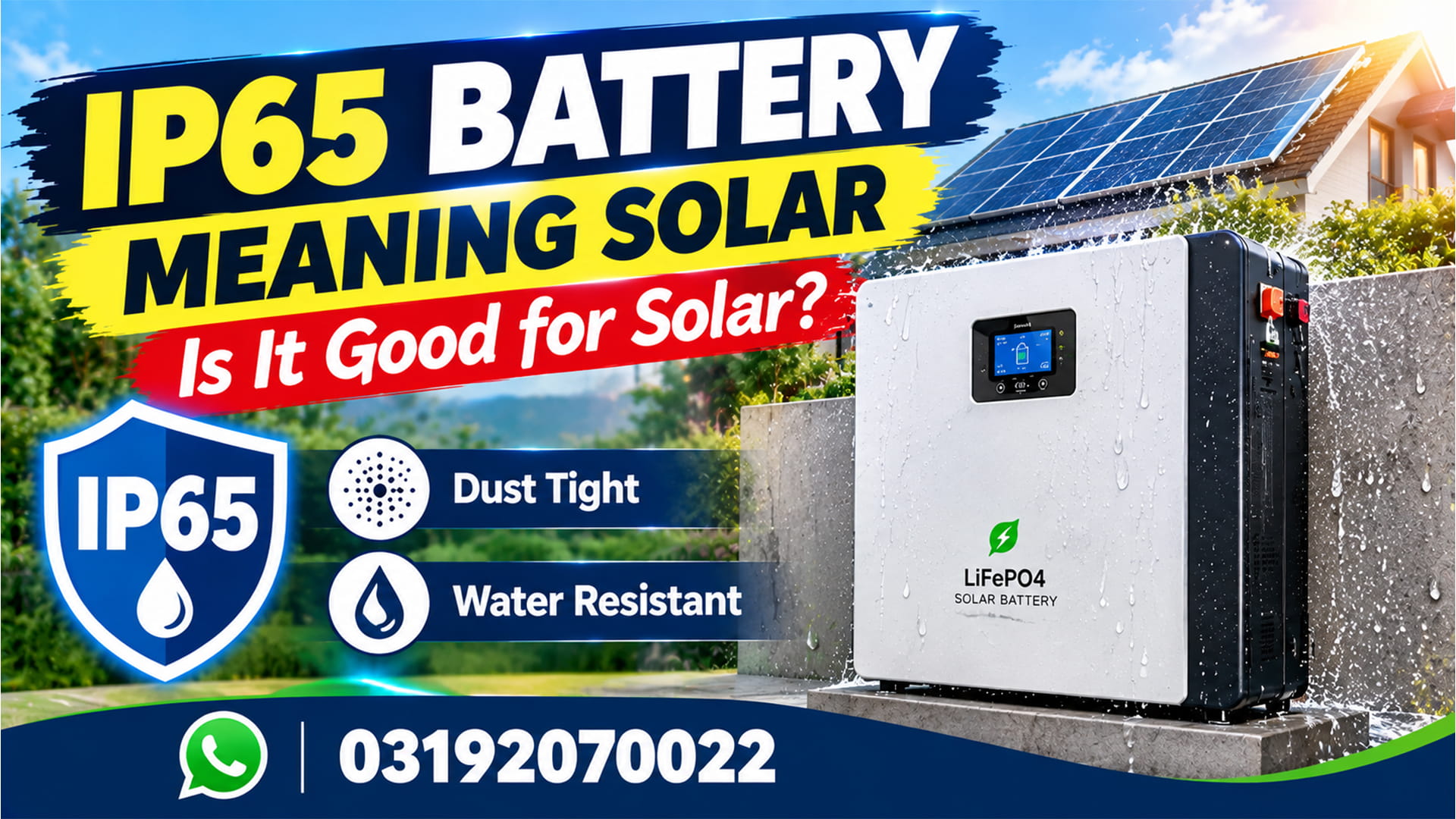
You see it printed on nearly every solar battery datasheet: IP65. Almost nobody selling the battery explains what the two digits actually mean, and almost nobody buying it asks. That is a problem in Pakistan specifically, because where you can install a battery, and how long it survives there, depends heavily on this one rating.
Here is what IP65 actually certifies, what it does not, and why it matters more here than in the country these ratings were originally written for. No prices in this guide. WhatsApp us now for the latest price of the battery at 03192070022 once you know what rating your installation needs.
What the letters and numbers stand for
IP stands for Ingress Protection. It is an international standard, IEC 60529, that describes how well an enclosure keeps things out. Two digits follow, and each one answers a separate question.
The first digit describes protection against solid objects, on a scale from 0 to 6. It answers the question: can dust, dirt, insects, tools or fingers get inside the enclosure?
The second digit describes protection against liquids, on a scale from 0 to 9K. It answers the question: can water get inside, and under what conditions?
So “IP65” is really two independent claims bundled into one code. The 6 covers solids. The 5 covers water. They are tested separately in a lab, and a product genuinely rated IP65 has passed both tests, not just one.
The 6: what it actually stops
A first digit of 6 is the strongest rating on the solid-ingress scale, and it means dust tight. Not dust resistant, not mostly sealed. In the standard test, the enclosure is placed in a chamber with fine talc powder circulated under vacuum for eight hours, and afterward no dust may have entered in a quantity or location that could interfere with operation.
This matters enormously in Pakistan because dust here is not an occasional inconvenience. It is a routine condition across most of the country, and a genuine hazard during the seasonal dust storms that hit Sindh and south Punjab, when visibility drops to a few metres and fine particulate gets driven into every gap that exists.
Anyone who has opened an electrical enclosure after one of those storms and found a layer of fine dust coating the circuit board understands why the 6 rating is not a marketing flourish. Dust ingress into a battery causes two real problems. It can create conductive paths across circuit board traces once humidity is added, and it degrades heat dissipation by coating components and vents that were designed to breathe.
The 5: what it actually stops, and what it does not
A second digit of 5 means protection against water jets from any direction, at low pressure. The standard test sprays the enclosure with water from a nozzle at roughly 12.5 litres per minute from all angles for at least three minutes.
This is genuinely useful protection against what a solar battery is likely to encounter outdoors in Pakistan: driving rain during the monsoon, water sheeting off a roof edge, or a hose used to clean panels running down onto nearby equipment.
Here is the important limit, and it is where the marketing sometimes gets ahead of the standard. IP65 does not mean submersible. It does not mean the enclosure can sit in standing water, and it does not mean it survives being fully immersed even briefly. That level of protection is IP67 (temporary immersion) or IP68 (continuous immersion), and those are different, more demanding certifications. A battery advertised loosely as “waterproof” on the strength of an IP65 rating is being oversold. IP65 is water resistant against jets and driving rain. It is not waterproof against submersion.
This distinction matters for where you site the battery. IP65 is appropriate for a covered outdoor location, a carport-style enclosure, or a semi-exposed utility area. It is not sufficient justification for installing a battery somewhere it could sit in floodwater during a heavy monsoon downpour, which is a real risk in low-lying parts of several Pakistani cities during the wet season.
Reading the whole scale
Seeing where IP65 sits against the alternatives helps you judge a spec sheet properly.
IP20 offers basic protection against fingers and small tools touching live parts, and against dripping water falling vertically. This is adequate for a battery inside a sealed, climate-controlled room with no dust exposure and no possibility of water contact. It is not adequate for anywhere near a rooftop, a carport, or a dusty utility area.
IP54 offers protection against dust ingress in quantities that would not interfere with operation, described as “dust protected” rather than the fully sealed “dust tight” of IP6X, along with protection against water splashed from any direction. This is a reasonable minimum for a sheltered indoor installation in a dusty climate, but it is a step down from IP65 and the difference is not trivial where dust storms are a regular feature of the local weather.
IP65 is dust tight and protected against low pressure water jets, as covered above. This is the sensible target for most outdoor and semi-exposed solar battery installations in Pakistan.
IP66 steps the water protection up to powerful jets rather than standard ones, useful in more exposed or industrial settings.
IP67 adds protection against temporary immersion, typically up to one metre for thirty minutes. This exceeds what most residential installations need, but it is relevant for anywhere with a genuine flood risk.
For a typical Pakistani home, the decision usually comes down to one question: is the battery going somewhere fully indoors and climate controlled, where a lower rating is acceptable, or somewhere outdoor, rooftop, or semi-exposed, where IP65 is close to a minimum sensible standard.
Why this matters more here than where these batteries are designed
Most LiFePO4 packs sold in Pakistan are designed and manufactured for markets with more temperate, less dusty conditions, and the IP rating is often the single specification that determines whether the product is actually suited to local installation practice.
Housing here frequently places electrical and mechanical equipment on rooftops or in semi-open utility areas, both because indoor space is at a premium and because ventilation is genuinely useful in the heat. That is precisely the environment IP65 is meant for and IP20 is not.
The seasonal dust storms across Sindh and south Punjab are a specific and severe test of the first digit that many installations elsewhere in the world never face at all.
And the monsoon brings sustained, heavy, wind-driven rain to large parts of the country for weeks at a time, a genuine test of the second digit that a battery designed for a drier climate may not have been rigorously validated against.
So when a Pakistani installer or homeowner sees IP65 on a spec sheet, it is not a box-ticking exercise. It is the specification most directly responsible for whether the unit survives its first serious dust storm or monsoon season intact.
How to tell a genuine rating from a printed one
IP ratings are not self-certifying in the way some sellers imply, and the gap between a real rating and a claimed one is where problems start.
A genuine rating comes from testing to the IEC 60529 standard, ideally by an accredited independent lab, with a test report or certificate available on request. A reputable manufacturer will provide this, or at minimum point to a published datasheet carrying the certification body’s name.
Ask for that documentation rather than accepting the two characters printed on a sticker at face value. A number on a marketing page with no test report behind it tells you what the seller wants you to believe, not what an independent lab confirmed.
It also helps to physically inspect the sealing. Genuine IP65 construction uses gasket seals around access panels, sealed cable glands where wires enter and exit the enclosure, and no exposed vents or unsealed joints. If a unit has visible gaps, unsealed screw holes, or a panel that does not sit flush, treat the printed rating with scepticism regardless of what the sticker says.
What IP65 does not tell you about a battery
An IP rating describes the enclosure, and only the enclosure. It says nothing about what is inside it.
It does not tell you the cell grade. Grade A matched LiFePO4 cells and mismatched reclaimed cells can sit inside equally well-sealed boxes, and the enclosure rating has no bearing on which one you are getting.
It does not tell you about the BMS. Passive versus active balancing, temperature sensing, low temperature charge protection and inverter communication are all separate specifications that a dust tight, water resistant case does nothing to guarantee.
It does not tell you the continuous discharge rating, which decides whether the pack can actually support your inverter under load.
And it does not protect against heat. IP65 is about ingress, not thermal management. A pack sealed to IP65 and mounted in direct summer sun in Multan or Jacobabad is still ageing faster than the same pack installed in shade, because cycle life ratings are measured near 25°C and a sealed enclosure in direct sun runs considerably hotter than that. A good IP rating is not a substitute for sensible siting.
Our broader guides to choosing the best solar battery in Pakistan and to LiFePO4 cell grades and BMS quality cover those other specifications, which matter alongside the enclosure rating rather than instead of it.
Practical siting advice
Given all of the above, here is how to think about placement.
Fully enclosed indoor installations, in a dry, climate-considered utility room with no dust ingress and no water risk, can reasonably use a lower rated unit, though IP54 is a sensible minimum even indoors in a dusty climate.
Rooftop, carport, or any semi-exposed installation should be IP65 as a baseline, and genuinely verified rather than assumed.
Anywhere with a realistic flood risk during monsoon season should be sited above likely water levels regardless of IP rating, since IP65 explicitly does not cover submersion.
Regardless of rating, shade the installation and keep it off direct sun and off a hot concrete or metal surface. The IP rating protects against ingress. It does not lower the ambient temperature.
You can see the ingress protection specified for each unit in our current range, including the itel lineup, on the products page. Our itel battery guide also covers a specific case worth knowing: the same nominal model exists in more than one physical variant, and some carry a full IP65 rating while others are built for indoor use only, so the model code matters as much as the family name.
No. It means protected against low pressure water jets from any direction, not submersion. For genuine waterproofing against immersion you need IP67 or IP68.
Generally yes, for rain, dust and general outdoor exposure, provided it is not sited somewhere it could sit in standing water and is kept out of direct sun for thermal reasons.
Better protection, but not necessarily needed. IP67 or IP68 exceed what most residential installations require and add cost for a capability you may never use. Match the rating to where the battery will actually live.
Only if the cable glands and terminal seals are poorly made. Genuine IP65 construction seals every entry point, not just the main enclosure panels.
Indirectly. It affects performance and lifespan by preventing dust and moisture ingress that would otherwise cause faults or corrosion. It has no direct bearing on cycle life, which depends on cell grade, BMS quality and installation temperature.
Yes, across our lithium range. Tell us your installation location and we will confirm the correct rating and model.
Checking before you buy
Ask for the actual IP rating in writing, not just a verbal assurance. Ask whether it has been independently tested and whether a certificate is available. Inspect the physical sealing if you can see the unit before purchase. And match the rating to where the battery will genuinely live, rather than buying the highest number available or accepting whatever a seller happens to have in stock.
WhatsApp us now for the latest price of the battery at 03192070022 with your installation location, and we will confirm which rating and model actually suits it. You can also reach the team through our contact page.
Buy Battery is your trusted battery partner. Premium batteries built for Pakistan’s climate, powering homes, businesses and vehicles nationwide.