
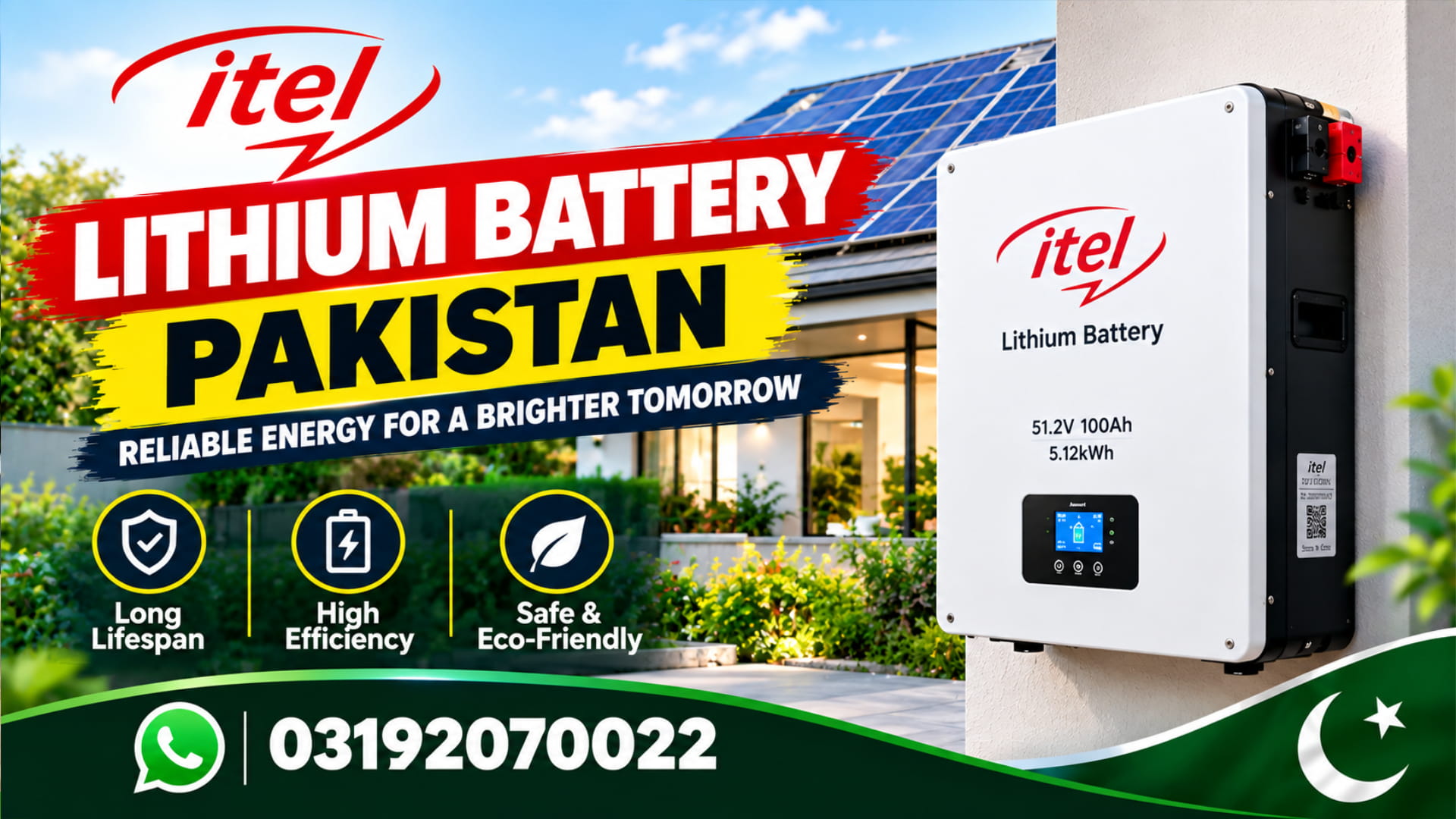
We stock four itel lithium batteries, and the question we get asked most is not about the brand. It is about which one.
That question is easier to answer than most people expect, because the four sizes do not overlap much. Each one has a household shape it fits. The trap is that two of them hold exactly the same amount of energy and are not remotely interchangeable, and that catches people out regularly.
So here is the range laid out properly, what each one suits, and what to confirm before you order. No prices in this guide, because rates move with the exchange rate and cell markets. WhatsApp us now for the latest price of the battery at 03192070022 for the current figure on any of them.
The four sizes, in kilowatt hours
Amp hours alone tell you nothing until you attach a voltage. Energy is what you actually consume, and energy is volts multiplied by amp hours.
Use the true nominal voltages here, not the labels. A “24V” LiFePO4 pack is eight cells at 3.2V, so 25.6V. A “48V” pack is sixteen cells, so 51.2V.
itel 24V 100Ah — 25.6V × 100Ah = 2.56 kWh
itel 24V 200Ah — 25.6V × 200Ah = 5.12 kWh
itel 48V 100Ah — 51.2V × 100Ah = 5.12 kWh
itel 48V 314Ah — 51.2V × 314Ah = about 16.08 kWh
Then subtract for reality. A good LiFePO4 pack gives you 80 to 90 percent depth of discharge, and your inverter loses another 10 to 15 percent converting DC to AC. Working figures for what actually reaches your appliances: roughly 2 kWh, 4 kWh, 4 kWh and 12.5 kWh respectively.
The trap in the middle of the range
Look at the two middle entries again. The 24V 200Ah and the 48V 100Ah hold identical energy: 5.12 kWh each.
They are not alternatives. You cannot choose between them on merit, because the choice is not yours to make. Your inverter decides.
A 24V inverter needs a 24V bank. A 48V inverter needs a 48V bank. There is no adapter, no workaround, and no configuration setting that bridges the two. Buy the wrong voltage and the battery is unusable with your equipment, regardless of how much energy it holds.
There is a second point that matters if you are buying the whole system at once. With lead acid, you could wire batteries in series to build up to a higher voltage. Lithium packs contain a BMS, and most drop-in packs are not designed for series connection, so you generally cannot combine two 24V units to make 48V. That means the voltage you pick today is the voltage you are stuck with for the life of the pack.
Our full comparison of 24V versus 48V lithium systems works through when each makes sense. The short version: below about 2KW of load and staying there, 24V is efficient and appropriate. At or near 3KW, or with any chance of adding air conditioning, choose 48V.
itel 24V 100Ah: the small setup
About 2.56 kWh nominal, roughly 2 kWh delivered.
This is the entry point, and it suits a genuinely small load. A shop, an office with a few computers and lights, a single room, a small flat, or a household running fans and lights without a fridge on backup.
At a 400W evening load, 2 kWh delivered gives you roughly five hours. At 250W it stretches past eight.
Pair it with an inverter in the 1KW to 2KW range. Do not buy this expecting it to carry a whole house, and do not buy it because it is the cheapest itel option if your load is actually bigger. Undersizing means you cycle the pack flat every night, and running a battery to empty daily is the fastest way to age it.
itel 24V 200Ah: the larger 24V household
About 5.12 kWh nominal, roughly 4 kWh delivered.
This exists for one specific situation: you have a 24V inverter and you need more than 2.56 kWh of storage behind it. That covers a household running several fans, a full set of lights, a refrigerator and general electronics through an evening, all on 24V equipment.
If you already own a 24V inverter, this is your upgrade path, and it is a legitimate one. You get the same usable energy as the 48V 100Ah unit without replacing your inverter.
If you are buying the whole system fresh and your load is at this level, think carefully before committing to 24V. At 3000W a 24V system draws 125 amps where a 48V system draws about 62. That difference shows up in cable thickness, breaker ratings, terminal heat and resistive losses, which rise with the square of current. The 24V 200Ah is the right answer for an existing 24V system and usually the wrong answer for a new one.
itel 48V 100Ah: the default choice
About 5.12 kWh nominal, roughly 4 kWh delivered.
This is the one most Pakistani households end up buying, and the reason is that the 5KW hybrid inverter has become the standard residential installation. This pack is built for exactly that pairing.
What 4 kWh delivered covers: six fans, a dozen LED lights, an inverter refrigerator, a television and assorted chargers comes to roughly 900W, which runs for about four and a half hours. Trim to four fans and a shorter TV evening and you comfortably clear six hours.
What it does not cover on its own is air conditioning. A 1.5 ton inverter AC pulls 1000 to 1500W in steady operation, so three hours of AC alone is 3 to 4.5 kWh, which is the entire pack before anything else runs. Households wanting AC on backup run two of these in parallel or move up the range.
The critical specification here is continuous discharge current, not capacity. A 5KW inverter at full output pulls roughly 98 amps at 51.2V, closer to 105 to 110 once you account for losses. The itel 48V 100Ah units we supply are rated for 100A continuous with higher pulse capability for motor and compressor startup, which is what makes them suitable for a 5KW inverter rather than merely compatible with one. Our 48V 100Ah buying guide explains why that number decides whether a battery is fit for purpose.
One thing to check before you order this model
“itel 48V 100Ah” is not a single product. itel builds this capacity in several variants: wall-mounted, stackable, and rack-format ESS versions, with different model codes and meaningfully different specifications between them. Ingress protection ratings differ across variants, with some rated for indoor use only and others sealed to IP65 for dusty or semi-exposed installations. Published cycle-life figures also vary by variant.
That matters. An indoor-rated unit is fine in a shaded utility room and a poor choice for a semi-exposed installation in Sindh or south Punjab, where dust is a permanent condition. So when you enquire, tell us where it will physically live and we will confirm the right variant and model code rather than shipping whichever version happens to be in stock.
itel 48V 314Ah: the whole-house unit
About 16 kWh nominal, roughly 12.5 kWh delivered.
This is a different class of product. It suits a large home running multiple air conditioners, a small commercial premises, a clinic, an office, or anyone who wants genuine overnight independence rather than an evening of backup.
Twelve and a half delivered kilowatt hours covers two inverter ACs for several hours alongside a full household load, or a modest load right through the night with margin left.
Two advantages over stacking smaller packs. Fewer units means fewer interconnections, and connections are where most solar installations actually fail. And one unit means one warranty rather than several with different start dates.
The constraint is charging. A 5kW array in Pakistan produces somewhere around 18 to 25 kWh on a clear summer day and drops to roughly 10 to 15 kWh in late December. A 16 kWh bank behind a 5kW array will not reach full charge on short winter days, and a pack that never completes a full cycle ages faster than one that does. If you are buying at this capacity, size the array to match, or accept shallow cycling through winter. The 5kW system sizing guide covers that calculation.
Sizing worked through
Three common households, so you can place yourself.
Fans, lights and electronics, no fridge on backup, six hours. Roughly 400 to 500W. The 24V 100Ah covers this if you are on 24V equipment.
Fans, lights, fridge, TV and chargers, six hours. Roughly 900W, so about 5.4 kWh needed. One 5.12 kWh pack gets you most of the way; trimming the load slightly clears it comfortably. Either the 24V 200Ah or the 48V 100Ah, depending entirely on your inverter.
The above plus one inverter AC for four hours. Roughly 10 to 11 kWh. Two 48V 100Ah packs in parallel, or step to the 48V 314Ah for headroom.
Work out your own figure before you order. List what runs when the grid is down, multiply watts by hours, add about 15 percent for conversion and wiring losses, divide by 1000. Fifteen minutes of arithmetic saves people from buying twice.
Parallel expansion
All the 48V units support parallel connection, and the 48V 100Ah in particular is designed for multi-unit banks with substantial parallel capacity.
If you are stacking, follow four rules. Use the same model and capacity throughout, not a mix. Keep the packs close in age, since an older higher-resistance unit takes less of the load and makes the newer one work harder. Charge both to a similar state before connecting, and check their resting voltages are within about half a volt. And run equal-length cables from each pack to the busbar, because a pack on a shorter cable sits on a lower-resistance path and carries more current on every single cycle.
Also confirm the manufacturer’s maximum parallel count for the specific variant. It is a hard limit, not a guideline.
Installation notes for Pakistani conditions
The same rules apply across all four models, and they matter more here than in the markets these products were designed around.
Set the charge profile to lithium at commissioning, or configure it manually. For a 16S pack, absorption sits around 56.8 to 57.6V, float around 54.4 to 55.2V, cutoff somewhere between 44 and 47V. Disable equalisation entirely, since that stage exists to stir lead acid electrolyte and does nothing for lithium except hold it at excessive voltage. For 24V packs, halve those figures.
Site the pack shaded and ventilated. Cycle-life ratings are measured near 25°C, and a sealed enclosure in direct sun in Multan, Jacobabad or Rahim Yar Khan in June is nowhere near that. Heat is the slow killer of every lithium pack regardless of brand.
If you are in Quetta, Skardu, Ziarat, Kalam or upper KP, ask us about low-temperature charge protection before ordering. Charging LiFePO4 below 0°C causes permanent lithium plating on the anode, and sub-zero winter mornings are routine in those areas.
Torque the terminal bolts to specification. At 100 amps, a loose lug generates heat, and heat at a connection is how connections fail.
The chemistry behind all of this, including why LiFePO4 tolerates Pakistani heat better than the lithium in phones and laptops, is covered in our LiFePO4 battery guide.
They hold the same energy, 5.12 kWh each, but they are not interchangeable. Your inverter’s voltage decides which one you can use.
No. Most drop-in lithium packs with an integrated BMS are not designed for series connection. Check the datasheet for the specific model and never assume.
The 48V 100Ah is the standard pairing, or the 48V 314Ah for larger loads. Confirm the continuous discharge rating covers your peak draw of roughly 100 amps.
It depends where it will be installed. Tell us the location and we will confirm the correct model code and ingress ratin
Yes, across Pakistan.
Getting the current rate
Confirm your inverter voltage first, because that eliminates half the range immediately. Then size from your real evening load rather than from the inverter’s rating. Then, on the 48V 100Ah specifically, confirm which variant suits your installation location.
WhatsApp us now for the latest price of the battery at 03192070022 with your inverter model, your city and a rough idea of what you run at night. We will confirm the right model before quoting, and we can supply full specifications for any unit in the range. You can also reach the team through our contact page, or see the current lineup on the products page.
Buy Battery is your trusted battery partner. Premium batteries built for Pakistan’s climate, powering homes, businesses and vehicles nationwide.