
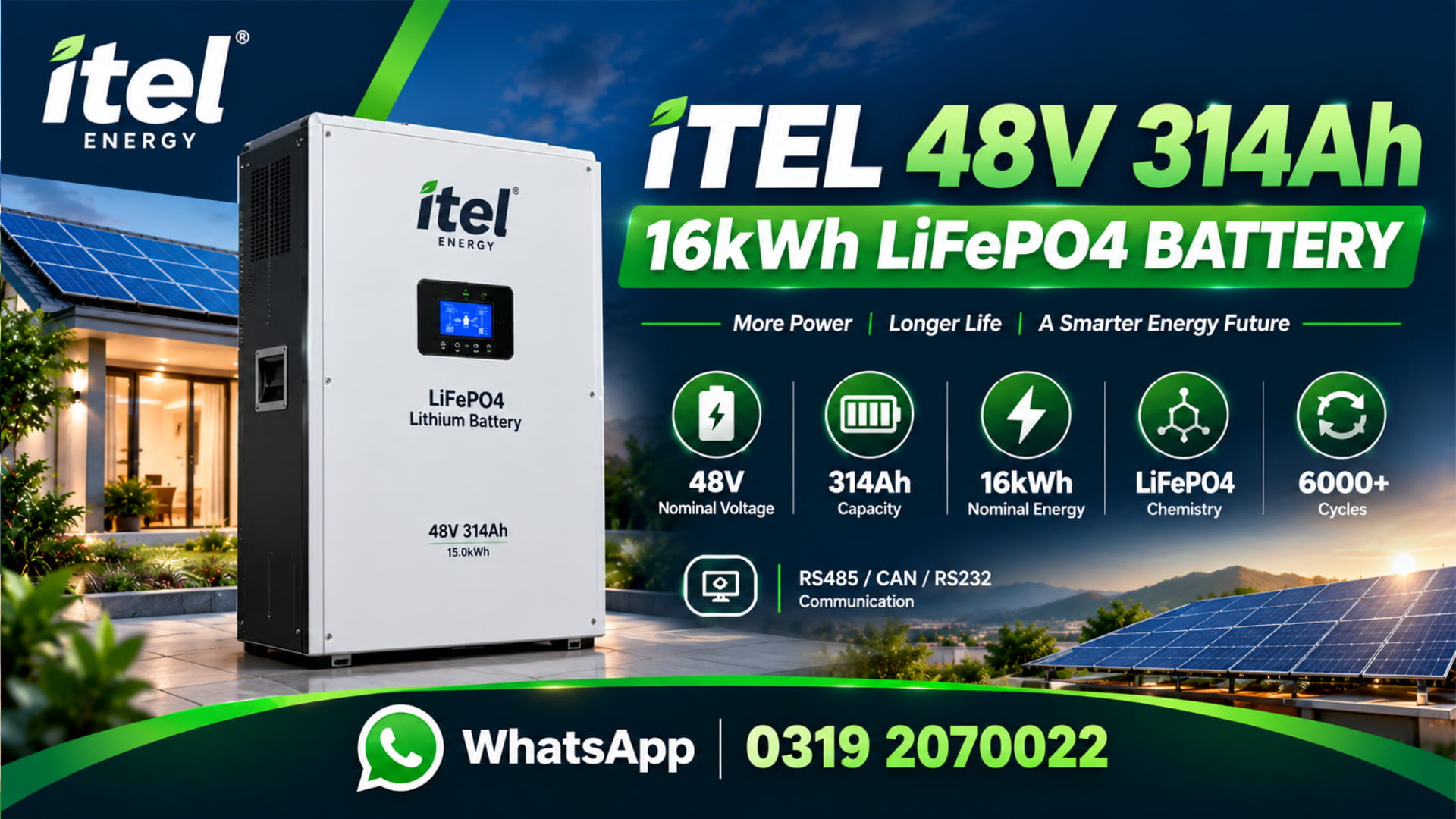
Most households asking about lithium batteries end up looking at the 48V 100Ah class, because most households run a fairly ordinary evening: fans, lights, a fridge, a TV. The itel 48V 314Ah exists for the households and small businesses that do not fit that description, and it is worth understanding on its own terms rather than simply as “the big one.”
This guide covers what it actually delivers, what kind of property it suits, and the specific things to check before ordering one, since a unit at this capacity comes with considerations that smaller packs mostly avoid. No prices here, since rates move with the exchange rate and global cell markets. WhatsApp us now for the latest price of the battery at 03192070022 for the current figure.
If you are still deciding between this size and the rest of the itel range, our itel lineup guide and our head-to-head comparison cover the full range side by side.
The real numbers
A “48V” LiFePO4 pack is actually sixteen cells in series at 3.2V nominal each, which gives a true nominal voltage of 51.2V. Using the correct number rather than the rounded label:
51.2V × 314Ah = 16.08 kWh nominal.
That is not what reaches your appliances. A good LiFePO4 pack gives 80 to 90 percent usable depth of discharge, and your inverter loses another 10 to 15 percent converting DC to AC. Working through both, delivered energy from a full charge lands somewhere around 12 to 13 kWh.
For scale, that is roughly two and a half to three times what a single 48V 100Ah pack delivers, and it is a genuinely different class of storage rather than simply a bigger number on a spec sheet.
What 12.5 kWh actually covers
Numbers are easier to trust once you attach appliances to them.
A household running six fans, a dozen LED lights, an inverter refrigerator, a television and general electronics comes to roughly 900W, and would run on that load alone for well over twelve hours from a full charge, far beyond a normal evening’s need.
Add air conditioning, which is where this capacity earns its place. A 1.5 ton inverter AC draws 1000 to 1500W in steady operation. Two such units running alongside the household load above comes to somewhere around 3.5 to 4.5 kW. At that draw, 12.5 kWh delivers roughly three to three and a half hours of genuine dual-AC comfort, or considerably longer if only one AC is running or the load is more moderate.
For a small commercial premises, a clinic, a boutique, a small restaurant kitchen’s lighting and refrigeration, or an office running computers, lighting and a couple of AC units through the working day, this capacity is frequently sized to bridge an entire outage rather than just a few hours of it.
Who this size actually suits
Four situations where the 314Ah is the right starting point rather than an oversized purchase.
A large home running two or more air conditioners on backup. This is the most common reason households step up to this capacity. A single 48V 100Ah pack is exhausted by one AC in a few hours. This size makes multi-room cooling through an outage realistic.
Genuine overnight independence for a moderate load. A household wanting to run comfortably from evening through morning without touching the grid, even without heavy AC use, fits well here.
Small commercial premises. Clinics, shops, small offices and similar businesses where an outage during working hours has a real cost, and where a single well-specified unit is simpler to manage than a bank of smaller ones.
Anyone consolidating an existing multi-pack bank. If you already run two or three 48V 100Ah packs in parallel and want to simplify the installation, or free up wall or floor space, a single 314Ah unit covers similar or greater capacity in one enclosure.
If your load is closer to a normal household evening without AC on backup, this is almost certainly more battery than you need, and the 48V 100Ah is the more sensible starting point.
Construction: why a large single pack is often simpler internally
Worth knowing, because it is a genuine advantage of buying at this capacity rather than assembling the same total from many small packs.
314Ah sits in the range of large-format prismatic cell capacities that the stationary storage industry has broadly standardised on, alongside similar sizes like 280Ah and 304Ah. Packs built at this capacity are commonly assembled as a straightforward sixteen cell series string, one large cell per position, rather than multiple smaller cells grouped in parallel to reach the rated capacity.
That matters because every parallel group inside a pack is another point where cells need to be matched to each other, and another set of internal connections that can develop resistance over time. A pack built from single large cells in series has fewer internal joints and a comparatively simpler balancing job for the BMS, because it is balancing sixteen cells rather than balancing sixteen groups of paralleled cells against each other.
This is a general characteristic of packs built at this capacity class rather than a guarantee about any specific unit, so ask your seller to confirm the actual internal configuration, written as something like 16S1P, before you order. We can confirm this for the units we supply.
The discharge current question, at this scale
The same rule that applies to every lithium pack applies here, and it matters more as the loads get larger.
Two ACs plus a household load might draw 4 to 4.5 kW continuously. At 51.2V nominal, that is roughly 80 to 90 amps, and considerably more during the brief surge when a compressor starts. A pack at this capacity needs a continuous discharge rating that comfortably covers that figure, not just enough to cover the stored energy total.
Ask for the continuous discharge current in amps and the peak current with its permitted duration, in writing, rather than assuming a larger capacity automatically means a higher current rating. The two specifications are related but not identical, and a pack can hold plenty of energy while still being under-specified for a heavy simultaneous load.
Sizing your array to match
This is the constraint people miss most often at this capacity, and it is worth taking seriously before you commit.
A 5kW solar array in Pakistan produces roughly 18 to 25 kWh on a clear summer day, dropping to about 10 to 15 kWh in late December when days are short and irradiance is lower. A 16 kWh bank behind a 5kW array is asking for more than three quarters of a summer day’s generation, and on a winter day it may not be possible to fill the bank at all once daytime household consumption is accounted for.
A pack that never completes a full charge cycle ages faster than one that does, so pairing this capacity with an undersized array is not simply a matter of slower charging. It is a genuine factor in how long the battery lasts.
As a working guide, an array in the 8kW to 10kW range is a more realistic match for a 314Ah bank if you want it reliably full through the winter as well as the summer. If your existing array is smaller and you are not planning to expand it, be realistic about how often this pack will actually reach 100 percent, particularly between November and February. Our 5kW system sizing guide works through the generation side of this calculation in more detail.
One large unit versus several smaller ones in parallel
A fair question at this capacity, and one worth thinking through rather than assuming the answer.
The single 314Ah wins on fewer connections, since every parallel joint is a place heat and resistance can build over years, and connections fail more often than cables do. It also means one warranty with one start date rather than several beginning at different times, and no need to match ages or states of charge between multiple packs.
Several 48V 100Ah packs in parallel win on flexibility, since you can buy incrementally as budget or need grows, and on redundancy, since a fault in one pack does not take down the whole bank while it is repaired. Discharge current also adds cumulatively, which can suit a household with particularly heavy simultaneous surge loads.
Our head-to-head comparison, linked above, runs this exact matchup in full, including the specific rules for connecting multiple packs correctly if you go that route.
Physical installation notes
A unit at this capacity is a serious piece of equipment, and it deserves more thought at installation than a smaller pack.
Confirm the weight and mounting method before you commit to a location. Units at this capacity are frequently floor-standing rather than wall-mounted, and if wall mounting is offered, confirm the wall construction can bear the load safely, particularly on upper floors. Moving and positioning a unit this size is typically a two-person job.
Site it shaded and ventilated, as with every lithium pack. Cycle-life ratings are measured near 25°C, and a large sealed enclosure retains heat more than a small one does, which makes shading and airflow even more important at this size.
If you are in a genuinely cold region, Quetta, Skardu, Ziarat, Kalam or similar, confirm low temperature charge protection before ordering. Charging LiFePO4 below 0°C causes permanent lithium plating on the anode, and the consequences of that damage scale with the size of the pack.
Confirm the ingress protection rating matches where the unit will actually live, particularly if it is going anywhere semi-exposed rather than fully indoors.
What to confirm before ordering
Given the scale of this purchase, treat these as non-negotiable questions rather than nice-to-haves.
The exact internal cell configuration, ideally 16S1P, and the cell brand and grade behind it.
The continuous and peak discharge current ratings in amps, checked against your actual combined AC and household load.
Whether the BMS communicates with your specific inverter model over CAN or RS485, since at this capacity an inaccurate voltage-based state of charge estimate is a bigger practical problem than it is on a small backup pack. Our hybrid inverter compatibility guide covers what to check on the inverter side.
The physical weight, mounting requirements, and dimensions, confirmed against the actual installation space.
Who backs the warranty and whether replacement parts are stocked in Pakistan, given that a fault on a unit this size is a considerably larger inconvenience than a fault on a smaller pack.
For a household with lights, fans, a fridge and general electronics, comfortably, likely for well over twelve hours. With two air conditioners running, expect a few hours of genuine dual-AC comfort rather than an all-night run, depending on your specific load.
Yes, provided the pack’s continuous discharge rating covers your peak draw. The inverter caps how much power you can draw at once; the battery needs to be rated to supply that current continuously.
Not reliably through winter. This capacity suits an array in the 8kW to 10kW range if you want it consistently full year round. A 5kW array will charge it well in summer and only partially in December and January.
For a settled, known load, generally yes, on fewer connections and one warranty. For a growing or uncertain load, multiple smaller packs give more flexibility. Our full comparison works through this matchup in detail.
It is a substantial unit, typically floor-standing, and moving it is usually a two-person task. Confirm exact weight and mounting requirements before choosing a location, especially on an upper floor.
Yes, across Pakistan.
Getting a current quote
Confirm your combined AC and household load, and check it against the pack’s continuous discharge rating rather than just its capacity. Plan your array size alongside it if you want it reliably full through winter. And confirm the internal cell configuration and warranty backing before committing, given the scale of the purchase.
WhatsApp us now for the latest price of the battery at 03192070022 with your load, your inverter model and your city, and we will confirm the right configuration before quoting. You can also reach the team through our contact page, or see the full range on the products page.
Buy Battery is your trusted battery partner. Premium batteries built for Pakistan’s climate, powering homes, businesses and vehicles nationwide.