
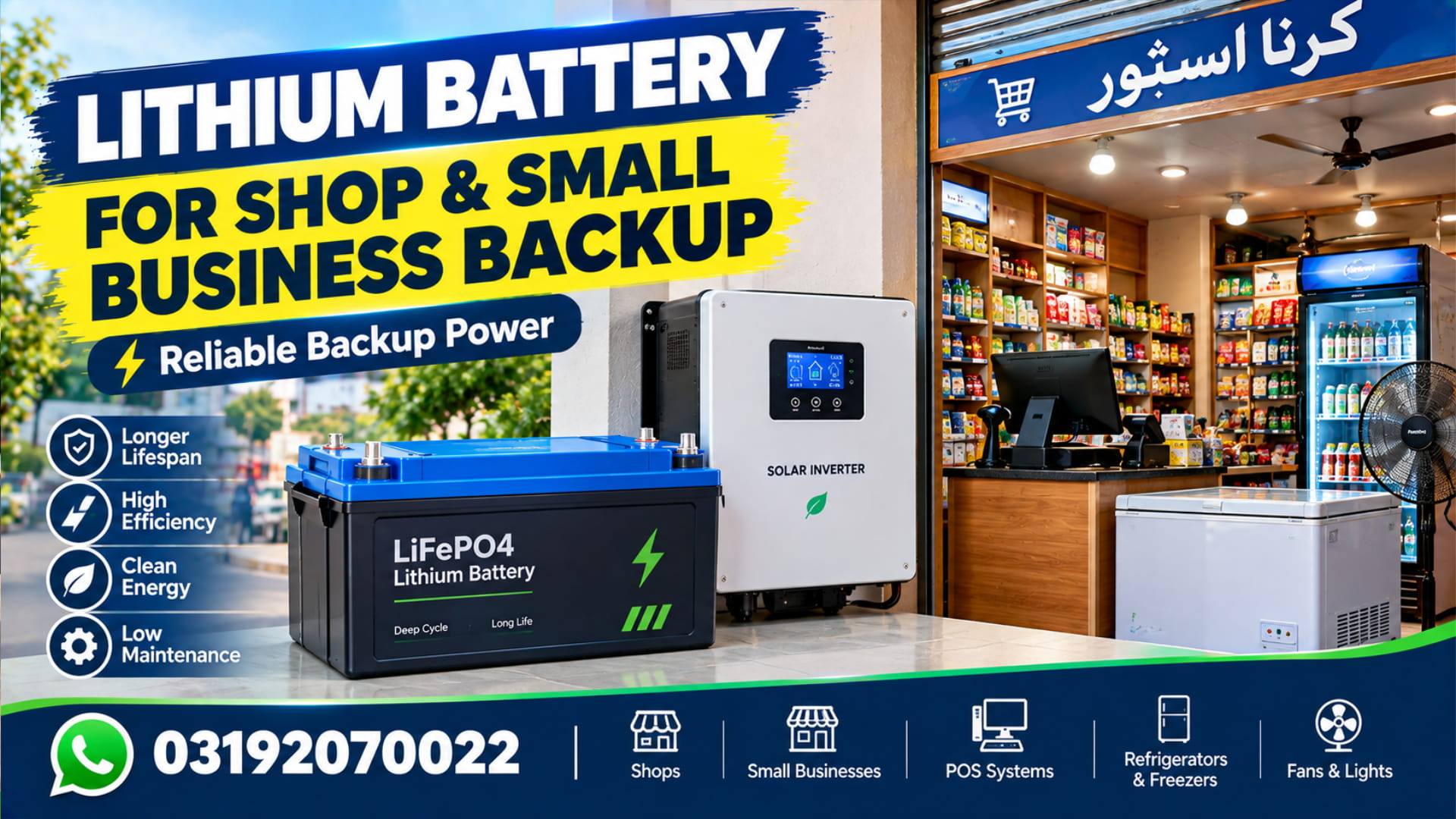
A household buying a solar battery is usually optimising comfort. A shop buying one is usually protecting revenue. That difference changes almost everything about how you should size and choose it.
A household that runs out of backup power at 11pm loses some comfort for the rest of the night. A shop that loses power mid-afternoon loses sales, spoiled stock, a stalled POS system, or a clinic loses refrigerated medicine and a functioning treatment room. The calculation is not really about kilowatt hours. It is about what an hour of downtime actually costs your business, and sizing backward from that number.
This guide is written for that calculation specifically: shops, clinics, small offices, salons, restaurants and similar small commercial premises. No prices here, since rates move weekly. WhatsApp us now for the latest price of the battery at 03192070022 once you know what you need.
Start from what you cannot afford to lose
Before any wattage arithmetic, separate your equipment into what must stay on and what can wait.
Critical load is anything whose interruption costs you directly and immediately. A POS terminal and card machine mid-transaction. Refrigeration holding stock, medicine or ingredients that spoil. Lighting adequate to keep serving customers or operating safely. A router and modem if online orders or card payments depend on connectivity. In a clinic, monitoring equipment, a fridge holding vaccines or medication, and enough lighting to continue safely.
Deferrable load is everything else. Decorative lighting, signage, air conditioning beyond what keeps perishable stock safe, water heaters, non-essential electronics.
Size your battery around the critical load and treat everything else as a bonus if the battery has headroom. This single step is where most oversized and undersized commercial purchases go wrong: people either size for everything running simultaneously, which is expensive and rarely necessary, or size only for lighting, which leaves the actual revenue-generating equipment unprotected.
Working out the number
The method is the same one we use for households, applied to different equipment.
List each critical item, its wattage, and how many hours a day it needs to run on battery. Multiply watts by hours for each, add them together, then add about 15 percent for inverter conversion and wiring losses. Divide by 1000 for kilowatt hours.
A few common commercial loads and their typical draw, to help you build the list.
A POS terminal and card machine together draw roughly 30 to 50W. A barcode scanner and receipt printer add another 20 to 30W. A desktop computer with a monitor is commonly 150 to 250W, a laptop closer to 50 to 65W. A small commercial upright refrigerator or chest freezer averages 150 to 300W across a day depending on size and how often the door opens, though the compressor’s running wattage is higher during active cooling cycles. A wifi router and modem draw around 15 to 25W. LED shop lighting runs roughly 15 to 30W per fixture depending on size and count. A hair dryer or styling tool in a salon can pull 1000 to 1800W, but typically only briefly and intermittently rather than continuously. A small espresso machine idles around 200 to 300W and spikes higher when actively brewing. A photocopier or laser printer in standby draws relatively little but can spike to 800 to 1200W when actively printing.
Multiply what applies to your business by the hours you want covered, and you have a working target.
Three worked examples
A small retail shop. POS system, card machine, barcode scanner and receipt printer at roughly 100W combined, a router at 20W, and four LED light fixtures at 25W each, totalling 100W. Call it 220W. For a typical four to six hour outage, that is roughly 1 to 1.3 kWh needed, plus losses. A single 24V 100Ah lithium pack, delivering around 2 kWh, covers this comfortably with room to spare, and pairs with a modest 1KW to 2KW inverter.
A pharmacy or small clinic. The load above, plus a medical refrigerator holding vaccines or temperature-sensitive medication, averaging perhaps 150 to 200W across a day, plus consulting room lighting and possibly basic monitoring equipment. Call it 500 to 600W for six to eight hours of coverage, which comes to roughly 3.5 to 4.5 kWh. A 48V 100Ah pack, delivering around 4 kWh, is a sensible fit here, and the higher voltage suits the slightly heavier combined load better than staying on 24V.
A small restaurant or café. POS and card systems, lighting, refrigeration for ingredients, and a coffee machine running intermittently through service hours. This load is often heavier and spikier than a simple retail shop, commonly 1 to 1.5 kW during active service. Covering a lunch or dinner service through an outage, three to four hours, needs roughly 4 to 6 kWh. This sits at the upper end of what a single 48V 100Ah pack comfortably covers, and many businesses at this load level choose two packs in parallel for genuine headroom during a busy service rather than running close to the edge of a single unit’s capacity.
If your business does not match any of these closely, the same method applies: list your actual critical equipment, work the arithmetic, and size to that figure rather than to a generic recommendation.
Why lithium specifically suits commercial backup
The case for lithium over lead acid is generally stronger in a commercial setting than in a household one, for reasons specific to how a business actually uses the battery.
Commercial backup often cycles more unpredictably than a household’s evening routine, sometimes daily during a bad load shedding stretch, sometimes rarely. Lead acid punishes irregular, unpredictable deep discharge particularly badly, since its cycle life assumes a controlled discharge depth that a business under genuine pressure to stay open is unlikely to respect.
A shop cannot usually accommodate the maintenance a lead acid bank needs. Topping up distilled water, ensuring ventilation, and periodic terminal cleaning require a level of routine attention that is easy to promise and hard to sustain in a working business, and the batteries that get neglected are the ones that fail early.
Space matters more in commercial premises than in most homes. A shop’s storeroom or back office is valuable square footage, and lithium’s much lighter weight and smaller footprint for the same usable energy is a genuine operational advantage, not just a convenience.
And the cost of downtime is usually higher for a business than for a household evening, which changes the economics of paying more upfront for a battery that reliably works when needed rather than one that might be at 60 percent of its rated capacity after eighteen months of hard, irregular use. Our broader comparison of lithium versus tubular batteries covers the underlying reasons in more depth.
Matching the battery to your actual outage pattern
Two businesses with identical loads can need different batteries depending on how their power actually fails.
If outages in your area are short and frequent, several short interruptions through the day rather than one long one, prioritise a battery and inverter combination with fast, reliable transfer, so equipment does not glitch or restart with every switch. This matters particularly for POS systems and computers, where a rough transfer can cause a card transaction to fail or a system to need restarting mid-sale.
If outages are long and infrequent, a planned load shedding block of several hours, prioritise total capacity over transfer smoothness, since you are optimising for lasting through the whole block rather than for handling frequent brief switches.
If your business runs across multiple locations with a shared pattern, standardising on the same battery and inverter configuration across sites simplifies maintenance, spares, and staff familiarity considerably, and is worth factoring into your decision even if a single site’s load might suggest a slightly different size.
Sizing the inverter alongside the battery
The battery capacity answers how long. The inverter rating answers how much at once, and getting this wrong is a common and avoidable mistake in commercial installations.
Add up the simultaneous peak draw of everything that might run together, not the average. A shop with four light fixtures, a POS system and a small fridge rarely runs all of it at true peak simultaneously, but a salon with two styling tools running at once, a fridge compressor cycling on, and full lighting can genuinely stack close to its rated maximum. Size the inverter with headroom above your realistic peak, not your average, since running an inverter at its absolute ceiling constantly shortens its working life and leaves no margin for a compressor startup surge landing at the wrong moment.
For most shop and small clinic setups, a 1KW to 3KW inverter on a 24V bank, or a 3KW to 5KW inverter on a 48V bank for heavier or spikier loads, covers the range described above. Our guide to 24V versus 48V systems explains when each voltage makes sense.
Practical business considerations beyond sizing
A few things that matter for a commercial installation specifically, beyond the technical sizing.
Ask about warranty response time, not just warranty length. A household can tolerate a slow warranty process more easily than a business losing trading days to a battery fault. Ask what a realistic repair or replacement timeline looks like and whether local stock exists for common faults, a point covered in more depth in our warranty claims guide.
Consider a service or maintenance visit at commissioning to confirm charge settings are correct and the system is performing as expected, rather than assuming a fresh installation is automatically fine. This is a small cost against a real risk if the business genuinely depends on the backup working when needed.
Think about physical security if the battery is visible or accessible to customers or the public. A battery bank in a customer-facing area is best sited discreetly, both for aesthetics and to reduce tampering risk.
And keep your invoice, serial number and installation date on file from day one. If you ever need to make a claim, that documentation is what turns a dispute into a straightforward process.
That depends entirely on your local outage pattern rather than a fixed rule. Size for your longest common outage, not the worst outage of the year, and accept that exceptional events may need generator support or load shedding on your side.
Below roughly 2KW of combined load, 24V is efficient and cost-effective. Above that, particularly for salons, cafés or clinics with heavier equipment, 48V is the more sensible choice.
Only if you size for it specifically. AC is a heavy, continuous draw, and most shop-sized battery purchases prioritise critical equipment over cooling, adding AC coverage only if budget and space allow a significantly larger bank.
Lithium packs in the 48V range can generally be expanded by adding another pack in parallel, provided you match the model and capacity. Sizing with some headroom from the start avoids needing to replace rather than expand later.
Usually yes, on a multi-year basis, because commercial use tends to be less gentle and more irregular than household use, which is exactly where lead acid loses life fastest. It also avoids the maintenance a busy shop is unlikely to keep up with consistently.
Yes, across Pakistan.
Getting a quote for your business
List your genuinely critical load, work out the hours you need covered, and size the battery to that figure with modest headroom rather than to every piece of equipment in the building.
WhatsApp us now for the latest price of the battery at 03192070022 with your equipment list, your typical outage length and your city, and we will recommend a configuration before quoting. You can also reach the team through our contact page, or see the current range on the products page.
Buy Battery is your trusted battery partner. Premium batteries built for Pakistan’s climate, powering homes, businesses and vehicles nationwide.