
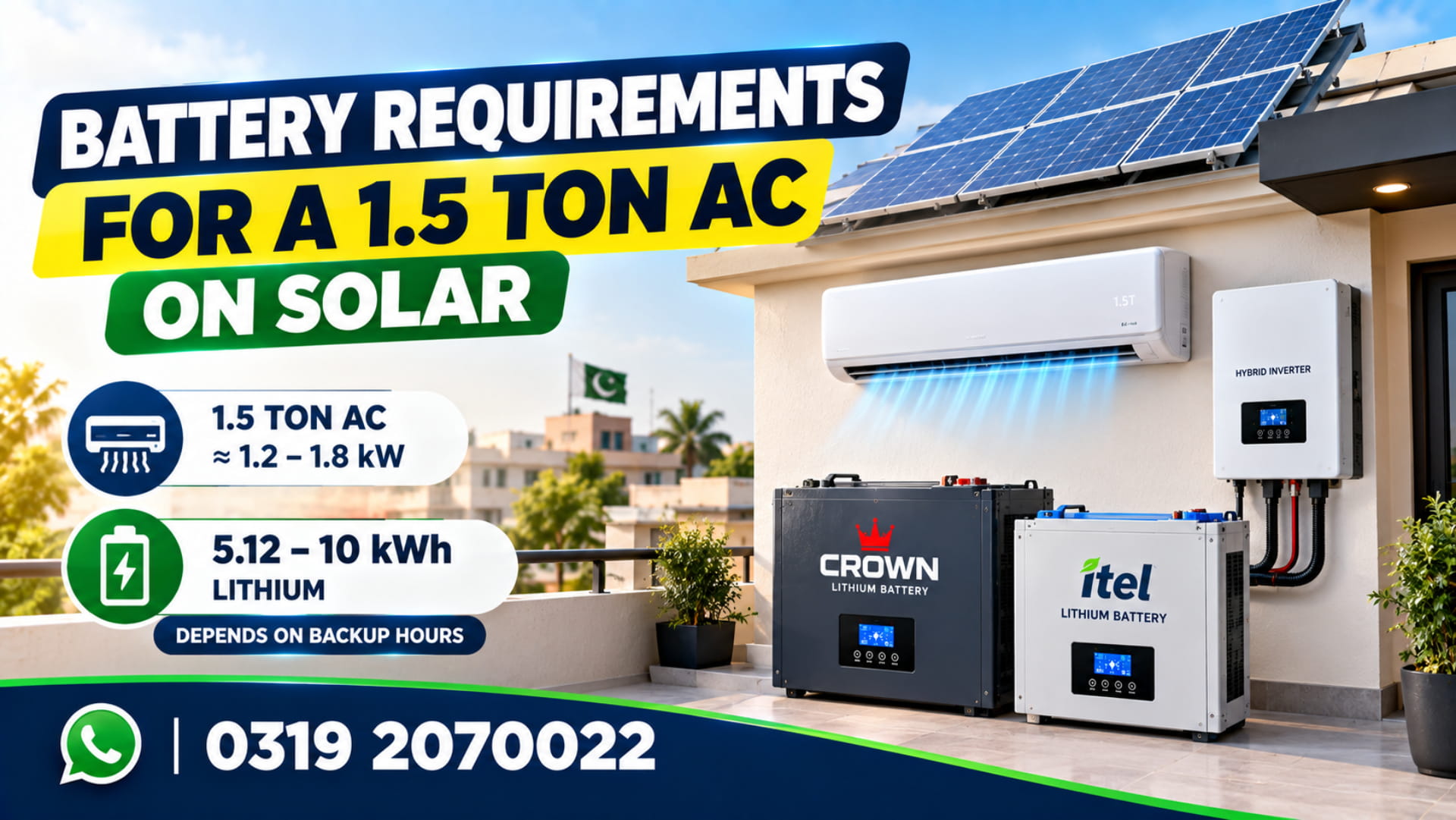
Running an air conditioner overnight on stored solar energy is the request that decides most home battery sizes in Pakistan. A fan load fits comfortably inside one battery. A 1.5 ton AC does not, and it is the reason a household that bought “enough” storage finds the bank empty at two in the morning.
This guide works out what a 1.5 ton AC actually asks of a solar and battery system: the power it draws, the energy it uses over a night, the battery that covers it, the surge a non-inverter AC adds, and the panels needed to refill the bank the next day. The sizing arithmetic is shown so you can redo it for your own room. No prices appear here, since rates move with the exchange rate. Once you know the size, WhatsApp us now for the latest price of the battery at 03192070022.
Start with the AC itself
Everything else follows from two questions: is the AC an inverter model, and how many hours will it run on battery?
An inverter AC varies its compressor speed. It draws more power while pulling a hot room down, then settles to a much lower steady draw. A non-inverter (fixed-speed) AC runs its compressor at full speed and cycles on and off, and it draws a large startup surge every time the compressor kicks in.
For planning, a 1.5 ton inverter AC is usually taken at roughly 1000 to 1500W in steady operation, and it can briefly draw more while cooling a hot room. A non-inverter 1.5 ton unit draws in the same region when running but needs a surge several times higher at startup. The nameplate on your unit and a plug-in power meter give far better numbers than any rule of thumb, so check them if you can.
From watts to a night’s energy
Energy is power multiplied by time. Take a 1.5 ton inverter AC at 1.2 kW, a middle figure within that range, and run it for different lengths of time:
- 3 hours uses about 3.6 kWh.
- 4 hours uses about 4.8 kWh.
- 6 hours uses about 7.2 kWh.
- 8 hours uses about 9.6 kWh.
That is the energy your appliances receive, and the battery has to supply more than that, because some is lost in depth-of-discharge limits and inverter conversion. The rest of the house does not stop either. Fans, lights, a fridge and a television typically add another 500 to 900W on top of the AC.
Turning delivered energy into battery size
A LiFePO4 pack allows roughly 80 to 90 percent usable depth of discharge, and the inverter loses another 10 to 15 percent converting battery power to the AC your appliances use. Working with 85 percent DOD and 13 percent inverter loss, one nominal kWh of battery delivers about 0.74 kWh to your appliances. To find the nominal battery you need, divide the energy you want delivered by 0.74.
Run that for the AC alone at 1.2 kW:
- 3 hours: 3.6 kWh delivered needs about 4.9 kWh nominal, which is one 48V 100Ah pack (5.12 kWh).
- 4 hours: 4.8 kWh delivered needs about 6.5 kWh nominal, which is two 48V 100Ah packs (10.24 kWh).
- 6 hours: 7.2 kWh delivered needs about 9.7 kWh nominal, which is two 48V 100Ah packs, just inside.
- 8 hours: 9.6 kWh delivered needs about 13 kWh nominal, which is three 48V 100Ah packs (15.36 kWh) or a single larger 48V 314Ah unit.
Now add the household. An AC at 1.2 kW plus 700W of other load is 1.9 kW. Over six hours that is 11.4 kWh delivered, or about 15.4 kWh nominal. That is right at the capacity of three packs (15.36 kWh), so in practice you want three packs with some margin, or a large single unit. Our 48V 100Ah battery guide shows what a single pack runs without the AC, which helps you see how much of the bank the AC is taking.
These are planning numbers. A real AC cycles, so its average draw over a night is often below its peak figure, and a well-insulated room that holds its temperature lets it ease off. If you would rather not do this by hand, our battery bank sizing calculator takes your appliance list and hours and returns the pack count with the same assumptions.
Why overnight AC is such a big ask
One 48V 100Ah pack delivers around 4 kWh. A 1.5 ton inverter AC alone can use most of that in three to four hours. This is the central fact of AC on solar. A household with a single pack and an AC will get a few hours of cooling and little else, while the same household without the AC gets a whole evening.
That is not a flaw in the battery, it is the energy cost of cooling. Two things reduce it: running the AC at a higher set temperature, and using it for the first part of the night to cool the room before switching to fans. Both can stretch a given bank noticeably.
The inverter must carry the AC and everything else
The battery stores energy, but the inverter delivers power, and it needs to carry the AC and your other loads at once. A 1.5 ton AC at 1.2 kW plus 700W of other load is 1.9 kW, comfortably inside a 5KW hybrid inverter. A smaller 3KW inverter still copes with an inverter AC but leaves little spare for a second AC or a water pump starting at the same moment.
A non-inverter AC changes the picture. Its compressor’s startup surge can be several times its running draw, which means the inverter must handle a momentary spike in the range of several kilowatts. A 5KW hybrid inverter is the sensible floor for a non-inverter 1.5 ton unit, and the battery must also be able to supply the surge, so check its peak discharge rating along with the continuous figure. If you can choose, an inverter AC is far gentler on a solar system than a fixed-speed one.
The battery’s discharge current
Capacity says how long, and discharge current says whether the battery can deliver the power at all. At 48V, a 1.9 kW load draws about 37 amps, which any 48V 100Ah pack handles easily. The demand rises when the AC shares a 5KW inverter with other heavy loads, or when a non-inverter AC starts, and then the continuous and peak ratings matter.
A 5KW inverter at full output draws roughly 98 to 110 amps from a 48V bank, which is right at the limit of a pack rated 100A continuous. Households that run the AC alongside other heavy loads benefit from two packs in parallel, which share the current. Our guide on how many batteries a 5kW inverter needs works through that arithmetic.
Battery and inverter must talk to each other
A bank sized for an AC cycles deeply every night, so it matters that the inverter knows the true state of charge. LiFePO4 holds roughly 52 to 53V through most of its range, so an inverter guessing from voltage gives little warning before the bank runs flat. A battery with CAN or RS485 communication reports the real figure, so the inverter charges and cuts off at the right point.
Support depends on your exact inverter model and firmware, so give us both when you enquire. Our guide to pairing a battery with a 5KW hybrid inverter covers what to check.
The panels: refilling the bank each day
A battery is only half of a solar AC system. Whatever the AC takes overnight, the panels must put back the next day, while also running the daytime load.
As a rough guide, a 4 kWh daily recharge takes around 1 kW of panels and a 12 kWh recharge takes around 3 kW, assuming about four to five effective full-sun hours and some charging losses. Pakistan’s irradiance is generous, but cloud, dust and heat all trim the output, so leave margin. If you also run the AC in the daytime, directly off the panels, that load comes off the top before any charging happens, which pushes the array size up.
A household that wants overnight AC from a roughly 13 kWh nominal bank, plus daytime use, will often need an array in the range of 5 to 6 kW. That varies with roof space, shading and how much you run the AC in the day, so treat it as a starting point rather than a fixed answer. A solar installer can size the array against your roof, and we can confirm the battery side.
Keep the bank healthy under an AC load
An overnight AC means a deep cycle every day, which is the hardest regular duty a battery faces. A few habits keep it healthy. Install the battery somewhere shaded and ventilated, since heat accelerates ageing and an AC-sized bank works hard. Size it with some headroom rather than at the very edge, so it is not drained to its low-voltage cutoff every night. And use correct lithium charge settings on the inverter, with equalisation off.
In cold regions, confirm low-temperature charge protection, because charging LiFePO4 below 0°C causes permanent damage. In winter an AC is less likely to be used, but the same battery still has to be protected from freezing charge on cold mornings.
Worked example: a bedroom AC and a normal evening
Take a household with a 5KW hybrid inverter, a 1.5 ton inverter AC at 1.2 kW and a baseline load of fans, lights, a fridge and a television of about 700W. They want the AC from 11pm to 5am, six hours, and the house load from 6pm to 11pm, five hours.
The evening without AC is 0.7 kW for five hours, or 3.5 kWh. The night with AC is 1.9 kW for six hours, or 11.4 kWh. The total delivered is 14.9 kWh, and dividing by 0.74 gives about 20 kWh nominal.
That is four 48V 100Ah packs (20.48 kWh) or a larger 314Ah unit plus a pack. The same household without the AC needs only one pack. It is a useful illustration of why an AC changes the project, and why it is worth deciding whether the AC needs to run all night, or only for the first few hours to cool the room.
When it is better to rethink the plan
If the sizing lands somewhere uncomfortable, there are cheaper levers than a bigger battery.
- Cool the room with the AC in the first hours and switch to fans after midnight.
- Raise the thermostat set point, since each degree saves a noticeable share of compressor energy.
- Improve the room’s insulation, shading and sealing so the AC cycles off more.
- Choose an inverter AC if you currently run a fixed-speed one.
Each of these lowers the energy you must store, which is always cheaper than storing more.
For a 1.5 ton inverter AC at about 1.2 kW, one 48V 100Ah pack covers roughly three hours, two cover about six, and three cover a full eight-hour night. Add your other loads on top.
No. One pack delivers around 4 kWh, which a 1.5 ton AC alone can use in three to four hours.
Yes. An inverter AC avoids the large startup surge, draws less on average, and needs a smaller inverter and battery for the same cooling.
A 5KW hybrid inverter is the comfortable choice, since it carries the AC and your other loads together and gives room for a non-inverter AC’s startup surge.
It depends on how much energy you recharge each day. As a rough guide, about 1 kW of panels per 4 kWh of daily recharge, plus margin for dust, heat and cloud.
Yes, nationwide.
Get your AC bank sized
Tell us your inverter model, your AC type and hours, your other evening load and your city, and we will confirm the pack count and the configuration before quoting. WhatsApp us now for the latest price of the battery at 03192070022. You can browse the current range on the products page.
Buy Battery is your trusted battery partner. Premium batteries built for Pakistan’s climate, powering homes, businesses and vehicles nationwide.