
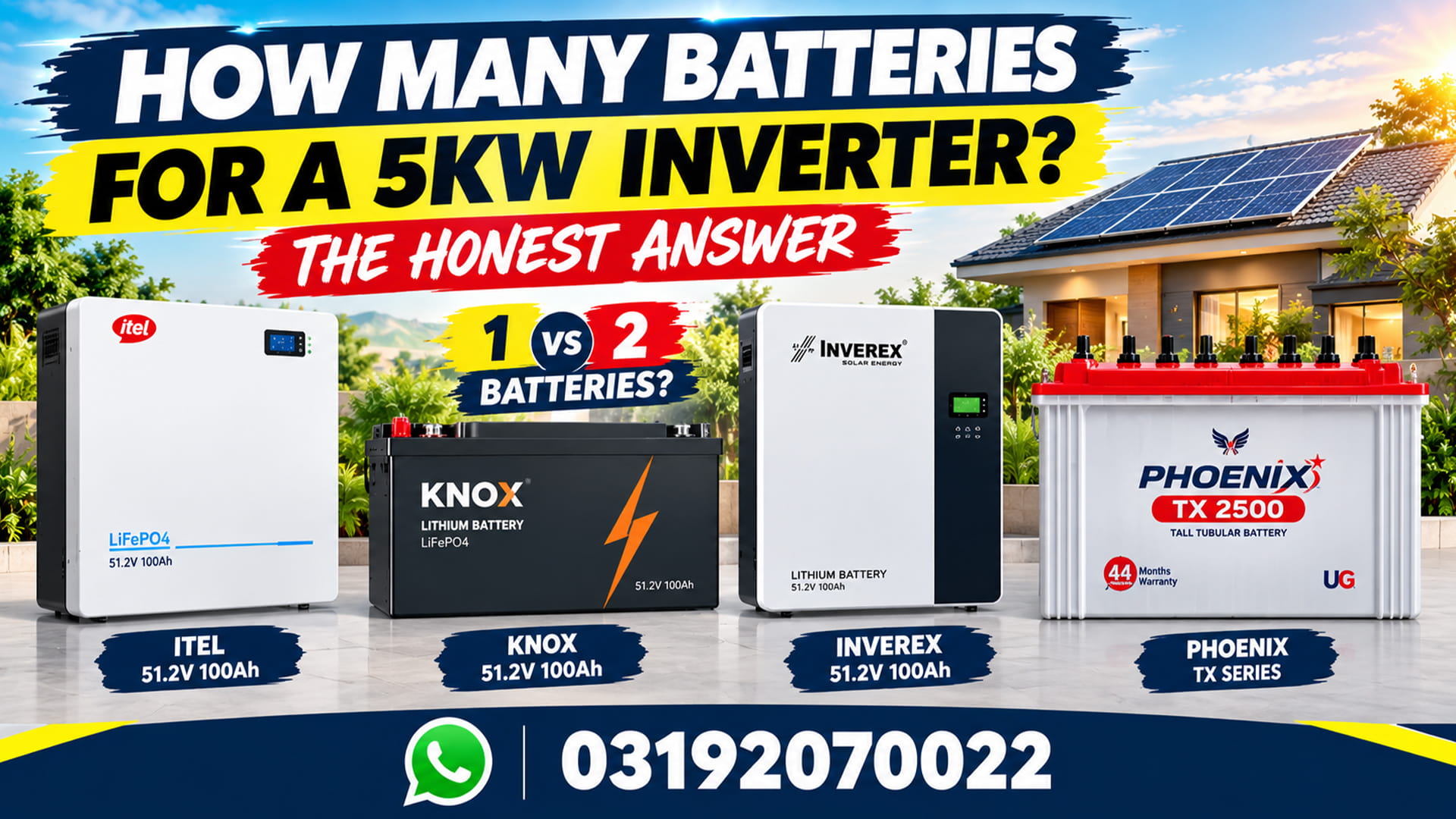
Ask this question in a shop and you will get a number. Ask it in three shops and you will get three numbers, ranging from one to sixteen.
They can all be correct. The question hides two completely separate calculations, and which number you get depends on which one the person answering had in mind, and what chemistry they assumed you were buying.
The two calculations are these. How many batteries do you need to reach 48 volts? And how many do you need to run your house for as long as you want? The first is fixed by physics. The second depends entirely on your household. Confusing them is why the answers vary so wildly.
Here is how to work out both. No prices, since rates move weekly. WhatsApp us now for the latest price of the battery at 03192070022 once you know what your bank needs to be.
Question one: how many to reach 48 volts
A 5kW hybrid inverter is almost always a 48V inverter. Your battery bank has to present 48V to it, and this part is not negotiable or adjustable.
With lead acid, the answer is four. A standard lead acid or tubular battery is 12V. Wire four in series, positive to negative down the chain, and 12 + 12 + 12 + 12 gives you 48V. That is the minimum bank. You cannot run a 48V inverter on three, and you should not run it on five.
This is where the traditional answer of “four batteries” comes from, and for decades it was the right one. It is still the right one if you are buying tubular.
With lithium, the answer is usually one. A 48V lithium pack already contains sixteen LiFePO4 cells wired in series inside the casing. Each cell is 3.2V nominal, so sixteen of them give 51.2V, which is what the industry labels 48V. The series wiring has been done for you at the factory, under the supervision of a BMS.
So a single 48V lithium pack satisfies the voltage requirement on its own. One battery, not four.
And here is the part that trips people up coming from lead acid: you must not wire lithium packs in series to build up voltage. Most drop-in packs with an integrated BMS are not designed for it. Doing it anyway exposes the boards to voltages they were not built for and removes the protection each is supposed to provide, because neither can see what the other is doing. If a datasheet explicitly permits series operation it will say so and state the maximum. Otherwise, do not.
Question two: how many to run your house
Voltage sorted, now capacity. This is where the real variation comes from, and it has nothing to do with your inverter’s 5kW rating.
A 5kW inverter can sit behind 5 kWh of storage or 20 kWh. Both work fine. One gives you a short evening, the other gets you through the night with cooling on.
So work out what you actually need.
List what runs when the grid is down and for how long. A DC inverter ceiling fan is around 75W, an older AC fan closer to 100W. LED lights are 10 to 15W each. A modern inverter refrigerator averages 100 to 150W across a day once the compressor cycling is accounted for. A 43 inch television is around 80W. Routers, chargers and small electronics come to perhaps 50W across a household. A 1.5 ton inverter air conditioner runs 1000 to 1500W in steady operation, considerably more at startup.
Multiply watts by hours, add them up, add about 15 percent for inverter conversion and wiring losses, then divide by 1000 for kilowatt hours.
Three typical results in Pakistani homes:
Fans, lights, fridge and electronics for six hours: roughly 3 to 5 kWh.
The same plus one inverter AC for three or four hours: roughly 7 to 10 kWh.
A larger house with two ACs and a pump overnight: 15 kWh or more.
Now convert that into a number of batteries, and the two chemistries diverge sharply.
Working it through: lithium
Take the middle case, 8 kWh of energy actually delivered to your appliances.
A 48V 100Ah lithium pack holds 51.2V × 100Ah = 5.12 kWh nominal. After 80 to 90 percent usable depth of discharge and 10 to 15 percent inverter losses, roughly 4 kWh reaches your appliances.
8 ÷ 4 = two packs.
Those two go in parallel, not series. Parallel connection keeps the voltage at 48V and adds the capacity together: two 100Ah packs behave as one 200Ah bank at 48V.
For the light case, 4 kWh, one pack. For the heavy case, 15 kWh or more, either four 100Ah packs or a single large unit such as a 48V 314Ah, which holds about 16 kWh nominal and delivers roughly 12.5 kWh. Our itel range comparison works through when a single large unit beats several smaller ones.
Working it through: lead acid
Same target, 8 kWh delivered. The arithmetic gets much less friendly.
Lead acid should not be discharged below about 50 percent, so to get 8 kWh out you need roughly 16 kWh of nominal capacity. Add round trip efficiency losses of 15 to 20 percent, which lead acid suffers and lithium largely does not, and you need more still.
A 12V 100Ah tubular battery holds 1.2 kWh nominal. Four in series make a 48V string holding 4.8 kWh.
16 ÷ 4.8 = 3.3 strings, so you need four strings.
Four strings of four batteries is sixteen batteries.
Sixteen units against two. That is the comparison, and it is why “how many batteries for a 5kW inverter” produces such wildly different answers depending on who you ask.
The follow-on costs are real too. Sixteen lead acid batteries weigh several hundred kilograms and need a floor that can take it. They need a ventilated room, because they vent hydrogen while charging. Each one needs distilled water topped up every four to eight weeks. There are far more terminals to corrode and far more connections to work loose, and connections are where solar installations fail more often than cables are.
None of which makes tubular the wrong choice for everyone. Our lithium versus tubular comparison sets out the situations where it genuinely wins, including one that surprises people. But if the deciding question is how many batteries you will be living with, the gap is not subtle.
The specification that matters more than the count
Here is the mistake I see most often, and it is not about numbers at all.
A 5kW inverter at full output pulls roughly 98 amps from a 48V bank, closer to 105 or 110 once you account for conversion losses. Your battery has to supply that continuously, not in a brief burst.
Two lithium packs can both read 48V 100Ah and be rated very differently. One is specified for 100A continuous discharge. Another is specified for 50A. They hold identical energy. Only the first can support a 5kW inverter running near its ceiling.
Put the 50A pack behind that inverter and the BMS will disconnect under heavy load. The battery is not faulty. It is refusing a discharge rate nobody specified it for. But your lights go out mid-evening and the error appears on the inverter, so that is what gets blamed.
So when you ask how many batteries you need, also ask what each one is rated to deliver. Adding a second pack in parallel doubles your available current as well as your capacity, which is one reason two smaller packs sometimes suit a heavy-surge household better than one large one. The 48V 100Ah guide covers discharge ratings in more depth.
Rules for connecting multiple packs
If your answer came out at more than one, get the installation right.
Use the same model and the same capacity throughout. Not a mix of brands, not a mix of sizes.
Keep the packs close in age. An older pack has higher internal resistance, so it takes less of the load and makes the newer one work harder on every cycle.
Charge all packs to a similar state before connecting them, and check their resting voltages are within about half a volt of each other. Connecting packs at significantly different voltages causes a large equalisation current at the moment of connection.
Run equal-length cables from every pack to the busbar. A pack on a shorter cable sits on a lower-resistance path and carries more current than its neighbours on every single cycle. Over years, that asymmetry shows up as one pack aged well ahead of the others.
Check the manufacturer’s maximum parallel count for the specific model. It is a hard limit.
And torque the terminal bolts to specification. At 100 amps, a loose lug generates heat, and heat at a connection is how connections fail.
Do not forget what refills the bank
A bank sized purely from your evening load can still be the wrong bank, because something has to recharge it.
A 5kW solar array in Pakistan generates roughly 18 to 25 kWh on a clear summer day, falling to about 10 to 15 kWh in late December when days are short and the sun is low. Dust on the panels and high cell temperatures take more than people expect.
In summer that comfortably exceeds a typical household’s daytime use, so there is real surplus to store. In winter the same array may only just cover daytime consumption, leaving little spare.
Which means a very large bank behind a modest array will not reach full charge on short winter days, and a pack that never completes a full charge cycle ages faster than one that does. As a working guide, storage roughly equal to half a day’s winter generation stays rechargeable year round.
If you are planning panels and batteries together, our 5kW system guide covers the generation side.
Quick answers by household
Fans, lights and electronics only, six hours. One 48V 100Ah lithium pack. Or four 12V tubular batteries in one series string, accepting shorter backup and a shorter service life.
Add a refrigerator and a TV. Still one lithium pack for a six hour evening if the load stays near 900W. Tubular would need two strings, so eight batteries.
Add one inverter AC for three or four hours. Two lithium packs. Tubular would need four strings, so sixteen batteries.
Two ACs or overnight running. Four lithium packs, or one 48V 314Ah unit. Tubular at this level becomes impractical for most homes on weight and space alone.
On one lithium 48V pack, yes, provided its continuous discharge rating covers your peak draw of roughly 100 amps. On one 12V lead acid battery, no, because you need four in series to reach 48V.
Only with 12V lead acid, where four in series make the required 48V. A single 48V lithium pack has that series wiring built in.
With lithium, yes, in parallel, using the same model and capacity and ideally close in age. With lead acid, adding a new string alongside old ones is possible but the older strings drag the new ones down.
No. Your inverter’s output is capped by its own rating. More batteries extend how long it can run at that output, and give more current headroom, but a 5kW inverter delivers 5kW regardless.
Never. The chemistries have incompatible charge and discharge curves and the arrangement damages one or both.
Beyond the point your solar array can recharge in a day, and beyond the manufacturer’s stated maximum parallel count.
Yes, across Pakistan.
Getting the number for your house
Two calculations, in this order. Reach 48V first, which means one lithium pack or four lead acid batteries in series. Then reach your runtime, which means however many of those units in parallel your evening load requires.
Then check the discharge rating, because a bank with enough stored energy but not enough current is a bank that cuts out when you need it.
Send us your inverter model, a rough idea of what you run at night and how many hours you want, and we will give you the number before quoting anything. WhatsApp us now for the latest price of the battery at 03192070022, or reach the team through our contact page. The full range, in both chemistries, is on the products page.
Buy Battery is your trusted battery partner. Premium batteries built for Pakistan’s climate, powering homes, businesses and vehicles nationwide.