
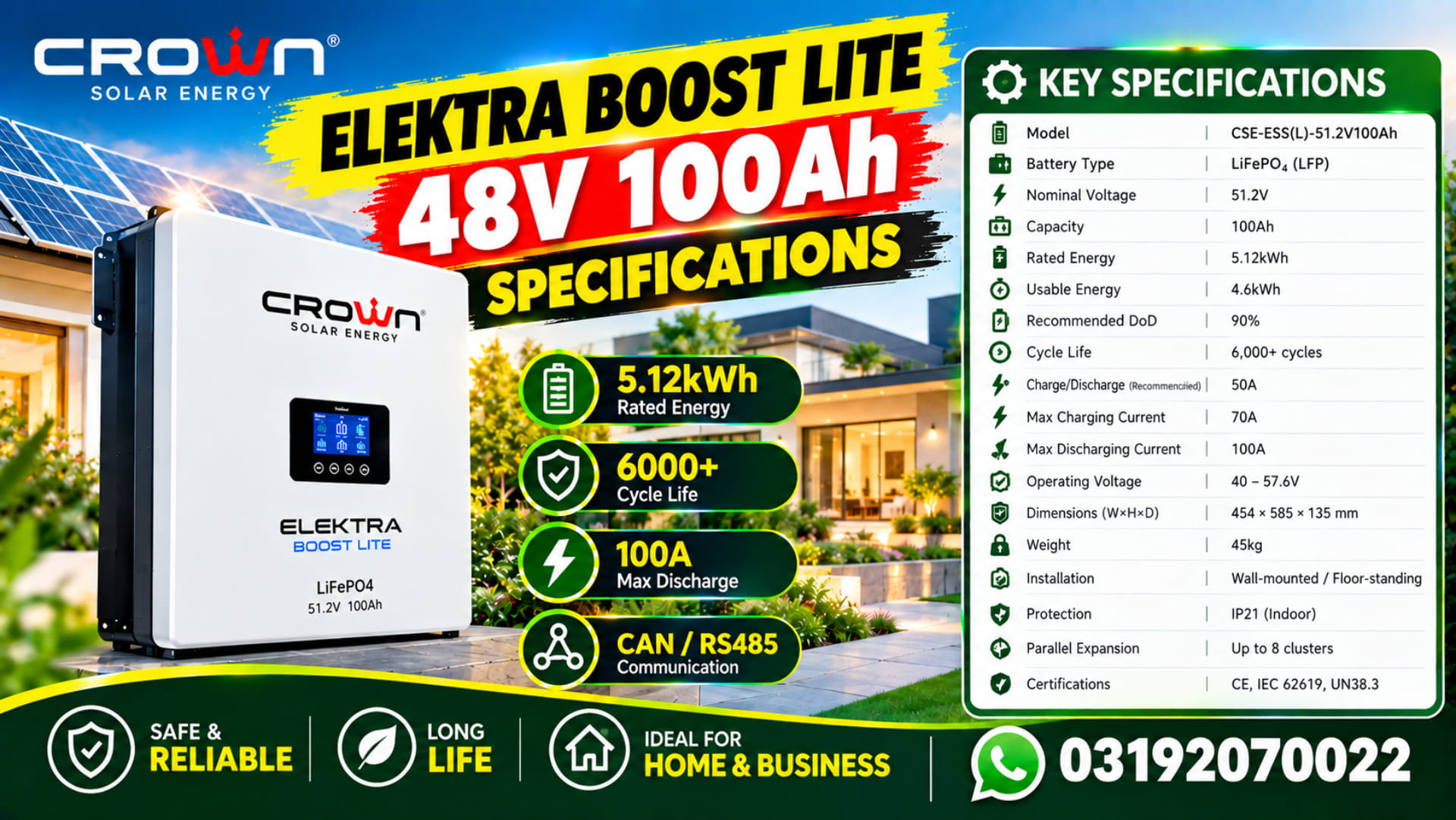
“Lite” in a product name is usually a signal, not a slur. It tells you the manufacturer made deliberate trade-offs to hit a lower price point, and the useful question is not whether those trade-offs exist but exactly what they are. For the Crown Elektra 48V 100Ah Lite, the honest answer is: a shorter warranty and, most likely, fewer built-in features than the standard or Pro tier, in exchange for a lower entry cost on the same core cell chemistry.
This guide sets out what the Lite tier’s specifications actually mean, what has been consistently documented about it, and what to confirm directly before you order, since some of the finer details vary between resellers more than the headline numbers suggest. No prices here, since rates move with the exchange rate. WhatsApp us now for the latest price of the battery at 03192070022 once you know what you are comparing it against.
If you want the full picture across Crown’s range first, our Crown Elektra battery price guide covers Lite, standard and Pro side by side.
Core specifications
Chemistry. LiFePO4, the same lithium iron phosphate chemistry used across the entire Elektra Boost family and the dominant chemistry for stationary solar storage generally, chosen for its thermal stability and long cycle life relative to cobalt-based lithium chemistries.
Voltage. Labelled 48V, with a true nominal voltage of 51.2V, built from sixteen LiFePO4 cells in series at 3.2V nominal each. Our 48V 100Ah buying guide explains this labelling convention and why the true figure matters for your own energy calculations.
Capacity. 100Ah.
Energy storage. 51.2V × 100Ah = 5.12 kWh nominal. After usable depth of discharge, typically 80 to 90 percent on a quality LiFePO4 pack, and inverter conversion losses of roughly 10 to 15 percent, expect delivered energy to your appliances of roughly 4 kWh from a full charge.
Cycle life. Documented figures for the Elektra Boost family generally sit around 6000 or more cycles, though this figure is only meaningful alongside the depth of discharge and temperature it was tested at. Confirm the specific cycle rating and its test conditions for the Lite tier directly, since a lower cost tier does not automatically carry the same rating as the standard or Pro unit, even within the same nominal capacity.
Efficiency. Round trip efficiency above 95 percent has been documented for this family, consistent with LiFePO4 generally, and considerably better than the 80 to 85 percent typical of lead acid.
Protection. A smart BMS providing protection against overcharge, over-discharge, short circuit and temperature extremes is standard across the range, including the Lite tier. This is baseline protection rather than a Pro-tier feature.
Operating temperature. Documented in the region of -10°C to 55°C for this family. As with any spec sheet, this describes a general operating window rather than necessarily confirming safe charging behaviour at the cold end of that range specifically, covered further below.
What “Lite” most likely leaves out
Based on how this tier has been consistently positioned against the standard and Pro units in the same family, expect the following differences, and confirm each directly for the specific unit you are quoted.
Warranty term. This is the most consistently documented difference. Where standard and Pro tier Elektra Boost units have commonly been advertised with a 10 year replacement warranty, the Lite tier has been specifically documented with a shorter term, commonly 5 years. That is a real trade-off worth weighing against the lower entry cost, not an oversight in the product design.
Inverter communication. RS485 and CAN communication, allowing the battery to report true state of charge directly to a compatible hybrid inverter, has been documented specifically for the Pro tier. There is no confirmed indication this is standard on the Lite tier. If your inverter setup depends on communicated state of charge rather than voltage-based estimation, confirm this feature is present before assuming it, since its absence is not necessarily a defect, simply a feature reserved for the higher tier.
Ingress protection. Crown’s range includes both IP21 rated units, indoor use only, and IP65 rated units, sealed against dust and water jets. Do not assume which rating applies to a Lite unit without asking directly. Our guide to what IP65 actually means explains the standard in full, and if your installation is anywhere outdoor, rooftop or semi-exposed, this is not a detail to leave unconfirmed.
None of this makes the Lite tier a poor choice. It makes it a specific choice, suited to installations where a communicating BMS is not required, where the location is a controlled indoor environment, and where the lower entry cost against a five rather than ten year warranty is an acceptable trade for your circumstances.
Physical specifications
Documented weight for the 24V 100Ah unit in this family sits around 25 to 30kg. The 48V 100Ah configuration, built from twice as many cells in series, is meaningfully heavier, though we have not seen a consistently documented figure specifically for the 48V Lite variant across resellers. Confirm the exact weight and dimensions for the specific unit you are ordering, particularly if you are planning a wall mount installation and need to confirm the wall construction can bear the load safely.
The discharge current question
The same check that applies across every unit in this capacity class applies here. A 5KW hybrid inverter running at full output draws roughly 98 to 110 amps from a 48V bank. Elektra Boost units in this capacity have commonly been documented with discharge rates around 1C, which on a 100Ah pack works out to roughly 100 amps continuous, close to but not comfortably above what a 5KW inverter demands at its ceiling.
Confirm the exact continuous and peak discharge current in amps for the Lite unit specifically, rather than assuming it matches the standard or Pro tier. If your household regularly runs the inverter near its full rating, two units in parallel give more comfortable current headroom than relying on one unit at the edge of its rating. Our guide to how many batteries a 5kW inverter needs works through that arithmetic.
What it runs
Roughly 4 kWh delivered covers a normal household evening: several fans, a full set of LED lighting, an inverter refrigerator, a television and general electronics, typically for four to six hours depending on the exact load.
Add a 1.5 ton inverter air conditioner, drawing 1000 to 1500W in steady operation, and the picture changes fast: three to four hours of AC alone consumes most or all of one unit’s delivered capacity before anything else in the house runs. Households wanting AC on backup typically add a second unit in parallel rather than relying on one.
Who this tier genuinely suits
Given the specifications and likely trade-offs above, the Lite tier makes the most sense for a few specific situations.
A household with a tighter budget who wants genuine LiFePO4 performance, long cycle life, no maintenance, light weight, without paying for inverter communication or a longer warranty term they may not need.
An installation in a controlled indoor location, where an IP65 rating is unnecessary and the standard IP21 protection this tier likely carries is entirely adequate.
A setup on an inverter without communicating BMS support, where the Pro tier’s RS485 or CAN capability would go unused regardless of which unit you buy.
Infrequent or standby backup use rather than heavy daily cycling near the pack’s limits, where the Lite tier’s specification still comfortably covers the demand.
If any of those does not describe your situation, particularly if the installation is outdoor or semi-exposed, or your inverter benefits meaningfully from communicated state of charge, the standard or Pro tier is worth the difference. Our guide comparing options across the itel range works through a similar tiering logic if you are weighing brands as well as tiers.
What to confirm before ordering
Given the documented variation within this specific product family, treat these as standard questions rather than optional extras.
The exact warranty term for the Lite tier specifically, and who backs it, importer or shop, given how inconsistently warranty terms have been advertised for this product family across different resellers. Our guide to warranty claims in Pakistan covers what to ask before you buy, not after something goes wrong.
The ingress protection rating, and whether it has been independently tested, matched to where the unit will actually be installed.
The continuous and peak discharge current in amps, checked against your inverter’s actual peak draw.
Whether the BMS communicates with your inverter at all, since this is not confirmed as standard on this tier.
Whether low temperature charge protection is present, if your installation sees routine sub-zero mornings.
A worked example
To make the 4 kWh delivered figure concrete: six fans at roughly 75W each, a dozen LED lights at 12W each, an inverter refrigerator averaging 130W, a television at 80W, and a router with chargers at roughly 50W together come to approximately 900W. Running that load for four and a half hours uses close to the full delivered capacity of one unit at this tier. Trim the load slightly, four fans rather than six and a shorter television evening, and the same unit comfortably covers six hours.
Siting it correctly
Whatever the confirmed ingress protection rating turns out to be, a few things matter regardless.
Shade the installation and keep it ventilated. Cycle life figures on any LiFePO4 pack are typically measured near 25°C, and a unit sitting in direct summer sun in Multan, Jacobabad or Rahim Yar Khan runs considerably hotter than that internally, regardless of how well its enclosure is sealed. Shade costs nothing at installation and adds real years to the pack’s working life.
If the confirmed rating turns out to be IP21 rather than IP65, treat that as a firm instruction to keep it indoors in a dry location, not a suggestion. IP21 protects against dripping water from directly above and basic solid object contact, not against dust storms or driving rain, both routine conditions across large parts of the country.
If you are installing anywhere with routine sub-zero winter mornings, Quetta, Skardu, Ziarat, Kalam and similar regions, ask specifically about low temperature charge protection rather than relying on the general operating temperature figure alone. Charging LiFePO4 below 0°C causes permanent, cumulative damage to the cells regardless of brand or tier, and a documented operating range does not always confirm the BMS actively guards against this at the charging stage specifically.
It shares the same core LiFePO4 chemistry and the same 48V 100Ah configuration, but is documented with a shorter warranty term and likely without the Pro tier’s inverter communication. Confirm the specific features and warranty for the exact unit you are quoted.
Confirm this directly for the specific model, since documented expandability has been most consistently associated with the Pro tier rather than guaranteed across the whole family.
Electrically, generally yes, provided the voltage range and discharge current align. Full communication features depend on whether this specific tier includes them, which is not guaranteed, so confirm before assuming your inverter will show live battery data.
Not necessarily. Confirm the ingress protection rating directly rather than assuming, since Crown’s range includes both indoor-only and outdoor-rated units.
It reflects the tier’s lower entry cost. Standard and Pro tier units in this family have more commonly been documented with a longer warranty term.
Yes, across Pakistan.
Getting the current price
Confirm the exact warranty term, ingress protection rating and continuous discharge current for the specific Lite unit you are quoted, since these are the details most likely to vary from what a comparison against the standard or Pro tier might lead you to assume.
WhatsApp us now for the latest price of the battery at 03192070022 with your inverter model, your city and a rough idea of your evening load, and we will confirm whether the Lite tier suits you or whether the standard or Pro tier is worth the difference. You can also see our current range on the products page or reach the team through our contact page.
Buy Battery is your trusted battery partner. Premium batteries built for Pakistan’s climate, powering homes, businesses and vehicles nationwide.