
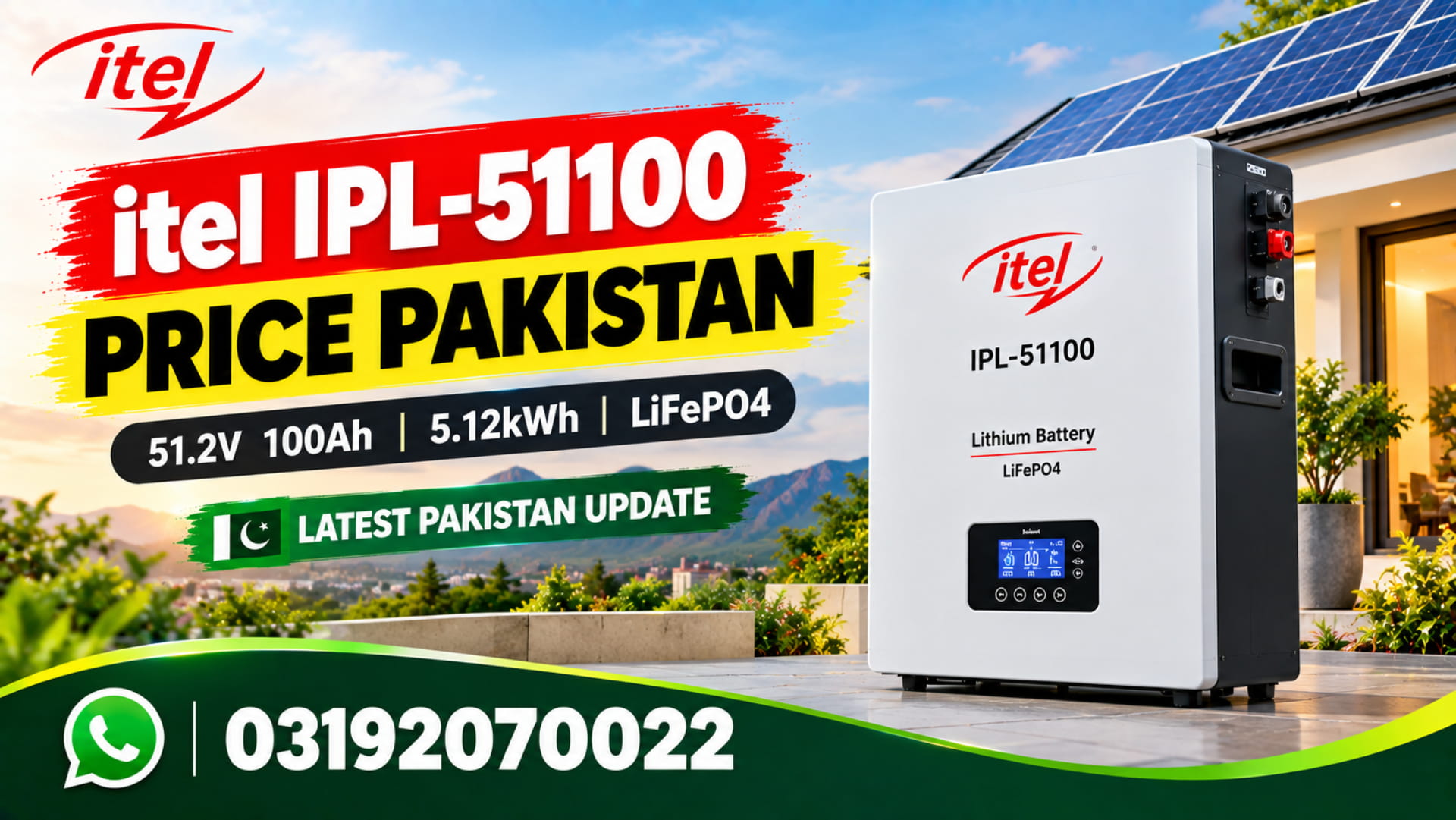
Unlike a lot of what gets asked about in this market, the IPL-51100 is a specific, well-documented model code rather than a loosely used family name. That makes it possible to answer this one precisely, with confirmed specifications rather than the usual “ask the seller to clarify” caveats a vaguer product name requires.
This is itel’s standard 51.2V 100Ah LiFePO4 pack, the size most Pakistani households land on for a 5KW hybrid inverter setup. Here is exactly what it is, one specification worth flagging clearly before you buy, and what to confirm around it. No prices in this guide, since rates move with the exchange rate. WhatsApp us now for the latest price of the battery at 03192070022 once you have the specifications in hand.
Confirmed specifications
Model. IPL-51100. A small number of resellers list it as IPW-51100, which appears to be a typo rather than a distinct model, since the specifications and description are identical wherever it appears under either spelling.
Chemistry. LiFePO4, lithium iron phosphate, built as a sixteen cell series string at 3.2V nominal per cell.
Voltage. 51.2V true nominal, commonly labelled “48V” or marketed under a “5KW” naming shorthand referring to its energy content rather than a power rating.
Capacity. 100Ah.
Energy storage. 51.2V × 100Ah = 5.12 kWh nominal.
Continuous discharge current. 100A.
Peak or pulse discharge current. 150A.
Communication. RS485, CAN and RS232 ports, allowing the battery to report state of charge and status directly to a compatible inverter or BMS system rather than leaving the inverter to estimate from voltage alone.
Ingress protection. IP20.
Design life. 10 years.
Cycle life. 6000 or more cycles, as documented across multiple listings, though as with any cycle figure, confirm the depth of discharge and temperature it was tested at if that detail matters to your decision.
Protection features. Current limiting, pre-charge protection, over-charge protection, over-discharge protection, voltage cut-off protection, and temperature protection.
Certifications. IEC62619, UN38.3, MSDS and DGM.
The specification worth flagging clearly: IP20
Every source documenting this specific model consistently lists it as IP20, not IP65. This is worth being direct about rather than glossing over, because it changes where you can install it.
IP20 means protected against solid objects like fingers and basic tools, and against dripping water falling vertically from directly above. It offers no meaningful protection against dust ingress and no protection against water jets, splashing, or driving rain from any angle. In practice, that means indoor installation only, in a dry, reasonably clean location.
If your installation is on a rooftop, in a carport, or anywhere semi-exposed, this specific model is not the one to order. Ask us for itel’s IP65 rated alternative instead, which exists within the broader range for exactly this situation. Confusing the two is a genuine risk in this market, since model names across resellers are not always used consistently, and it is worth confirming the exact model code on your invoice rather than trusting a general product photo or description.
What the discharge figures mean for a 5KW inverter
This is where having confirmed numbers rather than a general capacity rating actually matters.
A 5KW hybrid inverter at full output draws roughly 98 amps from a 48V bank, climbing toward 105 to 110 amps once conversion losses are factored in. The IPL-51100’s documented 100A continuous rating sits right at that line rather than comfortably above it. It will cover a 5KW inverter under most conditions, and the 150A pulse rating gives real headroom for a compressor or motor startup surge landing at the same moment as heavy household load.
The margin is tight enough, though, that if your household regularly pushes the inverter near its full rating, running an AC and a water pump and several other things at once, it is worth considering two units in parallel rather than relying on a single pack at the edge of its continuous rating. Two units in parallel double both your available capacity and your available discharge current, which gives you comfortable headroom rather than a pack working at its limit every evening. Our guide to how many batteries a 5kW inverter needs works through that arithmetic.
The communication ports, and why they are worth using
RS485, CAN and RS232 support means this pack is built to talk to a compatible inverter directly, reporting true state of charge, cell status and fault conditions rather than leaving the inverter to guess from terminal voltage.
That matters more than it sounds, because LiFePO4 has a deliberately flat discharge curve, sitting near 52 to 53V through most of its usable range on a 48V pack. Voltage barely moves until the pack is nearly empty, so an inverter estimating state of charge from voltage alone gives you very little useful warning before it cuts out. With a genuine communication link active, the inverter reads the real figure the BMS is calculating.
Having the ports present on the battery is only half the setup. The specific protocol and settings still need to be selected correctly on your inverter, and support varies by inverter brand and sometimes firmware version. Confirm your exact inverter model when you enquire, and our guide to pairing a battery with a hybrid inverter covers what to check on that side.
What the certifications actually mean
Worth a brief honest explanation rather than leaving four acronyms unexplained.
IEC62619 is an international safety standard specifically covering secondary lithium cells and batteries used in stationary applications, the category this battery falls into. UN38.3 is the mandatory transport safety testing lithium batteries must pass to be legally shipped, covering things like altitude simulation, thermal cycling, vibration and short circuit testing. MSDS, a material safety data sheet, is standard safety documentation describing the product’s hazards and handling requirements. DGM refers to dangerous goods documentation required for the safe transport of lithium batteries, which are classified as dangerous goods for shipping purposes regardless of brand.
None of these are unique selling points specific to itel, since any legitimately imported lithium battery should carry equivalent documentation. Their presence here is a reasonable baseline indicator that the product has gone through standard safety and transport testing, and it is worth asking any seller of any brand whether they can produce this documentation on request.
What it delivers
5.12 kWh nominal, and after usable depth of discharge of roughly 80 to 90 percent and inverter conversion losses of 10 to 15 percent, expect roughly 4 kWh delivered to your appliances from a full charge.
That covers a normal household evening on a 5KW hybrid inverter: several fans, a full set of LED lighting, an inverter refrigerator, a television and general electronics, typically for four to six hours depending on the exact load. Add a 1.5 ton inverter air conditioner, drawing 1000 to 1500W in steady operation, and three to four hours of AC alone consumes most or all of that capacity before anything else in the house runs.
Our 48V 100Ah buying guide and itel range comparison both cover sizing and stacking for this capacity class in more depth if you are weighing it against a larger or smaller unit.
A worked example against the actual load
To make the 4 kWh delivered figure concrete rather than abstract, here is a specific evening against it. Six fans at roughly 75W each, a dozen LED lights at 12W each, an inverter refrigerator averaging 130W, a television at 80W, and a router with chargers at roughly 50W together come to approximately 900W. Running that combined load for four and a half hours uses close to the full delivered capacity of one IPL-51100.
Trim the load slightly, four fans instead of six and a shorter television evening, and the same unit comfortably clears six hours. That is the honest range this specific model covers on its own: a normal household evening without air conditioning, with some flexibility either side depending on exactly what stays switched on.
If your evening genuinely includes an inverter AC for several hours, do the arithmetic for your own load before assuming a single unit will stretch to cover it. A 1.5 ton unit alone can consume the entire delivered capacity in three to four hours, which is most of what one IPL-51100 has to offer for the whole evening.
Where this fits against itel’s wider capacity range
The IPL-51100 sits in the middle of itel’s lineup rather than at either end. Below it, a 24V 100Ah configuration in the same family holds roughly half the energy, 2.56 kWh nominal, suited to a smaller load, a shop, or a household without a fridge on backup. Above it, a 48V 314Ah unit holds roughly three times the energy, around 16 kWh nominal, suited to a larger home running multiple air conditioners or wanting genuine overnight independence.
For most households on a 5KW hybrid inverter running a normal evening of fans, lights, a fridge and electronics, the IPL-51100 at this single capacity is the right starting point, with the option to add a second unit in parallel later if the load grows or air conditioning gets added to the backup circuit. That expansion path is one of the more practical reasons to start here rather than jumping straight to a larger single unit if your needs are not yet fully settled.
Installation notes
Given the confirmed IP20 rating, this unit belongs indoors, in a dry location without meaningful dust exposure. That is not a suggestion, it is the specification.
Shade and ventilation still matter even indoors. Cycle life figures on any LiFePO4 pack are typically measured near 25°C, and an indoor utility room that gets genuinely hot in summer, particularly one under a roof with poor insulation, still shortens the pack’s working life over time compared to a cooler, better ventilated space.
If your installation is somewhere that gets genuinely cold overnight even indoors, a poorly insulated rooftop room in Quetta, Skardu or a similar region, confirm whether this model includes low temperature charge protection. Charging LiFePO4 below 0°C causes permanent, cumulative damage to the cells, and an indoor location does not automatically guarantee the ambient temperature stays above that threshold in every part of the country.
What to still confirm before ordering
The core specifications here are well documented and consistent, so the remaining questions are fewer than usual, but worth asking regardless.
Confirm the warranty term and who backs it, importer or shop, since this detail is set by the seller rather than the model itself and varies accordingly. Our guide to warranty claims in Pakistan covers what to ask before you buy.
Confirm which communication protocol, RS485 or CAN, and what settings your specific inverter brand and model needs to actually use it, since the ports being present does not guarantee automatic compatibility without correct configuration.
Confirm what is included in the price: delivery, cables, lugs and installation support are sometimes bundled and sometimes not.
And if you are at all uncertain whether your installation location is genuinely indoor and dry, ask directly whether an IP65 rated alternative within the range would suit you better before committing to this model.
It is itel’s standard model at this capacity, documented with IP20 protection specifically. If you have seen a different itel unit marketed as IP65 or outdoor-rated, that is a different model code, and the two are not interchangeable for an outdoor installation.
Not recommended as a substitute for buying the correctly rated unit. A field-built enclosure is unlikely to match a genuine tested IP65 rating, and doing so may also affect your warranty. If you need outdoor protection, ask for the IP65 rated model instead.
In most conditions, yes, since it sits right at what a 5KW inverter draws at full output. If your household regularly runs the inverter near its ceiling with multiple heavy loads simultaneously, two units in parallel give more comfortable headroom.
The battery supports RS485, CAN and RS232 hardware ports. Whether your specific inverter brand and firmware version is configured to use them requires confirming your exact model, since support and settings vary.
It describes the manufacturer’s general expected service life under normal conditions, distinct from the warranty term, which is set separately by whoever sells it to you and should be confirmed directly.
Yes, across Pakistan.
Getting the current price
Confirm this is genuinely the model you need, IP20 for an indoor installation, and check the continuous discharge rating against your inverter’s peak draw if your household load is heavy. WhatsApp us now for the latest price of the battery at 03192070022 with your inverter model, your installation location and your evening load, and we will confirm the right configuration before quoting.
You can see our full itel range and current stock on the products page, or reach the team through our contact page.
Buy Battery is your trusted battery partner. Premium batteries built for Pakistan’s climate, powering homes, businesses and vehicles nationwide.