
“Solar battery kitni chalti hai” actually asks two different questions, and most people asking it want an answer to both without realising it. One is about a single evening: how many hours will it run my house tonight. The other is about years: how long before this battery needs replacing. This guide covers both, with real numbers rather than a vague “many years” answer that tells you nothing useful.
No exact prices here, since rates move with the exchange rate and the configuration you choose. WhatsApp us now for the latest price of the battery at 03192070022 once you know roughly what size and lifespan you need.
Question one: kitni der chalti hai per charge
This is arithmetic, not guesswork, and it comes down to three numbers: how much energy the battery actually holds, how much of that you can safely use, and how fast your appliances are drawing it down.
Start with nominal capacity. A common 48V 100Ah lithium pack holds 51.2V × 100Ah, which works out to 5.12 kWh nominal. That is the number on the spec sheet, not the number you actually get to use.
Apply usable depth of discharge next. A good LiFePO4 pack allows 80 to 90 percent depth of discharge without damaging the cells, so call it roughly 4.3 to 4.6 kWh available. Then subtract inverter conversion losses, typically 10 to 15 percent, since some energy is lost converting DC battery power to the AC your appliances actually use. The real, delivered figure lands around 3.8 to 4 kWh from a full charge. Our 48V 100Ah lithium battery guide breaks this exact calculation down appliance by appliance if you want the fuller picture.
Divide that delivered energy by your actual load in kilowatts, and you get hours of runtime.
Worked examples, so the number means something
A light evening load, four ceiling fans at 75W each, ten LED bulbs at 12W, a router and a few chargers at 40W, comes to roughly 460W. Divide 4 kWh by 0.46 kW and you get close to eight and a half hours, comfortably covering a full evening.
A normal household evening, six fans, twelve LED lights, an inverter refrigerator averaging 120W, a television at 80W, and assorted electronics, comes to roughly 900W. That same 4 kWh delivers about four and a half hours, which covers dinner through to late evening but not necessarily until morning.
Add a 1.5 ton inverter air conditioner, drawing somewhere around 1000 to 1500W in steady operation, and the arithmetic changes fast. Three to four hours of AC alone can consume most or all of one pack’s delivered capacity before anything else in the house has run. Households wanting overnight AC backup generally need two packs in parallel or a larger single unit. If you are not sure exactly what your own evening adds up to, our battery bank sizing calculator does this math for your specific appliance list rather than a generic example.
The spec that quietly limits runtime: discharge current
Capacity answers how long. A separate number, continuous discharge current measured in amps, answers whether the battery can actually deliver that power at the rate your inverter demands.
A 5KW inverter running near its ceiling draws roughly 98 to 110 amps from a 48V bank. A battery rated for 100A continuous discharge covers that. One rated for only 50A trips and cuts off well before its stated capacity is used up, regardless of how many kWh it holds on paper. This is a common reason a battery seems to drain faster than expected, when the real issue is a mismatch between discharge rating and inverter load rather than capacity at all. Our guide on how many batteries a 5kW inverter needs covers this pairing in more depth.
Question two: kitne saal chalti hai
This is the longer-term version of the same question, and the honest answer depends heavily on chemistry, usage habits, and installation conditions, not just a number printed on a box.
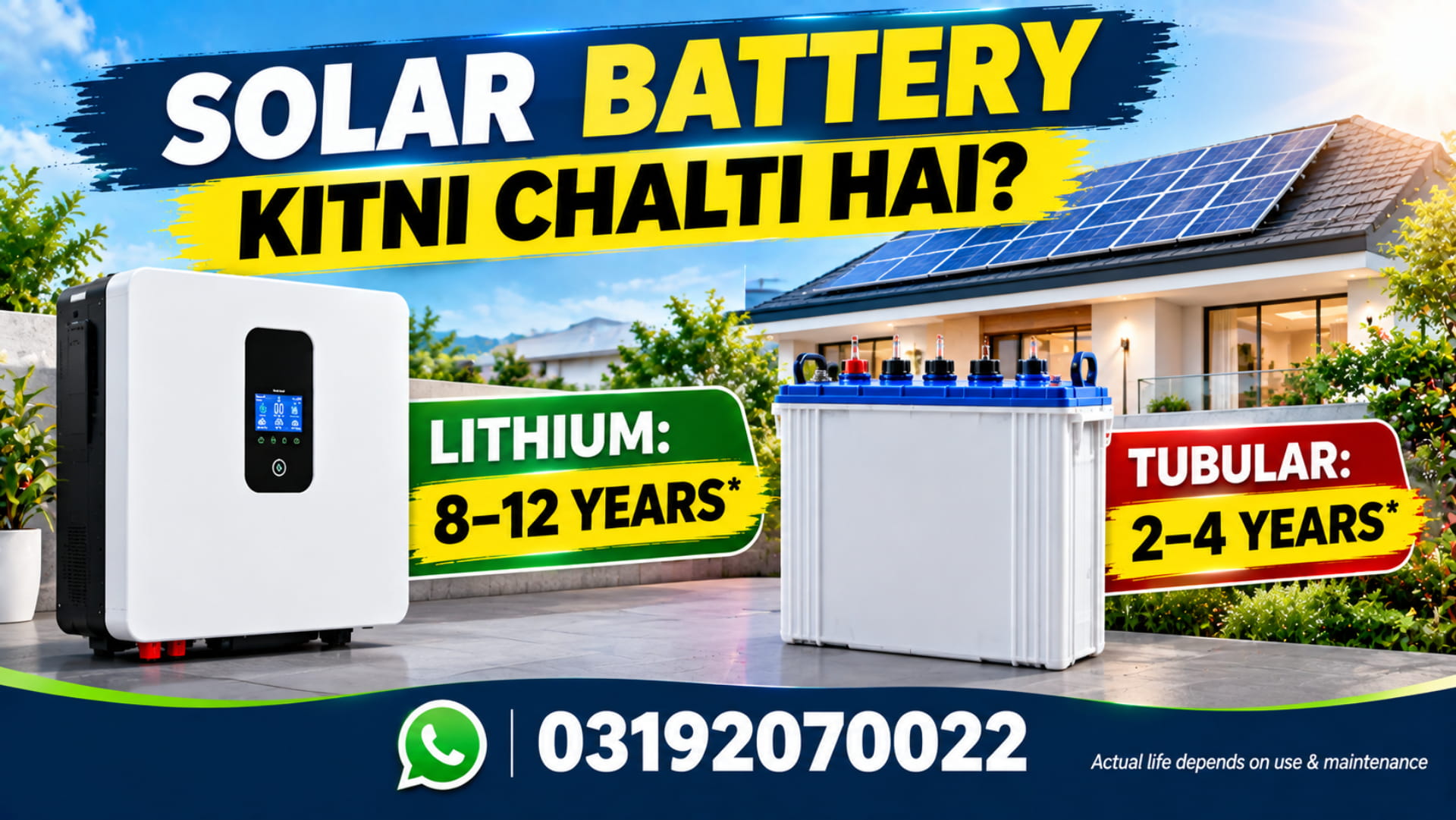
LiFePO4, the chemistry inside nearly every modern lithium battery sold in Pakistan, is rated for several thousand charge cycles, commonly 4000 to 6000 or more at 80 percent depth of discharge, and a rated design life of around ten years from most manufacturers. A cycle means one full charge and discharge, so a battery cycled once a day, which is typical for a household running it every evening, can realistically reach eight to ten years of useful service before its capacity drops meaningfully. Our deeper dive into LiFePO4 battery pricing and chemistry explains why this chemistry outlasts older options by such a wide margin.
Compare that to tubular or lead-acid batteries, which typically manage 3 to 5 years under regular daily cycling and offer roughly half the usable depth of discharge for the same rated capacity. Our honest comparison of lithium versus tubular batteries covers this trade-off in full, including the one area, cold-weather charging, where tubular still holds a genuine edge.
What actually shortens a battery’s life
The rated cycle count assumes reasonable conditions. Real-world habits and installation choices move the actual number up or down, sometimes significantly.
Heat. Cycle life figures are typically measured near 25°C. A battery installed in a poorly ventilated rooftop enclosure that regularly sits above 40°C in summer ages faster than the datasheet suggests, sometimes considerably faster. Shade and airflow around the unit matter more than most buyers expect.
Cold-weather charging. Charging LiFePO4 below 0°C causes permanent lithium plating on the anode, damage that accumulates with every cold charge and cannot be reversed. This matters in Quetta, Skardu, Ziarat, Kalam and much of upper KP, where winter mornings regularly sit below freezing. A pack with proper low-temperature charge protection refuses to charge until it warms, which looks like a fault but is actually the battery protecting itself correctly.
Cell grade. Grade A matched cells age evenly. Grade B, reclaimed or unmatched cells drift apart faster, and once they drift, the weakest cell in the series string caps what the whole pack can deliver, shortening real-world usable life well before the rated cycle count is reached. Our guide on checking an original lithium battery before you buy covers how to tell matched cells from a corner-cut build.
Deep discharge habits. Routinely draining the battery close to empty rather than the recommended 80 to 90 percent depth of discharge adds stress to every cycle. Most modern BMS units cut off automatically before genuine over-discharge, but staying well inside that limit as a habit still extends real-world life.
Ingress and dust. A unit installed somewhere dust or moisture reaches without a properly rated enclosure faces a different kind of failure risk entirely, separate from cycle aging. Our explainer on what an IP65 rating actually means covers what to check before installing anywhere semi-exposed.
Getting the longest life out of what you buy
A handful of habits, none of them expensive, add real years to a battery’s working life.
Site it somewhere shaded and ventilated rather than sealed inside a hot rooftop box. Avoid routinely draining it below the recommended depth of discharge, even though the BMS will protect against genuine over-discharge. Confirm low-temperature charge protection before installing anywhere that drops below freezing overnight. And buy from a seller who can document cell grade and BMS specification rather than a vague capacity number, since that single choice affects lifespan more than almost anything you do after installation. Confirming warranty backing in writing at the point of purchase also matters here, since it is your protection if a pack underperforms its rated life. Our guide to warranty claims in Pakistan covers what to ask before you pay.
Runtime and lifespan together: what to actually expect
Put both answers side by side and a realistic picture emerges. A well-specified 48V 100Ah LiFePO4 pack, sized correctly for your evening load and installed with reasonable care, delivers roughly four hours of runtime under a normal household load, stretching to eight or more on a lighter load, and remains useful for somewhere between eight and ten years of daily cycling before its capacity noticeably declines.
Neither number is fixed. Runtime scales directly with how many packs you install and how heavy your load is. Lifespan scales with cell quality, installation conditions and how gently you treat it. Brands like itel document their range with consistent model-specific specifications that make both numbers easier to verify before you buy, covered in our itel lithium battery range guide.
How to tell if your existing battery is already ageing
If you already own a lithium battery and are asking this question because it seems to run out faster than it used to, a couple of simple checks tell you whether that is normal ageing or something worth addressing.
Compare today’s runtime against what you got in the first few months, under a similar load. A gradual decline of 10 to 20 percent over several years is normal and expected as the cells age. A sudden drop, or a battery that discharges noticeably faster than it used to within a single season, points to something else, most often one weak cell dragging down the whole pack, and is worth raising with whoever sold it while the warranty is still active.
Check the resting voltage a few hours after a full charge. A healthy 48V LiFePO4 pack settles somewhere in the low 50s. A pack that settles noticeably lower, or that shows unusual voltage swings under light load, is worth a proper capacity test rather than guessing. If the battery has a BMS app, cell-level voltage spread is a more reliable early indicator than the runtime itself, since a handful of drifting cells shows up there well before it becomes obvious in daily use.
A realistic overall picture
Put both answers together and here is what a typical household should actually expect. A correctly sized 48V 100Ah LiFePO4 pack, installed with reasonable shade and ventilation, delivers around four hours under a full evening load or considerably more on a lighter one, and remains genuinely useful for eight to ten years of daily cycling. Push either number and something has to give: heavier loads mean shorter nightly runtime unless you add capacity, and harsher conditions or corner-cut components mean a shorter working life regardless of what the spec sheet claims on day one.
Knowing both numbers before you buy, rather than after, is what lets you size a system that actually matches how your household lives, instead of one that looks right on paper and disappoints by the second summer.
Roughly 4 to 8 hours under a normal household load, or as little as 3 to 4 hours if you are running an air conditioner. It depends directly on your load and battery size.
A good LiFePO4 pack can reach 8 to 10 years of daily cycling if it is sized correctly, installed with reasonable ventilation, and maintained sensibly.
Yes, a 1.5 ton AC alone can use most of a pack’s delivered capacity within three to four hours, which is why AC backup usually needs two batteries in parallel or a larger single unit.
Yes, a battery kept in a hot, poorly ventilated enclosure can age faster than its rated design life. A shaded, ventilated location matters more than most buyers expect.
Yes, on both counts. Lithium delivers roughly double the usable capacity per charge and typically lasts two to three times as many years under normal daily use.
Get the right size and brand for your home
Share your inverter model, evening load and city, and WhatsApp us now for the latest price of the battery at 03192070022 to confirm the right size and today’s rate. See the current range on the products page, or reach the team directly through the contact page.
Buy Battery is your trusted battery partner. Premium batteries built for Pakistan’s climate, powering homes, businesses and vehicles nationwide.