
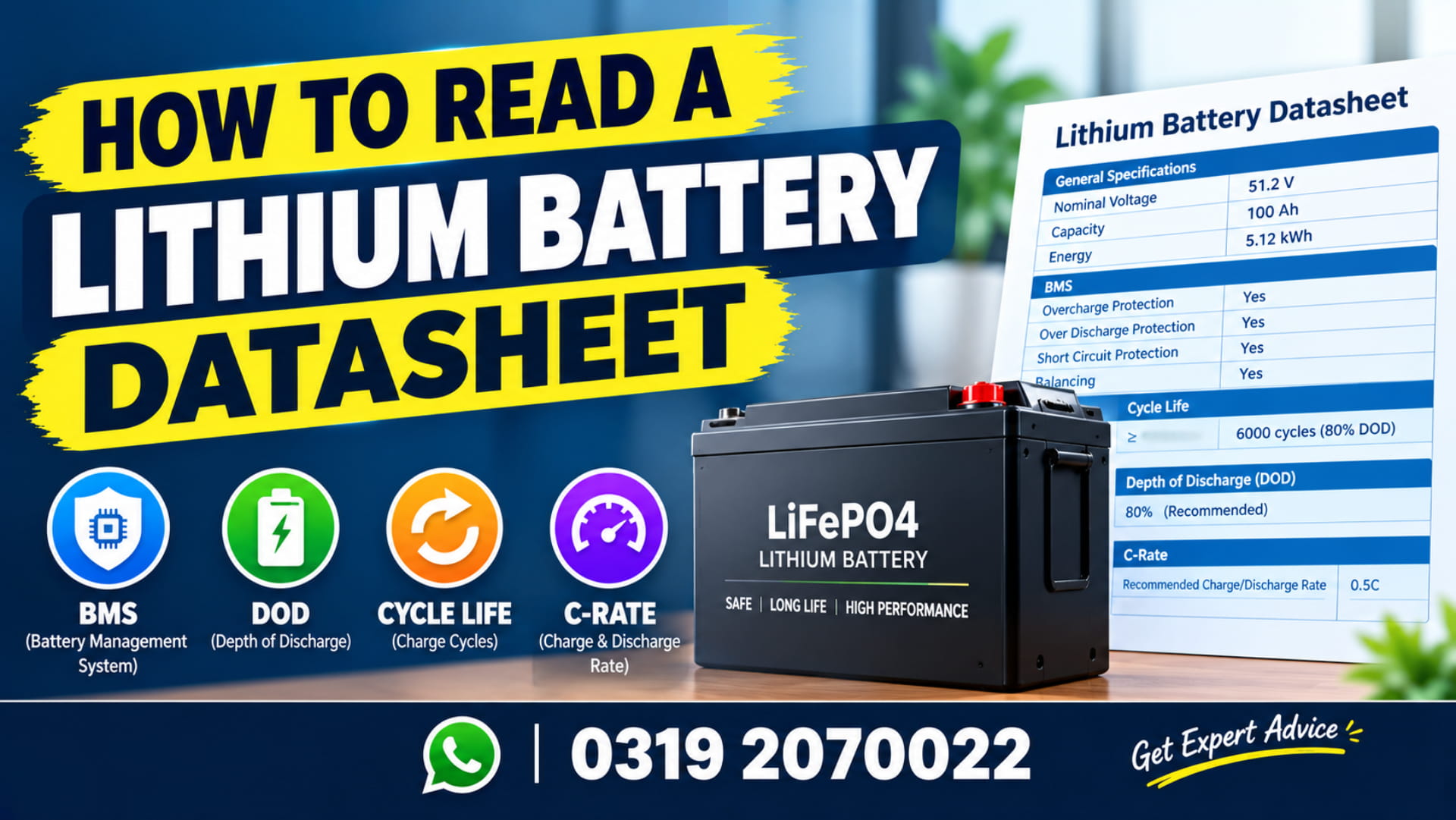
A lithium battery datasheet is a page of abbreviations that most buyers glance at, nod at, and then ignore in favour of whatever the seller says out loud. That is a pity, because the datasheet is the one document that cannot drift into vagueness. A figure is either printed there with its conditions, or it is missing, and the missing ones tell you as much as the printed ones.
This guide walks through a typical LiFePO4 datasheet line by line, with four terms given extra room because they cause most of the confusion: BMS, depth of discharge, cycle life and C-rate. It ends with a worked example using a real model, and a short list of red flags. No prices appear here, since rates move with the exchange rate. Once you know what you are reading, WhatsApp us now for the latest price of the battery at 03192070022.
How a datasheet is usually laid out
Most datasheets follow the same rough order. Electrical specifications come first: voltage, capacity, energy, charge and discharge currents. Then the environmental limits, the physical details and the certifications. The BMS features are sometimes a separate block and sometimes buried in a notes column.
Read it in that order, and for every number ask the same two questions. Under what conditions was this measured, and does it agree with the other numbers on the page? A datasheet is a set of claims that should be consistent with each other, and the inconsistencies are where the problems hide.
Nominal voltage, capacity and energy
Three figures sit at the top and they are linked by one multiplication.
Nominal voltage is the average voltage the pack sits at during use. A LiFePO4 cell is nominally 3.2V, so a sixteen-cell series pack, written 16S, is 51.2V, which the market labels “48V” for historical reasons. We cover that labelling in our guide to 51.2V 100Ah batteries.
Nominal capacity is in amp-hours, such as 100Ah. It tells you how much charge the pack holds, not how much energy.
Energy is in kilowatt-hours, and it is voltage times capacity. 51.2V times 100Ah is 5.12 kWh. This is the first consistency check. If the datasheet says 100Ah, 51.2V and 5.12 kWh, it agrees with itself. If it says 100Ah, 51.2V and 6 kWh, one of those numbers is wrong, and you want to know which before you pay.
Depth of discharge (DOD)
Depth of discharge is how much of the battery’s capacity you use in a cycle, as a percentage. Use 80 Ah from a 100Ah pack and you have discharged to 80 percent DOD. The opposite figure is state of charge, so 80 percent DOD leaves 20 percent state of charge.
Datasheets use DOD in two places, and the difference matters.
The first is recommended or usable DOD, usually 80 to 90 percent for a good LiFePO4 pack. That is why a 5.12 kWh pack does not hand you 5.12 kWh. After DOD and inverter losses of roughly 10 to 15 percent, a 48V 100Ah pack delivers around 4 kWh to your appliances.
The second is the DOD at which the cycle life was tested, which is a condition attached to the cycle life figure. We turn to that next, because it is the single most misquoted pairing on any datasheet.
Cycle life
Cycle life is the number of full charge and discharge cycles the battery completes before its capacity falls to a stated fraction of the original. A figure like “6000 cycles” is meaningless on its own. A usable cycle life claim has four parts.
- The number of cycles. For quality LiFePO4, several thousand.
- The depth of discharge. Cycles at 80 percent DOD are harder on the cells than cycles at 50 percent, so the same pack will show a bigger number at a shallower depth.
- The end-of-life threshold. Usually 70 or 80 percent of original capacity. “6000 cycles to 80 percent” and “6000 cycles to 70 percent” are different promises.
- The temperature. Typically around 25°C. A pack sitting in a hot rooftop enclosure will not match a figure measured in a lab.
If any of those four is missing, the number is closer to a slogan than a specification. A pack cycled once a day reaches 3,650 cycles in ten years, so even a conservative rating covers a decade of daily use. Our piece on how long a solar battery lasts turns these numbers into runtime and years.
Also keep design life separate from cycle life. A “10 year design life” is the manufacturer’s expected service life under normal conditions. It is not a warranty, which is set separately by whoever sells you the battery.
C-rate
C-rate is the speed at which a battery is charged or discharged, expressed relative to its capacity. It is the least intuitive of the four terms, and probably the most useful.
The definition is simple. 1C means a current equal to the battery’s capacity in amp-hours. For a 100Ah pack, 1C is 100 amps. 0.5C is 50 amps. 2C is 200 amps. A battery discharged at 1C empties in about an hour, and at 0.5C in about two.
So a datasheet that lists a continuous discharge current of 100A on a 100Ah pack is telling you it is rated at 1C. One that lists 50A is rated at 0.5C. The amp figure and the C-rate are the same information in two forms, and it helps to convert in your head.
This is why capacity alone cannot tell you whether a battery suits your inverter. A 5KW inverter at full output draws roughly 98 to 110 amps from a 48V bank. A 100Ah pack rated at 1C sits right at that line. A 100Ah pack rated at 0.5C will trip under the same load while holding exactly the same kWh. Our guide on how many batteries a 5kW inverter needs works through why two packs in parallel give comfortable headroom when your load runs near the ceiling.
Watch for three separate C-rate lines on a datasheet.
- Continuous discharge current. What the pack can deliver indefinitely. This is the number to match against your inverter’s maximum draw, not your average load.
- Peak or pulse discharge current. A higher figure allowed for a short stated duration, covering motor and compressor startup surges. A peak figure with no duration is incomplete.
- Charge current. Often lower than the discharge figure. A recommended charge current of 0.5C on a 100Ah pack is 50 amps, and charging faster than that shortens life.
The BMS block
The battery management system is the electronics that keep the pack inside safe limits, and it is where cheap and good packs differ most. A datasheet that says only “built-in BMS” has told you almost nothing. Look for these specifics.
Protections. Over-charge, over-discharge, over-current, short-circuit and over-temperature protection are the basics. Low-temperature charge protection belongs on the list too, and matters for cold regions. Charging LiFePO4 below 0°C causes permanent lithium plating on the anode, so in Quetta, Skardu, Ziarat or upper KP, a pack without it is a real risk.
Cell balancing. Passive balancing bleeds charge from the highest cells through a resistor and wastes it as heat. Active balancing moves charge between cells, which is faster and works better on a pack that has started to drift. Balancing current is sometimes listed, and larger is better.
Communication. CAN, RS485 and RS232 ports let the battery tell the inverter its true state of charge. This matters because LiFePO4 holds roughly 52 to 53V through most of its range, so an inverter estimating from voltage alone has little warning before the pack runs empty. A communication port on the datasheet is half the answer. Whether your inverter model and firmware actually use it is the other half, which our guide to pairing a battery with a hybrid inverter covers.
Thresholds. Better datasheets give the actual cut-off voltages and temperatures. These let you set your inverter’s charge profile sensibly, and they show the manufacturer has numbers worth publishing.
Operating temperature
Look for two separate ranges, one for charging and one for discharging. They are usually different, with discharge allowed over a wider span. A single combined range hides the figure you most need, which is the minimum charge temperature. If it reads 0°C or above for charging, the pack should refuse charge in freezing weather. If the datasheet shows nothing at all, ask.
Ingress protection, size and weight
The IP rating tells you where the pack can live. IP20 means indoor and dry only, and IP65 means dust-tight and protected against water jets, though not submersion. It is specific to the model, not the brand, so match it to the model code. Our explainer on what an IP65 rating means goes through the practical differences.
Dimensions and weight look dull but are a quiet authenticity check. LiFePO4 cells have a fairly predictable mass, so a 48V 100Ah pack has a predictable weight, and a unit that comes in well under the listed figure is not holding what the label says.
Certifications
Common ones are IEC62619, a safety standard for secondary lithium cells and batteries in stationary use, UN38.3, the mandatory transport test, and a safety data sheet. Any legitimately imported lithium battery should have equivalent documentation, so they are a baseline rather than a selling point. The point is to ask for the documents themselves, since a logo in a corner of a datasheet is not a test report.
A worked example
Here is how the reading goes on a real, well-documented model. The itel IPL-51100 is documented with 51.2V, 100Ah, 5.12 kWh, 100A continuous and 150A pulse discharge, RS485, CAN and RS232 ports, 6000 or more cycles, a 10 year design life and an IP20 rating. Our IPL-51100 specification guide covers it in full.
Run the checks. Voltage times capacity is 51.2 times 100, which is 5.12 kWh, so the energy figure is consistent. Continuous discharge of 100A on 100Ah is 1C, which sits at the line for a 5KW inverter, so a household running near its ceiling should consider two in parallel. The 150A pulse figure gives headroom for startup surges. The communication ports are present, so the next question is whether your inverter supports them. The 6000 cycles figure needs its conditions, so ask what depth of discharge and end-of-life threshold it was tested at. And IP20 means indoor only, so a rooftop installation needs a different model.
That is the whole method. Every line either agrees with the others or raises a question to ask.
Red flags on a datasheet
Be wary of a cycle life figure with no DOD, temperature or end-of-life threshold. An energy figure that does not equal volts times amp-hours is a problem, and so is a peak discharge current with no duration. A BMS described only as “intelligent” or “smart” gives you no detail to check, and a single operating temperature range hides the charge limit. Another warning sign is a datasheet that is generic to a whole brand rather than specific to a model code. Lastly, treat a seller who will not provide the datasheet at all as having answered your question.
Once you have a datasheet that holds up, it is worth testing the battery itself. Our guide to checking an original lithium battery covers weight, resting voltage, capacity and cell spread checks after delivery.
From datasheet to the right size
A datasheet tells you what a pack can do. It does not tell you what your house needs. Once you can read the numbers, work out your own evening load and match it against them. Our battery bank sizing calculator takes your appliance list and returns the pack count, using the same usable-energy arithmetic described above.
For most buyers, the continuous discharge current, because it decides whether the battery can run your inverter at full load. After that, the cycle life conditions.
Not safely. A pack may allow it on paper, but the usable DOD recommended for long life is usually 80 to 90 percent, and the BMS cuts off before genuine over-discharge.
A current of 100 amps. 0.5C is 50 amps and 2C is 200 amps. It is capacity expressed as a rate.
Only if its conditions match yours. A big number at 50 percent DOD is not comparable to a smaller number at 80 percent DOD, so compare like with like.
Check that it names a specific model code, that the numbers agree with each other, and that the weight and dimensions match the pack in front of you.
Yes, nationwide.
Get the datasheet for the exact model
Tell us your inverter model, your evening load and your city, and we will send the datasheet for the specific model we recommend, so you can check each line against what you have just read. WhatsApp us now for the latest price of the battery at 03192070022. You can browse the current range on the products page, or reach the team through the contact page.
Buy Battery is your trusted battery partner. Premium batteries built for Pakistan’s climate, powering homes, businesses and vehicles nationwide.