
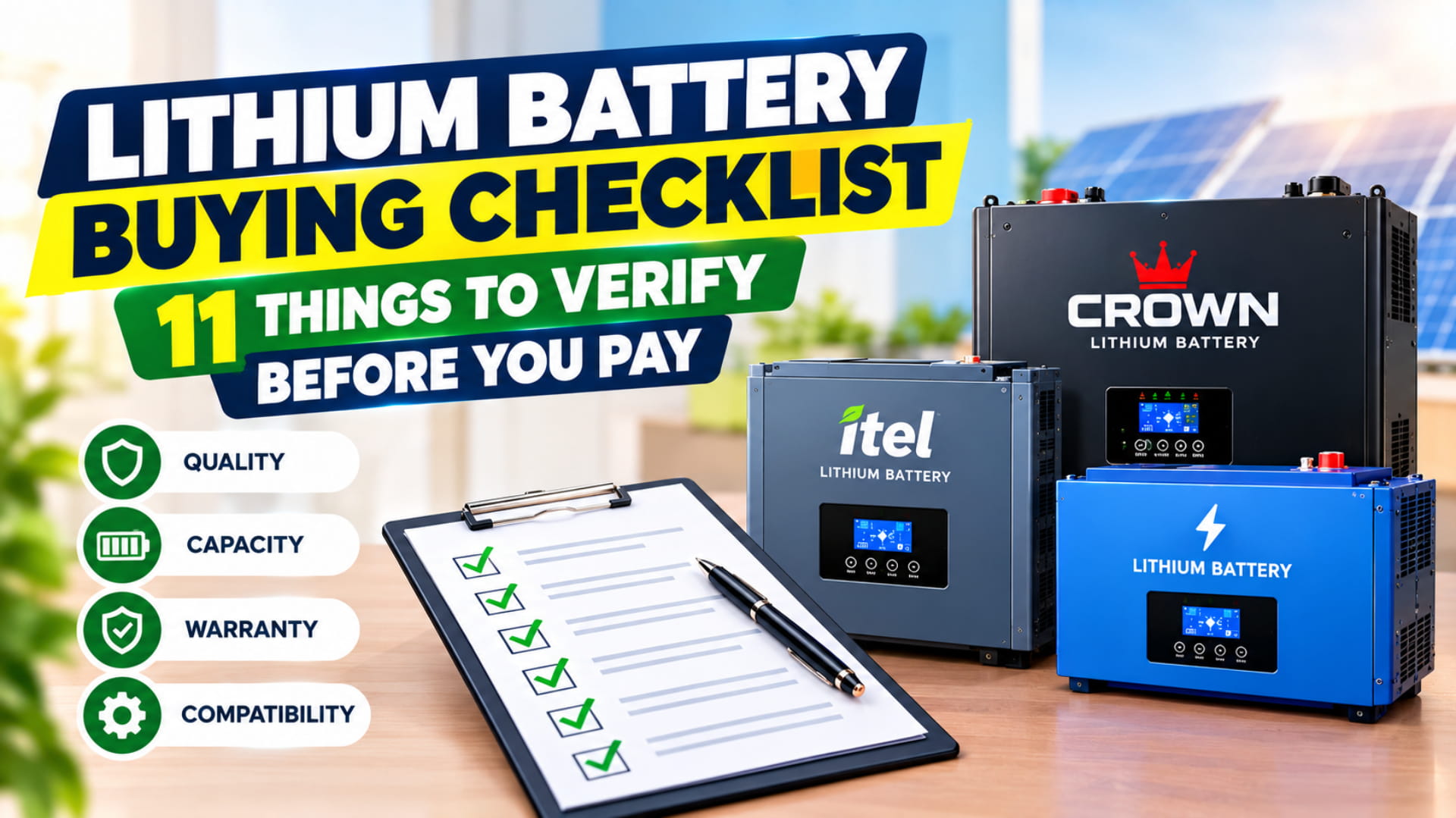
Most lithium battery regrets in Pakistan are decided before the money changes hands, in the conversation where nobody asked the right questions. The battery arrives, it powers the house for the first few weeks, and the problems show up in month eight: capacity that has quietly dropped, an inverter that trips under load, a warranty nobody can find the paperwork for.
This checklist is the set of questions that prevents that. It has eleven items, written so you can work down them with a seller on WhatsApp or across a counter, and each one is short enough to ask in a single message. No prices appear here, since rates move with the exchange rate and your configuration. Once you have the answers, WhatsApp us now for the latest price of the battery at 03192070022.
1. Does the voltage match your inverter
Start with the one that cannot be negotiated. Your inverter has a battery voltage, 12V, 24V or 48V, and the battery must match it. Most households on a 3KW to 5KW hybrid inverter are on 48V, while smaller setups and shops often sit at 24V. If you are unsure which your system needs, our comparison of 24V versus 48V lithium batteries explains how the two differ and why they are not interchangeable even when the energy content looks identical.
One label quirk to know about: a “48V” lithium pack is really 51.2V, sixteen LiFePO4 cells at 3.2V each. That is normal and not a defect.
2. Is the capacity sized to your actual load
A battery that looks generous on paper can still leave you in the dark at ten o’clock if it was sized against a guess. Write down your evening load in watts, fans, lights, fridge, television, any air conditioning, multiply by the hours you want covered, and add roughly 15 percent for inverter losses.
A 48V 100Ah pack holds 5.12 kWh nominal and delivers roughly 4 kWh to your appliances after depth of discharge and conversion losses. If you would rather not do the arithmetic by hand, our battery bank sizing calculator takes your appliance list and returns the pack count.
3. Is it actually LiFePO4
“Lithium battery” is a broad label. The chemistry matters, because the cycle life, safety behavior and charge settings in this series of guides all assume lithium iron phosphate. Ask for the chemistry in writing. If a seller cannot say whether the cells are LiFePO4 or something else, treat that as an answer. Our guide to LiFePO4 battery pricing and chemistry covers what the chemistry gives you and why it is the standard for home storage.
4. What cell grade is inside
This is the single biggest driver of both price and longevity, and the hardest to see from the outside. Grade A cells are tested and matched for capacity and internal resistance before the pack is assembled. Grade B, reclaimed or mixed-batch cells cost less and drift apart in service, and once they drift, the weakest cell in the series string caps the capacity of the whole pack.
Ask for the cell brand and grade on the invoice or quotation, not just by voice. A pack built on unmatched cells can measure correctly on delivery day and lose a serious share of its usable capacity within a year. Our guide to checking an original lithium battery shows how to test for this yourself after delivery.
5. What is the continuous discharge current
Capacity says how long the battery lasts. Continuous discharge current, in amps, says whether it can run your inverter at full load at all. A 5KW inverter near its ceiling draws roughly 98 to 110 amps from a 48V bank.
A pack rated for 100A continuous sits right at that line. A pack rated for 50A will cut out under the same load even though its kWh figure is identical, and you will blame the wrong component. Ask for the continuous figure and the peak figure with its duration, and match the continuous number to your inverter’s maximum draw rather than your average. If your household regularly pushes the inverter hard, our guide on how many batteries a 5kW inverter needs shows why two packs in parallel give more comfortable headroom than one pack at its limit.
6. What does the BMS actually do
The battery management system protects the cells, balances them, and in better packs talks to your inverter. Ask three things. Does it balance passively or actively? Does it have temperature sensing? And does it support CAN or RS485 communication so the inverter reads the true state of charge rather than guessing from voltage?
The communication point matters more than it sounds. A LiFePO4 pack holds roughly 52 to 53V through most of its usable range, so voltage tells an inverter very little until the battery is nearly empty. Support is specific to inverter model and firmware, so give the seller your exact inverter when you ask. Our guide to pairing a battery with a 5KW hybrid inverter covers the configuration side.
7. Which exact model, or which tier
Brand names alone settle very little. What you are buying is a specific model or tier, and the specifications differ between them. itel, for example, uses specific model codes that are documented consistently across resellers, which makes them easy to verify. The itel IPL-51100 specification guide shows what a fully documented model looks like, including the details people overlook, like its indoor-only IP20 rating.
Crown Elektra sells across Lite, standard and Pro tiers with different specifications and warranty terms, so a quote for “Crown 48V 100Ah” needs one extra question: which tier. Our Crown Elektra guide lays out what changes between them. Whichever brand you choose, get the exact model code or tier written on the quotation.
8. What is the ingress protection rating
IP ratings describe protection against dust and water, and they are specific to the model, not the brand. IP20 means indoor and dry only. IP65 means dust-tight and protected against water jets, though not submersion. If the battery is going on a rooftop, in a carport, or anywhere semi-exposed, you need the IP65 variant, and a product photo is not proof of which one you are getting. Our explainer on what IP65 actually means goes through the practical differences. Confirm the rating by model code, in writing.
9. Is there low-temperature charge protection
If you are in Quetta, Skardu, Ziarat, Kalam or anywhere in upper KP where winter mornings drop below freezing, this is not optional. Charging LiFePO4 below 0°C causes permanent lithium plating on the anode, damage that accumulates and cannot be reversed. A properly protected pack refuses charge until it warms up, which looks like a fault but is the battery doing its job.
In warmer parts of the country this matters less, but it costs nothing to ask, and a seller who knows the answer is usually a seller who knows the product.
10. What does the warranty cover, and who backs it
A warranty is only as good as the party standing behind it. An importer-backed warranty and a shop-backed warranty are different products, because the second lasts only as long as the shop does. Ask four things: how many years, whether it is importer or shop backed, what voids it, and whether replacement modules are stocked locally.
Get the terms in writing before you pay, not after a problem appears. If you want to know what a fair claims process looks like and what your options are if one goes wrong, read our guide to lithium battery warranty claims in Pakistan first.
11. What is included in the quote, and what paperwork comes with it
Two quotes are not comparable until you know what each one covers. Delivery, battery cables and lugs, breakers, installation support and inverter configuration are sometimes bundled and sometimes charged separately, and a low headline number that leaves them out is not low at all.
On paperwork, ask for an invoice that names the exact model, the cell grade, the serial number and the warranty term. Any legitimately imported lithium battery should also carry standard safety and transport documentation, such as IEC62619 and UN38.3 test records and a safety data sheet, which a reputable seller can produce on request. Why quotes move from week to week, and how to tell a stale one from a current one, is covered in our guide to today’s lithium battery rates.
What to check after delivery, before you install
The checklist does not stop at the counter. When the battery arrives, run three quick checks before it goes anywhere near your inverter.
Weigh it. LiFePO4 cells have predictable mass, so a 48V 100Ah pack has a predictable weight, and one that is noticeably light is not full of what the label claims. Check the resting voltage, which on a healthy 16S pack shipped at partial charge should read in the low 50s. And compare the label against the invoice, model code, serial number and capacity, so that what you paid for is what is in the box.
If anything is off, say so before installation. Raising it while the battery is still in its packaging is a much easier conversation than raising it after it has been wired in and cycled.
How to ask without turning it into an argument
Some buyers hold back from these questions because they feel confrontational. They are not. A seller with a properly specified battery has the answers to hand, and asking for them in a single organised message reads as a serious buyer rather than a difficult one.
The simplest approach is to send the checklist itself. List your inverter model and voltage, your evening load, and then ask for the model or tier, the cell grade, the continuous and peak discharge current, the BMS communication support, the IP rating, the low-temperature protection, and the warranty term with its backing, all in writing. Sellers who reply with complete, specific answers are worth buying from. Sellers who reply with “everything is original, do not worry” and nothing else have told you what you needed to know.
It also helps to ask the same questions of every seller you are comparing. That is the only way a price difference becomes something you understand rather than something you are guessing at.
The short version
If you only remember five things from this list, make them these: match the voltage to your inverter, size capacity to your real evening load, check the continuous discharge current against your inverter’s peak draw, get the cell grade and model code written on the invoice, and confirm who backs the warranty. Those five catch most of what goes wrong. The other six refine the choice and protect you in specific situations, like cold regions and exposed installations.
Cell grade, because it drives both price and long-term capacity. It is also the hardest to see, which is why it needs to be written on the invoice.
No. Even within one brand, models and tiers differ in discharge current, communication support, IP rating and warranty terms, so the checks still apply.
Weigh it, check that the kWh figure equals volts times amp hours, and test the capacity or the cell voltage spread after delivery. Our guide on checking an original battery covers each step.
Not always, but a large gap between two similar-looking quotes almost always traces back to cell grade, BMS quality, warranty backing or what is bundled.
Two packs in parallel give more discharge headroom and let you start smaller, as long as they are the same model and bought together where possible.
Yes, nationwide.
Ready to compare quotes
Send us your inverter model, your evening load and your city, and WhatsApp us now for the latest price of the battery at 03192070022. We will confirm the right configuration, answer the checklist questions for the specific model, and quote against your actual needs. You can browse the current range on the products page, or reach the team directly through the contact page.
Buy Battery is your trusted battery partner. Premium batteries built for Pakistan’s climate, powering homes, businesses and vehicles nationwide.