
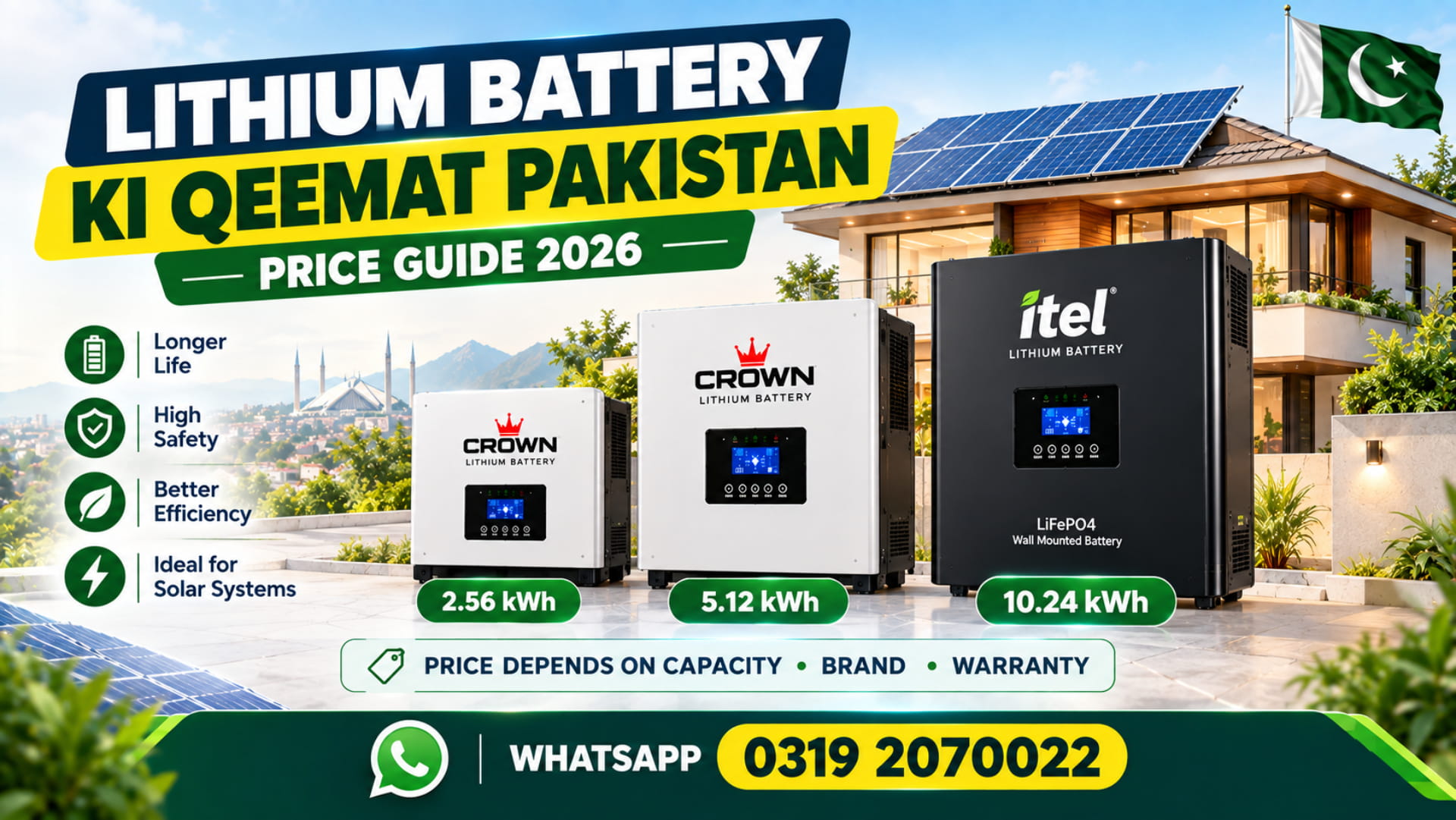
“Lithium battery ki qeemat kitni hai” is one of the most common messages this business receives on WhatsApp, and it is also the hardest one to answer with a single number, because the honest answer depends on four or five things a quick search result cannot capture.
This guide is written for that exact question, in plain terms rather than a spec sheet. It covers what actually moves the price up or down, what most Pakistani households end up buying, and how to avoid paying more for less without realising it. No exact figures here, since rates move with the exchange rate and the specific configuration you need. WhatsApp us now for the latest price of the battery at 03192070022 once you know roughly what you are looking for.
The question underneath the question
Before “what does it cost” can get a useful answer, a smaller question needs answering first: which battery, at what size.
Most homes running a standard 3.5KW to 5KW inverter end up at 48V, and most of those start at 100Ah, holding roughly 5.12 kWh nominal and delivering close to 4 kWh usable after normal losses. Smaller households, or a shop with a lighter evening load, often land on 24V instead. Our detailed guide on 48V 100Ah lithium battery pricing walks through exactly what that size runs, hour by hour, if you want the full sizing picture before asking for a number.
Ask for a price before knowing your own voltage and capacity, and every answer you get back is a guess dressed up as a quote. Know those two things first, and everything else becomes much easier to compare.
What actually decides the price
Two batteries that look identical on paper, same voltage, same capacity, same “lithium” label, can be priced very differently. Four things usually explain the gap.
Cell grade. Grade A cells are tested and matched for capacity and internal resistance before assembly. Grade B, reclaimed or mismatched cells cost less upfront and drift apart during use, and once they drift, the weakest cell in the series string caps what the whole pack can deliver. A battery built on unmatched cells can test fine on day one and lose real capacity within a year. This single factor explains most of the wide range you will see quoted for what looks like the same product.
BMS quality. The battery management system decides how well the pack balances its cells, whether it reports true state of charge to your inverter, and whether it protects itself correctly under load. A basic passive-balancing BMS costs less than one with active balancing, temperature sensing, and CAN or RS485 communication. Our guide on checking an original lithium battery before you buy covers how to tell a properly built pack from a corner-cut one.
Brand and documentation. Some brands, like itel, use specific model codes with consistent specifications across resellers, which makes their range easy to verify. See the full itel lineup breakdown for an example of how that works in practice. Others, like Crown Elektra, sell across tiers with meaningfully different specifications, and our Crown Elektra pricing guide covers what changes between those tiers. Neither approach is automatically better, but it changes what you need to ask before comparing two quotes fairly.
Warranty backing. A warranty backed by the importer and one backed only by the shop that sold it are two different products wearing the same word. Our article on lithium battery warranty claims in Pakistan explains what to confirm in writing before you pay, and what your options look like if something goes wrong later.
Cheap versus expensive: an honest answer
This is the question underneath the question, and it deserves a straight answer rather than a sales pitch either way.
A cheaper battery is not automatically a bad one. Some price difference is genuinely explained by brand overhead, marketing, or a seller’s own margin, and paying less for those reasons costs you nothing in performance. But when the gap is large, more than 15 or 20 percent for the same stated capacity, it is almost always one of the four factors above, most often cell grade, and that is the kind of saving that turns into a problem in year two rather than on day one.
The practical test: ask the seller directly what cell grade is inside, ask for the BMS specification rather than just an amp figure, and ask who backs the warranty and for how long. A seller with a genuinely good, fairly priced battery answers all three without hesitation. A seller relying on a low headline number usually gets vague on at least one of them.
The number people forget to ask about
Capacity gets all the attention, but the figure that actually decides whether your battery can run your inverter at full load is continuous discharge current, measured in amps, not kWh.
A 5KW inverter running near its ceiling draws somewhere around 98 to 110 amps from a 48V bank. A battery rated for 100A continuous discharge handles that comfortably. One rated for only 50A trips and cuts out under the same load, even though its capacity looks identical on the label. Our guide on how many batteries a 5kW inverter needs and our breakdown of pairing a battery correctly with a hybrid inverter both cover this in more depth, since it is the most common reason a correctly sized battery still seems to underperform after installation.
Why the price keeps moving
If you have compared prices across a few weeks and noticed the number shift, that is not a sales tactic, it is the real market at work.
Cells, BMS boards and enclosures are imported and priced in dollars, so the rupee’s movement against the dollar changes landed cost directly. Global lithium carbonate prices, after a long stretch of falling, turned upward again through 2026, so the old assumption that waiting a few months makes a battery cheaper no longer holds reliably. Add seasonal demand on top, since most buyers purchase in the May to July heat and load-shedding window, and a quote from March genuinely does not apply in June. Our detailed guide to today’s lithium battery rate factors walks through this in full if you want to understand why we quote live rather than publishing a fixed number.
What a fair price actually looks like
A fair price is not the lowest number you can find. It is the number that matches what you are actually getting, checked against the four factors above, from a seller who will still be answering your calls in year three.
That means the same nominal specification, 48V 100Ah for example, can fairly cost different amounts from different sellers, and the cheapest of three quotes is not automatically the best deal. It is the one worth the most scrutiny, since it usually means something was cut to reach that number. A slightly higher quote backed by a documented cell grade, a real BMS specification, and a clear warranty is very often the better purchase, even when it looks worse at first glance.
Why lithium costs more than tubular, and whether that gap is worth it
Anyone comparing quotes has usually also compared lithium against a tubular or lead-acid alternative at some point, and the upfront number for lithium is genuinely higher. That comparison deserves its own honest answer rather than a brand’s marketing line, and our guide on lithium versus tubular batteries works through it in full, including the one area where tubular still has a real advantage in cold weather.
The short version: a tubular battery gives you roughly half the usable depth of discharge for the same rated capacity, needs replacing far sooner under regular cycling, and adds nothing in the way of communication with your inverter. A lithium pack costs more per unit on day one and, for most households running it several times a week, costs less per usable kilowatt-hour over its working life. Whether that trade makes sense for your specific situation depends on how often you actually cycle the battery and how long you plan to stay in the property, not on which one sounds more modern.
A quick example of how two quotes can differ
Say two sellers both quote you a 48V 100Ah pack, and the numbers come in noticeably apart. Here is roughly how that plays out once you ask the right questions.
The higher quote turns out to use Grade A matched cells, an active-balancing BMS with RS485 communication, and a two-year importer-backed warranty with stocked replacement modules. The lower quote uses cells the seller cannot name a grade for, a basic passive BMS with no communication port, and a warranty that the shop itself backs rather than any importer. Both batteries will power your inverter on day one. The difference shows up eighteen months later, when the cheaper pack’s capacity has visibly dropped and the shop that sold it is no longer easy to reach.
This is not an argument for always choosing the most expensive option in front of you. It is an argument for asking the same three questions, cell grade, BMS specification, and warranty backing, of every quote you receive, so that a price difference means something you understand rather than something you are guessing at. Our wider guide to LiFePO4 battery pricing covers the chemistry side of this comparison if you want to understand what you are actually paying for at the cell level.
Four things to have ready before you ask
A short checklist that turns a vague conversation into a firm, comparable number within minutes.
Your inverter’s make, model and voltage, so compatibility is confirmed before anything else. Your rough evening load in watts, fans, lights, fridge, television, air conditioning if you run one, and how many hours you need it covered. Your city, since it affects delivery and whether low-temperature charge protection needs specifying for colder regions. And whether you already have a preference between brands like itel and Crown Elektra, or want a recommendation based on your load and budget.
With those four answered, a quote stops being a guess and becomes a real number for your actual house.
Because it moves with the dollar rate, cell costs, and the specific configuration you need. A fixed published number goes stale within weeks.
Usually a 48V 100Ah pack from a documented brand like itel or Crown Elektra, sized correctly for your evening load. Getting the size and specification right matters more than finding the lowest number.
Not necessarily, but a large price gap between two similar-looking quotes usually points to a real difference in cell grade or BMS quality.
Most homes on a standard inverter buy 48V 100Ah, which delivers roughly 4 kWh usable for a normal evening of fans, lights, a fridge and electronics.
Yes, nationwide delivery is available.
Get today’s rate
Share your inverter model, the capacity you need, and your city, and WhatsApp us now for the latest price of the battery at 03192070022 for today’s accurate rate. See our current range on the products page, or reach the team directly through the contact page.
Buy Battery is your trusted battery partner. Premium batteries built for Pakistan’s climate, powering homes, businesses and vehicles nationwide.