
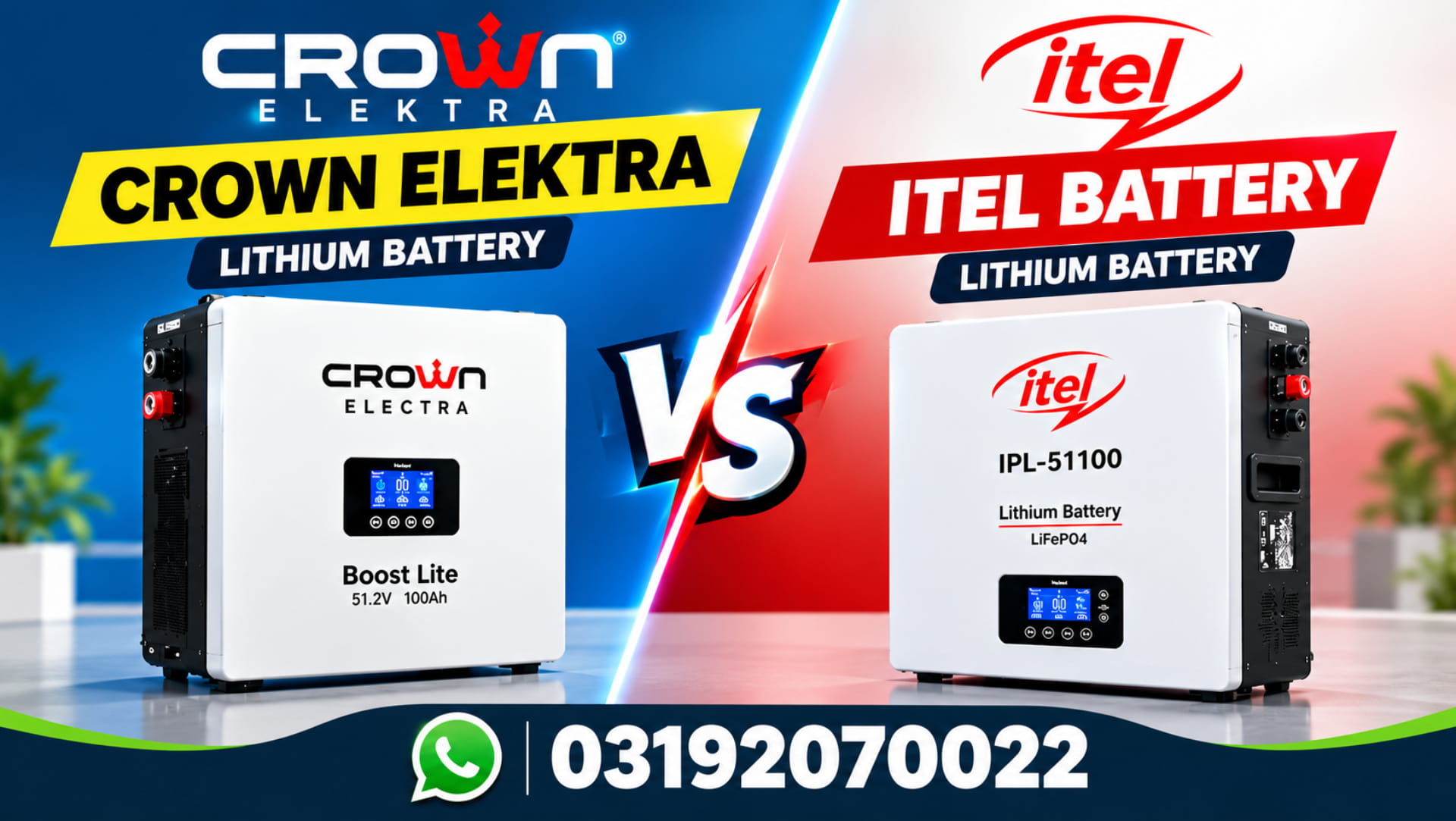
We stock both, so this is not a comparison written to steer you toward one at the other’s expense. It is written because the two questions we get asked most about this pairing, “which brand is better” and “why is one so much cheaper than the other,” usually turn out to be the same question asked two different ways, and the answer is almost never the brand name itself.
Both Crown Elektra and itel sell genuine LiFePO4 packs into the same Pakistani market, often at the same nominal capacities. What actually differs between a specific Crown unit and a specific itel unit is cell grade, discharge rating, communication support, ingress protection and warranty backing, the same handful of specifications that decide quality within either brand’s own range. This guide compares them on those terms rather than on reputation. No prices here, since rates move with the exchange rate. WhatsApp us now for the latest price of the battery at 03192070022 once you know what to compare.
Same chemistry, different documentation habits
Both brands build on LiFePO4, lithium iron phosphate, the same chemistry covered in our guide to LiFePO4 battery pricing. Neither has a chemistry advantage over the other. The differences that matter live in how each pack is specified, built and supported, not in what the cells are made of.
One practical difference worth knowing before you compare quotes: itel’s model codes, such as IPL-51100, are specific and consistently documented across resellers, which makes verifying a given itel unit’s exact specifications comparatively straightforward, as covered in our IPL-51100 specification guide. Crown Elektra sells across named tiers, Lite, standard, and Pro, with specifications and warranty terms that vary meaningfully between them and have been advertised inconsistently by different resellers, which our Crown Elektra price guide and Crown Elektra Lite specification breakdown both cover in detail.
Neither pattern makes one brand better. It does mean a Crown quote needs one extra question asked, which tier, before you can compare it fairly against an itel quote.
Capacity and voltage, side by side
Both brands sell into the same common configurations, so the underlying arithmetic is identical regardless of which you choose.
At 24V, true nominal 25.6V, a 100Ah pack from either brand holds 2.56 kWh nominal, delivering roughly 2 kWh to your appliances after usable depth of discharge and inverter losses.
At 48V, true nominal 51.2V, a 100Ah pack from either brand holds 5.12 kWh nominal, delivering roughly 4 kWh. This is the size most Pakistani households land on for a 5KW hybrid inverter, and it is where the bulk of the comparison below matters most, since it is the configuration both brands sell most heavily and where quotes are most often placed side by side.
itel also offers a 314Ah unit at 48V, holding roughly 16 kWh nominal, covered in our itel 48V 314Ah guide, for larger homes or businesses wanting a single large unit rather than several in parallel.
Continuous discharge current
This is the specification that decides whether a 48V 100Ah pack from either brand can actually support a 5KW hybrid inverter at full output, and it is worth comparing directly rather than assuming parity.
A 5KW inverter at full output draws roughly 98 to 110 amps from a 48V bank once conversion losses are included. The itel IPL-51100 has been consistently documented with a 100A continuous rating and a 150A pulse rating. Crown Elektra units in this capacity class have commonly been documented around 1C, which on a 100Ah pack also works out to roughly 100 amps continuous.
In practice, both brands sit at roughly the same point relative to a 5KW inverter’s demand, close to the line rather than comfortably above it. Neither has a documented advantage here at this specific capacity. What differs is how consistently each brand’s figure has been reported across sources, and itel’s single, stable model code makes that figure easier to verify with confidence than a Crown quote where the tier and its exact discharge rating both need confirming.
Regardless of brand, if your household regularly pushes a 5KW inverter near its ceiling, two units in parallel give more comfortable current headroom than relying on one pack at the edge of its rating. Our guide to how many batteries a 5kW inverter needs works through that arithmetic.
Communication and BMS features
Both brands offer packs with RS485 and CAN communication support, allowing the battery to report true state of charge to a compatible inverter rather than leaving it to estimate from voltage, a distinction that matters more than it sounds given LiFePO4’s flat discharge curve.
The itel IPL-51100 has been documented with RS485, CAN and RS232 ports as standard on that specific model. For Crown Elektra, this capability has been most consistently documented on the Pro tier specifically, not confirmed as standard across the Lite or standard tiers.
The practical takeaway: if inverter communication matters to your setup, confirm it directly for the specific Crown tier you are quoted, since it is not safe to assume it is included the way it more reliably is on itel’s standard 48V 100Ah model. Our guide to pairing a battery with a hybrid inverter covers what to check on the inverter side regardless of which brand you choose.
Ingress protection
Both brands sell units across a range of ingress protection ratings, and in both cases, the rating is specific to the model rather than guaranteed by the brand name.
itel’s standard IPL-51100 has been consistently documented as IP20, indoor use only, with IP65 rated alternatives existing elsewhere in itel’s broader range for outdoor or semi-exposed installations. Crown Elektra’s range similarly spans both IP21 rated units, indoor use only, and IP65 rated units, with both circulating under similarly styled model names across different resellers, a point covered directly in our Crown Elektra IP65 review and our general guide to what IP65 actually means.
Neither brand should be assumed into an outdoor-suitable rating without confirming the specific model code. If your installation is on a rooftop, in a carport, or anywhere semi-exposed, ask directly for the IP65 variant from whichever brand you are buying, and confirm it in writing rather than from a product photo or general description.
Warranty terms
This is the area with the clearest documented difference between how the two brands’ terms have been reported.
itel’s warranty terms across resellers, while worth confirming for any specific purchase as with any brand, have not shown the same wide inconsistency documented for Crown Elektra. Crown Elektra warranty terms have been advertised anywhere from one year to ten years for what is nominally the same 48V 100Ah product, an inconsistency traced largely to different tiers carrying different terms and some resellers being unclear about which tier they are actually listing. The Pro tier specifically, covered in our Crown Elektra Pro 5kW guide, has been more consistently associated with the longer end of that range.
The practical lesson applies to either brand but matters more with Crown given the documented spread: confirm the exact warranty term and who backs it, importer or shop, in writing from whoever you are actually buying from, rather than relying on a figure seen advertised elsewhere. Our guide to warranty claims in Pakistan covers what to ask before you buy and what a fair claims process looks like if you ever need one.
Certifications and documentation
The itel IPL-51100 has been documented with IEC62619, UN38.3, MSDS and DGM certifications, standard safety and transport documentation expected of any legitimately imported lithium battery. We have not found equivalently detailed certification documentation published for Crown Elektra units across the sources available to us, which is not evidence of a difference in actual compliance, since this kind of documentation is not always published prominently by every reseller, but it does mean itel’s paper trail has been easier for us to verify directly. Ask any seller of either brand to produce this documentation on request rather than assuming its absence from a listing means it does not exist.
Where the real differences sit, brand aside
Strip away the brand names and the comparison that actually matters is the same one that applies within either brand’s own range, covered in our guide to checking an original lithium battery in Pakistan. Cell grade, matched Grade A cells versus reclaimed or unmatched stock, decides real world capacity and longevity more than the name on the casing. BMS quality, active versus passive balancing and genuine communication support, decides how well the pack ages and how accurately your inverter can read it. Continuous discharge current decides whether it can actually support your inverter’s peak load. Ingress protection decides where you can install it. And warranty backing decides what happens if something goes wrong.
A well-specified itel unit and a well-specified Crown unit at the same capacity are close substitutes. A poorly specified unit from either brand, wrong tier, wrong IP rating, unclear warranty backing, is a worse purchase than a well-specified unit from the other, regardless of which name is more familiar to you.
A practical way to decide
If you already know your inverter model and evening load, ask us for a like-for-like quote on both brands at the matching capacity, with the same questions answered for each: exact model or tier, continuous discharge current, communication support, ingress protection rating, and warranty term with backing. Comparing two fully specified quotes side by side is a more useful exercise than comparing two brand names.
If you have no strong preference and want a starting recommendation, the itel IPL-51100 at 48V 100Ah is the more straightforward single-model comparison point, since its specifications are consistently documented and easy to confirm. If you are specifically drawn to Crown, ask directly which tier suits your situation and confirm the warranty and discharge figures for that tier in writing before comparing it against an itel quote. Whichever you choose, run the same verification checks before you pay rather than after.
Neither has a chemistry or general quality advantage over the other. The specific model, tier and specifications you are quoted matter more than the brand name, and a well-specified unit from either brand is a reasonable purchase.
Crown sells across multiple tiers, Lite, standard and Pro, with different specifications and warranty terms, and some resellers have not been clear about which tier they are listing. itel’s model codes have generally been documented more consistently across resellers.
itel’s warranty terms have generally been reported more consistently across resellers. Crown Elektra’s terms have varied widely by tier and reseller, so confirming the exact term and backing in writing matters more when buying Crown specifically.
No. Never parallel batteries of different brands or models, even at the same nominal voltage and capacity. Use matched units from the same model line throughout a parallel bank.
Yes, across Pakistan.
Getting a fair comparison
Ask us for a like-for-like quote on both brands at your required capacity, with the model or tier, continuous discharge current, communication support, ingress protection and warranty term specified for each. WhatsApp us now for the latest price of the battery at 03192070022 with your inverter model, your installation location and your evening load, and we will quote both fairly.
You can see our current range on the products page, read more buying guides on the blog, and reach the team directly through the contact page.
Buy Battery is your trusted battery partner. Premium batteries built for Pakistan’s climate, powering homes, businesses and vehicles nationwide.